
InshiHubIndia
Doctoral 2022 editionEnglish · IndiaComplete 73-page edition

NBHM Doctoral 2022 worked solutions

Prepare for NBHM Doctoral and PhD-level mathematics with independent derivations for all 34 numbered questions and 50 graded answer units. Read three complete solutions in searchable HTML and inspect six pages from the current guide before paid access opens.

34 worked questions · 50 answer unitsExact official source locatorsSource-defect disclosure

Six-page visual preview

Inspect six pages from the Doctoral guide

The six preview slots cover Questions 1, 6, 14, 22, 29, and 32 from the current 73-page manuscript. Every preview is an InshiHub explanation page, never a scan of the official paper or answer key.

Preview page 1 of 6Sample · not the official paper
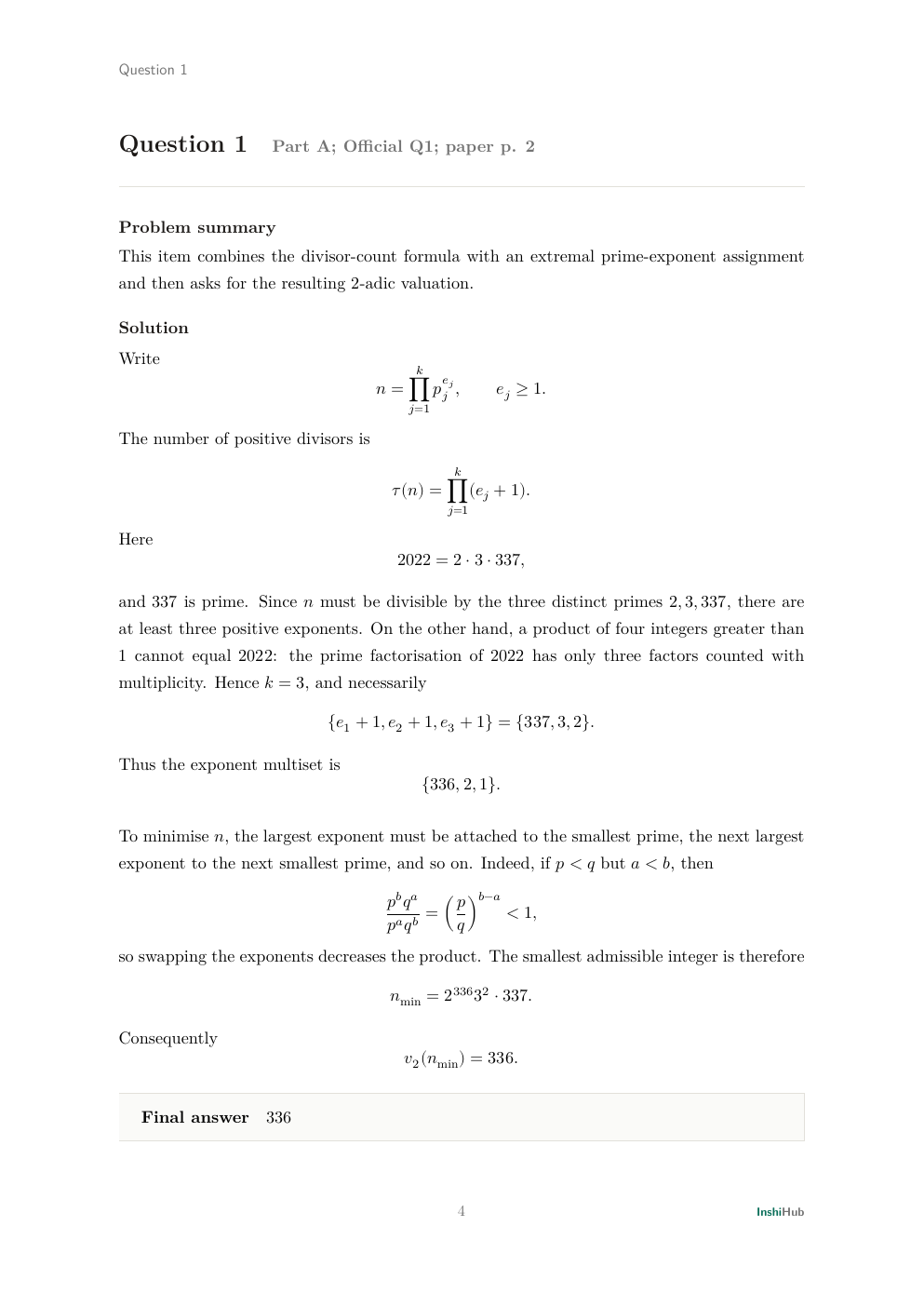
NBHM Doctoral 2022 Worked Solutions, preview page 1 of 6: Question 1 solution combining the divisor-count formula with an exchange argument for the least admissible integer.
Preview page 2 of 6Sample · not the official paper
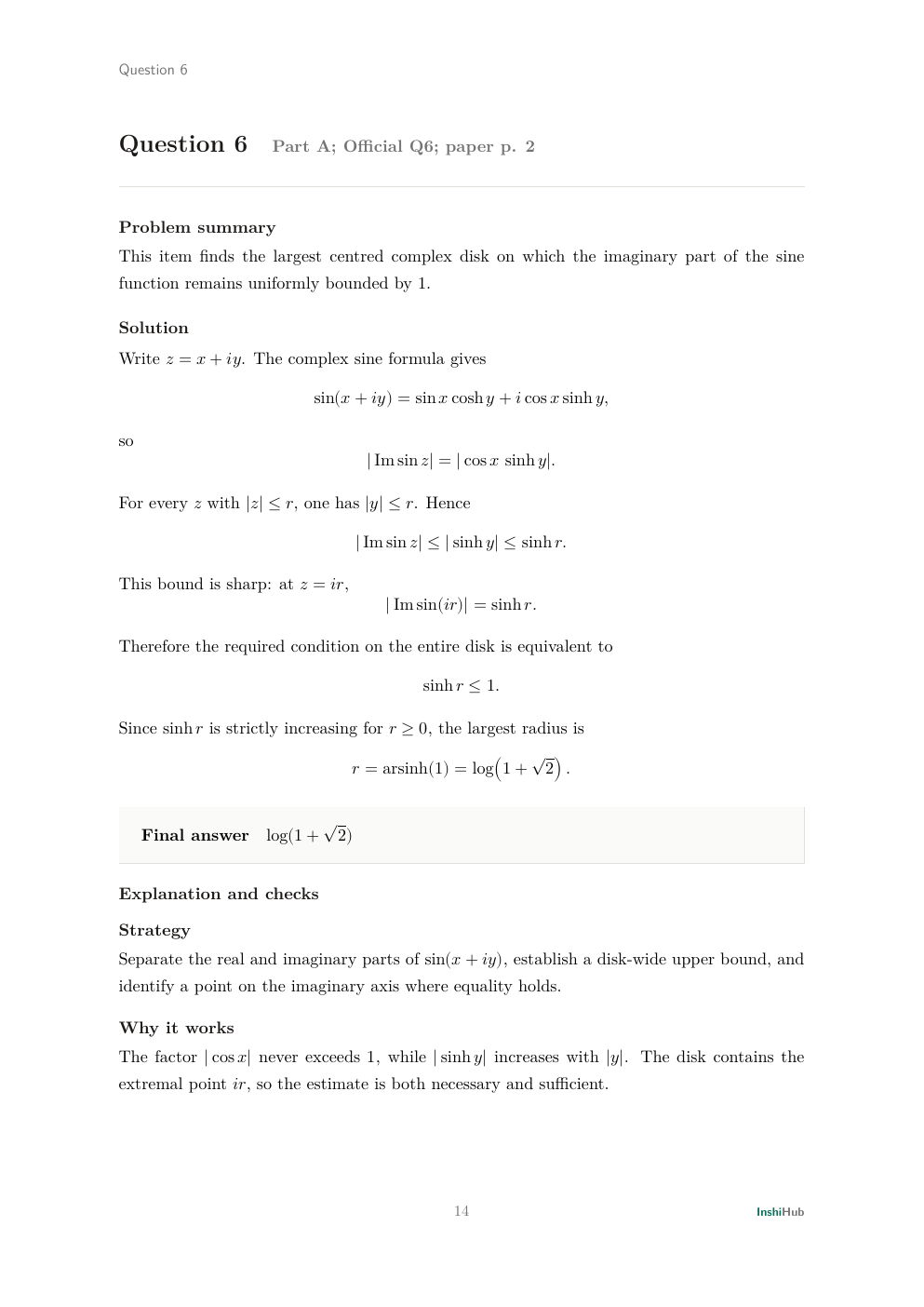
NBHM Doctoral 2022 Worked Solutions, preview page 2 of 6: Question 6 solution locating the sharp imaginary-part bound for the complex sine on a centred disc.
Preview page 3 of 6Sample · not the official paper
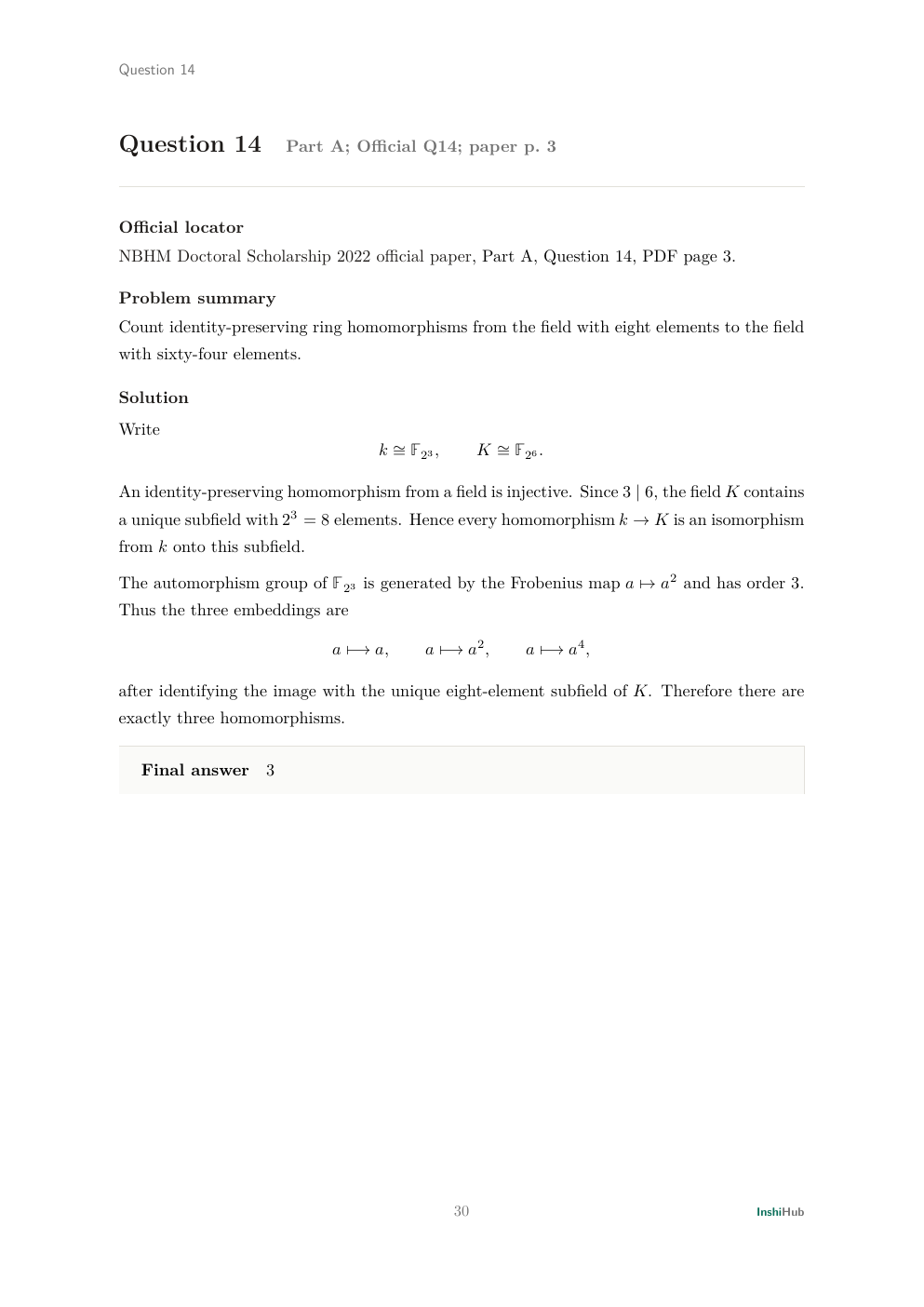
NBHM Doctoral 2022 Worked Solutions, preview page 3 of 6: Question 14 solution counting identity-preserving finite-field homomorphisms through Frobenius embeddings.
Preview page 4 of 6Sample · not the official paper
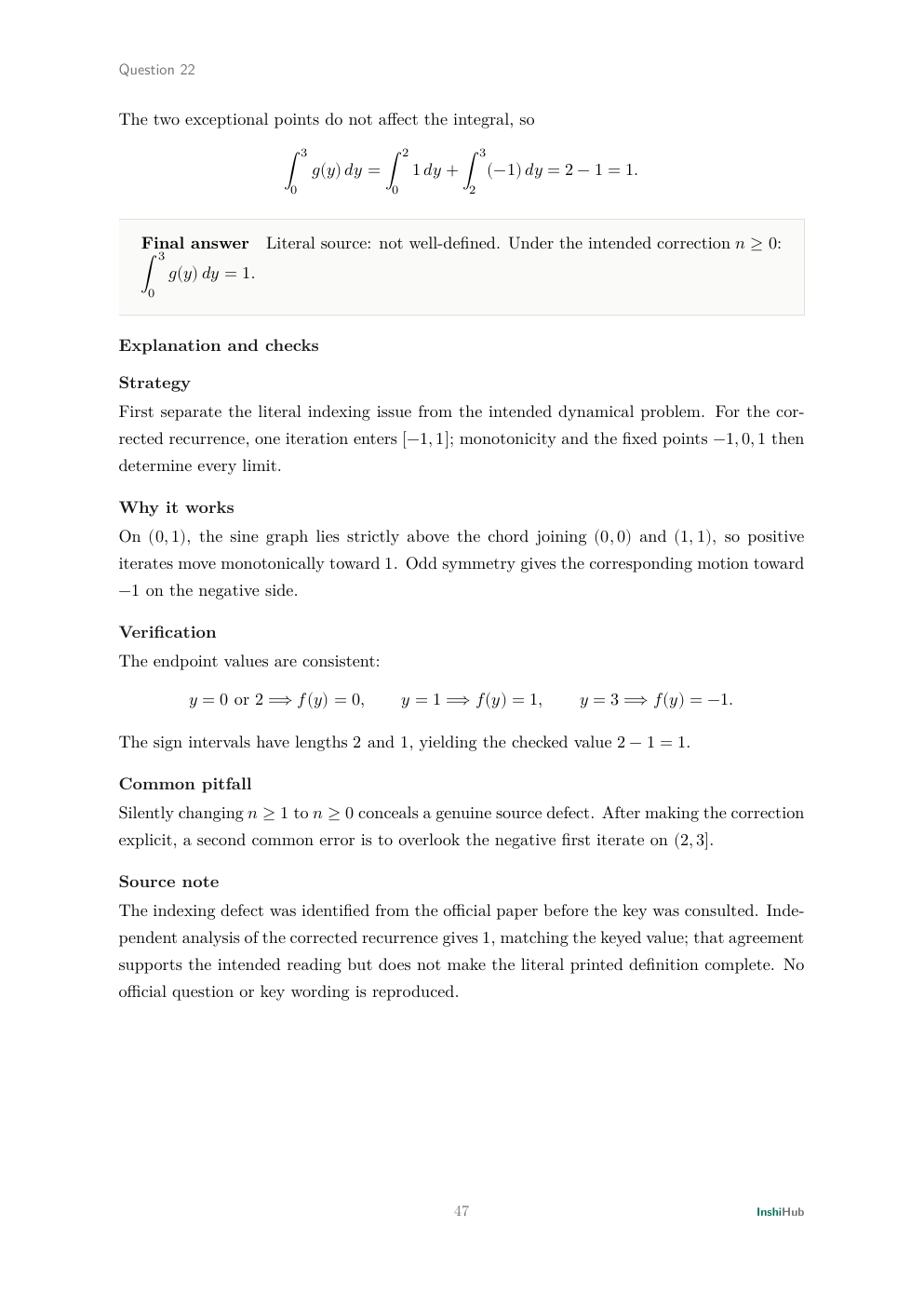
NBHM Doctoral 2022 Worked Solutions, preview page 4 of 6: Question 22 solution separating the literal indexing defect from the conditional zero-based iteration.
Preview page 5 of 6Sample · not the official paper
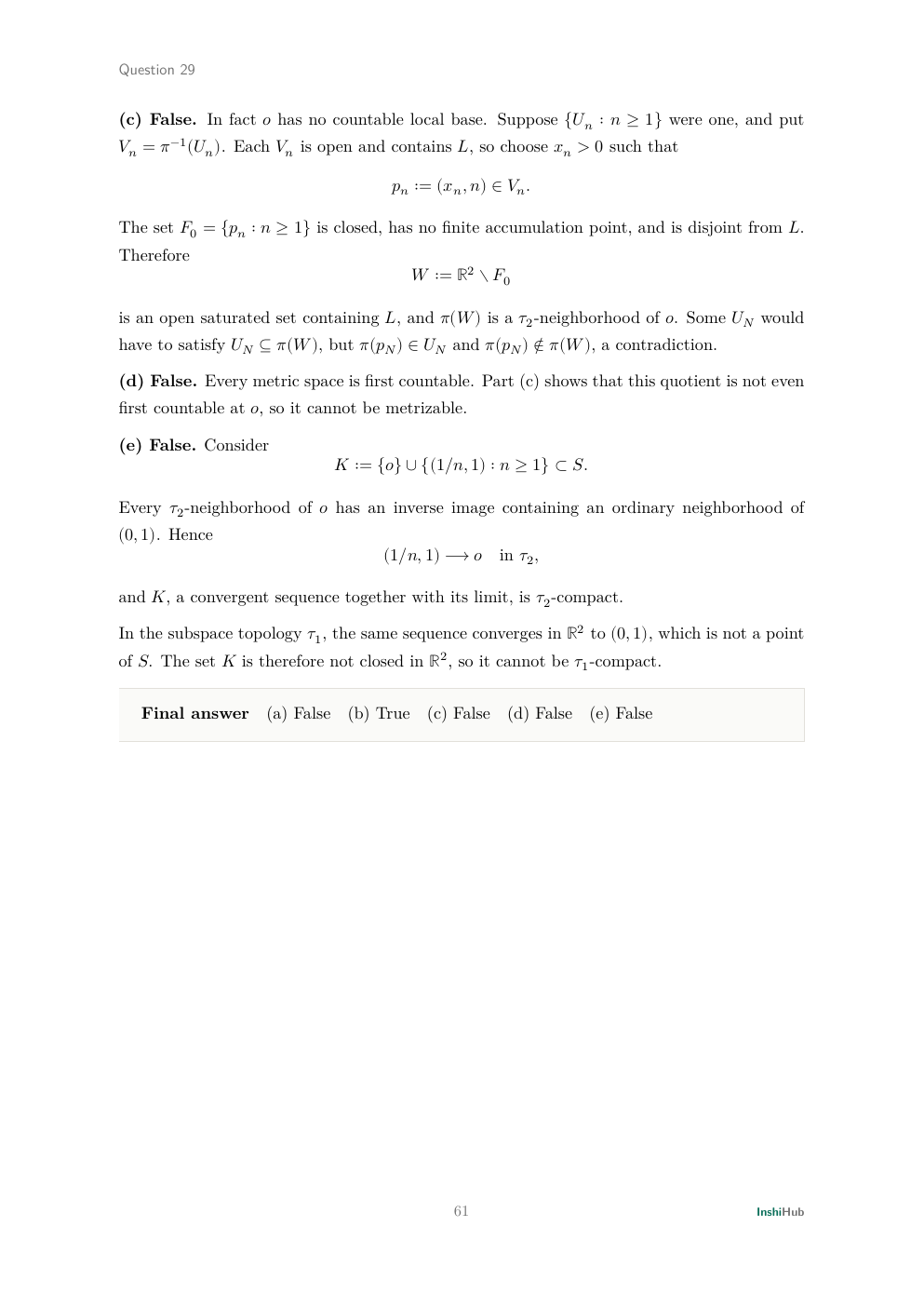
NBHM Doctoral 2022 Worked Solutions, preview page 5 of 6: Question 29 solution analysing regularity, countability, metrizability, and compactness in a quotient topology.
Preview page 6 of 6Sample · not the official paper
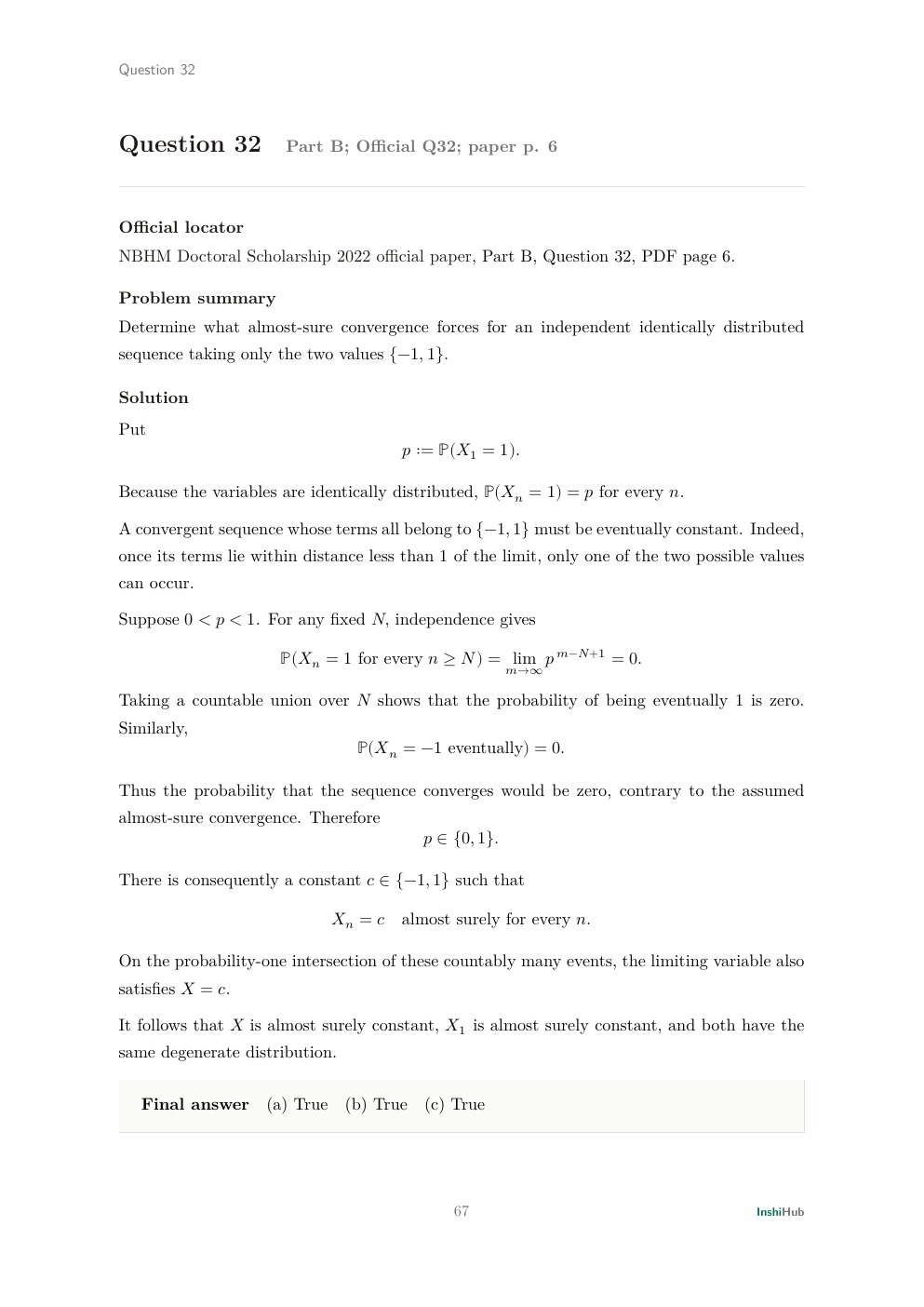
NBHM Doctoral 2022 Worked Solutions, preview page 6 of 6: Question 32 solution proving that almost-sure convergence forces an iid two-point sequence to be degenerate.

Crawlable HTML samples

Three free NBHM Doctoral 2022 solutions

Each summary identifies the mathematical task without replacing the official question. Open the source paper at the precise locator, attempt the problem, and then audit your reasoning against the derivation, check, and common-error note below.

Free sample 1

Official problem 1 · Divisor counts and the least admissible integer

Review recorded
Source locator
Part A, official problem 1, paper PDF page 2
Review note
Independently derived; divisor partition and exponent exchange checked; official-key match · 2026-07-28

Problem summary

Determine the exponent of two in the least integer satisfying a fixed divisibility condition and an exact divisor-count condition.

Core idea

Factor the target divisor count, use the required divisibility to force three distinct prime factors, and assign the largest exponent to the smallest prime by an exchange argument.

Derivation

  1. 1For a prime factorisation with positive exponents, the divisor count is the product of one plus each exponent.
  2. 2The required divisibility forces the primes 2, 3, and 337, while 2022 = 2 x 3 x 337 permits exactly three positive exponent factors.
  3. 3The exponent multiset is therefore 336, 2, and 1.
  4. 4If a smaller prime carries a smaller exponent than a larger prime, swapping the two exponents decreases the integer.
  5. 5The least admissible integer is 2^336 x 3^2 x 337, so its exponent of two is 336.

Final answer

The requested exponent is 336.

Free sample 2

Official problem 22 · A trigonometric iteration with an indexing defect

Review recorded
Source locator
Part A, official problem 22, paper PDF page 4
Review note
Literal source defect recorded; conditional n >= 0 derivation checked; official-key match under the editorial interpretation; no official erratum located · 2026-07-28

Problem summary

Analyse a limiting sign profile and its integral while keeping the literal printed recurrence separate from an evident zero-based interpretation.

Literal source versus editorial interpretation

As printed, the first iterate is unspecified and the requested quantity is not well-defined. Under the separately labelled editorial reading n >= 0, the derived value is 1. No official erratum was located; InshiHub does not describe this reading as an official correction.

Core idea

The printed recurrence leaves the first iterate unspecified. After recording that literal undefinedness, analyse the corrected n >= 0 iteration by monotonic convergence to the fixed points -1, 0, and 1.

Derivation

  1. 1The source defines the zeroth iterate but states the recurrence only from n >= 1, so the first iterate is not determined.
  2. 2Constant first iterates 1, 0, and -1 are all compatible with the recurrence from that point onward and give different limiting integrals, proving literal non-uniqueness.
  3. 3Under the explicitly conditional n >= 0 reading, positive first iterates converge to 1, zero stays at zero, and negative first iterates converge to -1.
  4. 4The initial sign is positive on (0, 2), zero at 0 and 2, and negative on (2, 3].
  5. 5The conditional integral is therefore the positive length 2 minus the negative length 1, which equals 1.

Final answer

As printed, the quantity is not well-defined. Under the disclosed editorial reading n >= 0, its value is 1.

Free sample 3

Official problem 29 · A quotient topology formed by collapsing an axis

Review recorded
Source locator
Part B, official problem 29, paper PDF page 5
Review note
Independently derived; all topology classifications and counterexamples checked; official-key match · 2026-07-28

Problem summary

Classify five statements about a plane quotient that collapses the vertical axis to one point and compare it with the related subspace topology.

Core idea

Read neighbourhoods through the quotient map: the induced topology is strictly coarser, the closed quotient map preserves regularity, and the collapsed unbounded axis defeats first countability.

Derivation

  1. 1Every quotient-open set is subspace-open, but a small subspace disk at the collapsed point has a non-open inverse image, so the inclusion is strict.
  2. 2The quotient map is closed; normal separation in the plane descends to disjoint quotient neighbourhoods, proving regularity.
  3. 3A diagonal construction removes one off-axis point from every proposed countable local-base element, so the collapsed point is not first countable.
  4. 4Failure of first countability rules out metrizability.
  5. 5A sequence approaching a point of the collapsed axis is compact together with its quotient limit, but is not compact in the subspace topology.

Final answer

The five classifications are False, True, False, False, False.

Full-edition scope

  • Original, step-by-step solutions for all 34 numbered questions
  • Separate reasoning for all 50 graded answer units
  • Verification, counterexamples, and problem-specific common-error notes
  • Part, question, and paper-page locators for every solution
  • An explicit literal-versus-intended analysis of the Question 22 indexing defect
  • A dated correction process and public correction log after release

What is not included

  • The official question paper, figures, logos, and answer-key text
  • Any claim that InshiHub's Question 22 interpretation is an official erratum
  • Coaching, admissions advice, or any score guarantee
  • Affiliation with NBHM, the Department of Atomic Energy, or IMSc

Editorial quality system

Every answer is derived, challenged, and source-mapped

1

Exact source mapping

Every solution identifies its official part, question number, and paper page without copying the question.

2

Independent mathematics

Each result is derived from first principles before the final answer is compared with the official key.

3

Defect-aware review

The Question 22 indexing gap is analysed literally first; the n >= 0 result is presented only as a disclosed editorial interpretation, not an official correction.

4

Release accountability

The edition is versioned, material corrections are dated, and paid access remains separate from editorial publication.

Review boundary

Publishing the mathematics does not activate payment

The guide page and free samples can be public while the commercial offer remains held. A separate merchant and end-to-end delivery approval is required before any purchase control can appear.

Official sources, provenance, and rights

Read the official paper alongside the independent guide

National Board for Higher Mathematics publishes the source documents, which are hosted by The Institute of Mathematical Sciences. InshiHub links to that archive but does not republish its paper, figures, logos, or answer-key text.

Source accessed
2026-07-28
Source status
Publicly accessible source; no reuse licence located
InshiHub content
Independent writing; versioned separately
Official paper SHA-256
e9bf18cd98de0752a728e4dd12b2cc1dbaa0dc19ec2ca296127de1a8ff1956a0
Official answer-key SHA-256
a50a1ef23c42c259427b29cb73bbcb1ea1233461d957753537ec132270c4d008

InshiHub is an independent study resource. It is not affiliated with, endorsed by, or sponsored by NBHM, the Department of Atomic Energy, or The Institute of Mathematical Sciences.

Transparent release status

Free samples are public. Paid access remains disabled.

The 2022 offer is still in validation. Publishing this page does not accept payment, reserve a purchase, or collect a release-alert address. Checkout can appear only after every recorded gate below passes for this exact edition.

  • All 34 numbered questions and 50 answer units completed
  • Independent mathematical review recorded
  • Question 22 literal-source and editorial-interpretation labels verified
  • Rights review completed for paid distribution
  • Merchant and 2022 product approval recorded
  • Exact transaction-seller entity and India responsibility allocation confirmed
  • Current buyer terms and privacy notice linked
  • INR final-price display, payment, delivery, refund, and order reconciliation tested

Paid access is under merchant review

For NBHM Doctoral 2022, the configured one-time catalogue price is ₹999, inclusive of applicable tax. Checkout stays disabled until the merchant, transaction-seller, INR payment, delivery, and refund checks are complete.

No release-alert form is active. InshiHub is not collecting email addresses or promising a release message until a verified double-opt-in email process is available.

Bookmark this page. The purchase button will replace this notice only after every published release gate passes.

Frequently asked questions

NBHM Doctoral 2022 guide details

Does this guide reproduce the official NBHM Doctoral 2022 paper?

No. It contains independently written solutions and short, non-substituting topic summaries. Use the official IMSc archive links on this page for the question paper and answer key.

What is covered in the NBHM Doctoral 2022 solution guide?

The current 73-page edition covers all 34 numbered questions and all 50 graded answer units, with source locators, complete derivations, verification, and problem-specific error notes.

How does the guide handle the indexing issue in Question 22?

It first states that the printed recurrence leaves the first iterate unspecified, so the literal quantity is not well-defined. It then gives the value 1 only under a clearly labelled n >= 0 editorial interpretation. No official erratum was located, and InshiHub does not present that interpretation as an official correction.

Can I buy the complete 2022 guide now?

Not yet. The editorial page and free samples are published, but the offer remains in validation. Checkout is disabled until merchant, transaction-seller, payment, delivery, refund, and reconciliation checks have all passed.

What will the complete 2022 guide cost?

The configured one-time catalogue price is ₹999, inclusive of applicable tax. It is not a temporary discount or a crossed-out-price promotion. A purchase button will appear only after the 2022 offer is separately approved and the final INR total can be verified before payment.

How were the answers checked?

Every answer unit is independently derived before comparison with the official key. Mathematical review records derivations, counterexamples, boundary cases, and any source ambiguity separately.

How are mathematical errors handled?

Confirmed material errors will be corrected in a new dated content version and logged publicly for eligible customers.

Is InshiHub affiliated with NBHM or IMSc?

No. InshiHub is an independent study resource and is not affiliated with, endorsed by, or sponsored by NBHM, the Department of Atomic Energy, or The Institute of Mathematical Sciences.