
InshiHubIndia
Doctoral 2021 editionEnglish · IndiaComplete 82-page edition

NBHM Doctoral 2021 worked solutions

Prepare for NBHM Doctoral and PhD-level mathematics with independent derivations for all 39 numbered questions and 50 graded answer units. Read three complete solutions in searchable HTML and inspect six pages from the current guide before paid access opens.

39 worked questions · 50 answer unitsExact official source locatorsAmbiguity-aware review

Six-page visual preview

Inspect six pages from the Doctoral guide

The six preview slots cover Questions 1, 13, 27, 31, 38, and 39 from the current 82-page manuscript. Every preview is an InshiHub explanation page, never a scan of the official paper or answer key.

Preview page 1 of 6Sample · not the official paper
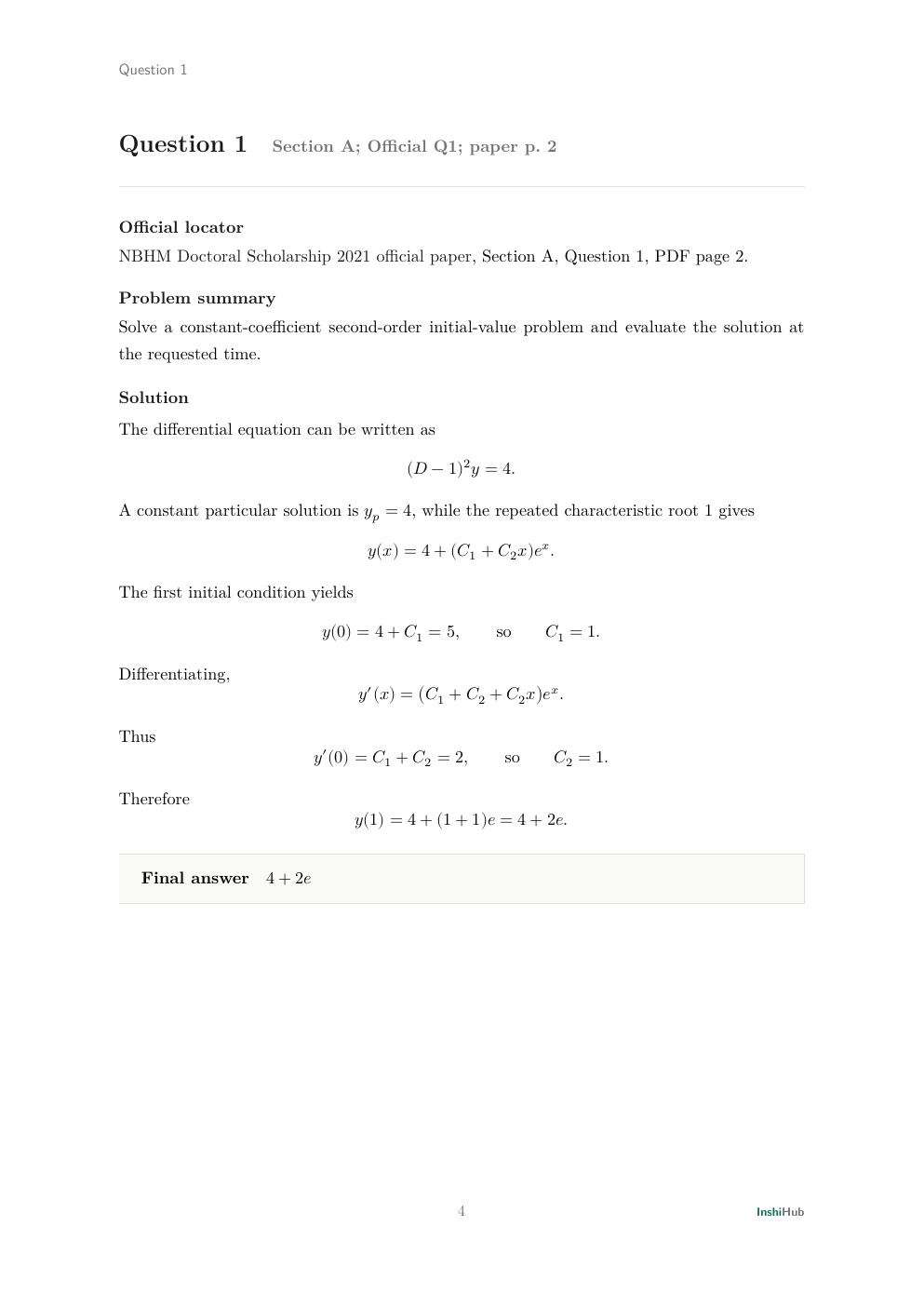
NBHM Doctoral 2021 Worked Solutions, preview page 1 of 6: Question 1 solution to a forced differential equation with a repeated characteristic root.
Preview page 2 of 6Sample · not the official paper
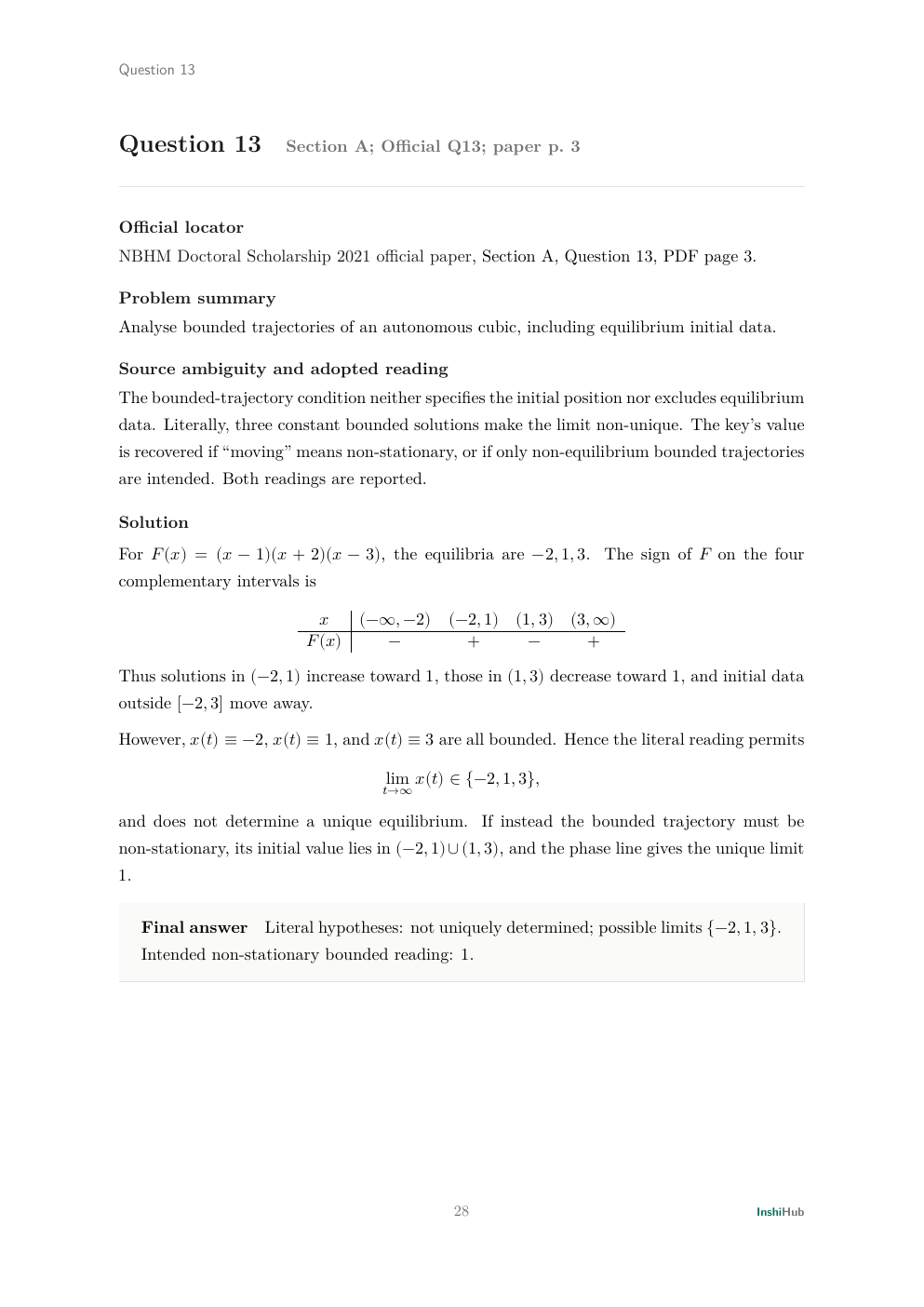
NBHM Doctoral 2021 Worked Solutions, preview page 2 of 6: Question 13 solution separating literal equilibrium cases from the intended non-stationary reading.
Preview page 3 of 6Sample · not the official paper
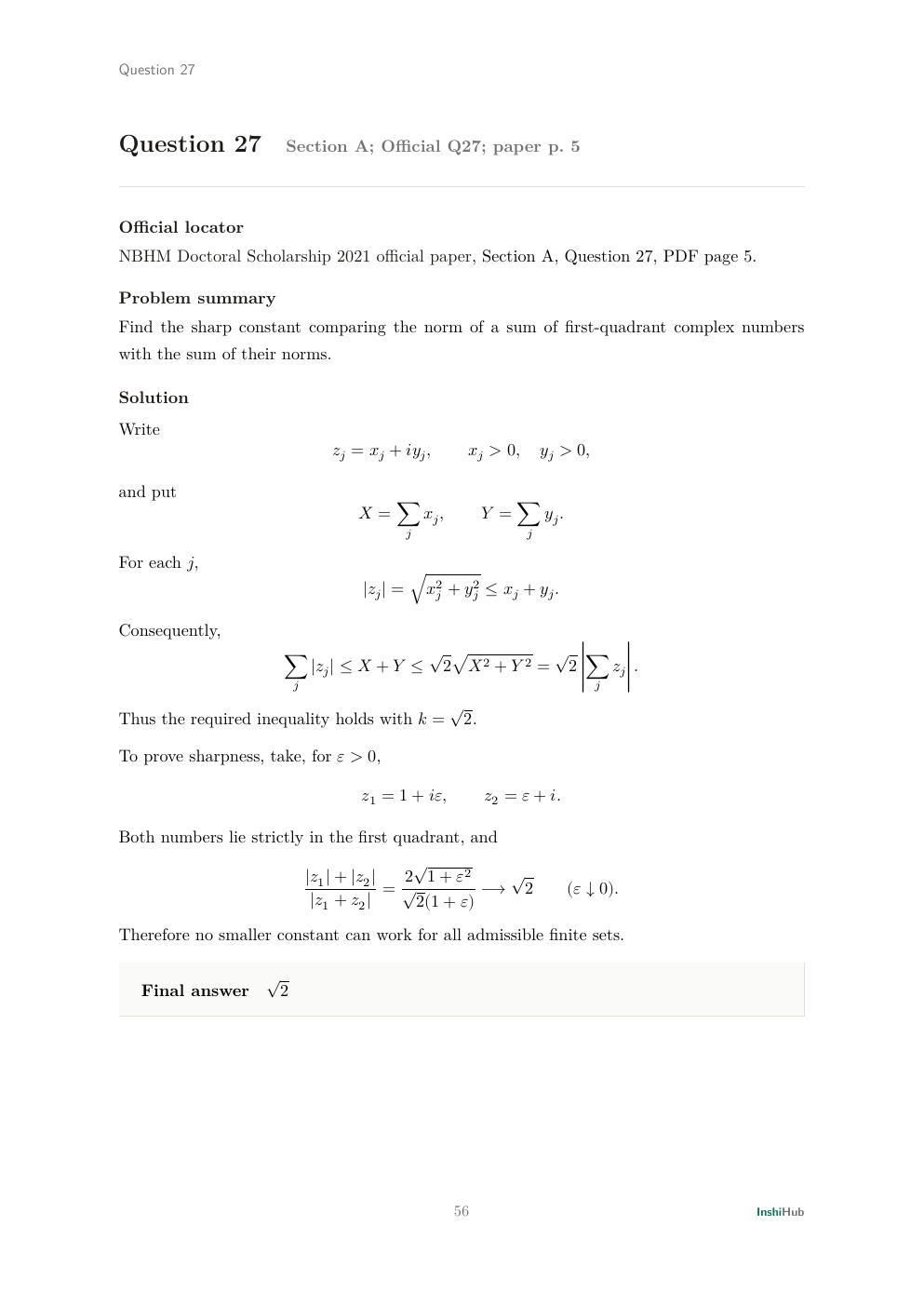
NBHM Doctoral 2021 Worked Solutions, preview page 3 of 6: Question 27 solution establishing the sharp norm inequality for vectors in the first quadrant.
Preview page 4 of 6Sample · not the official paper
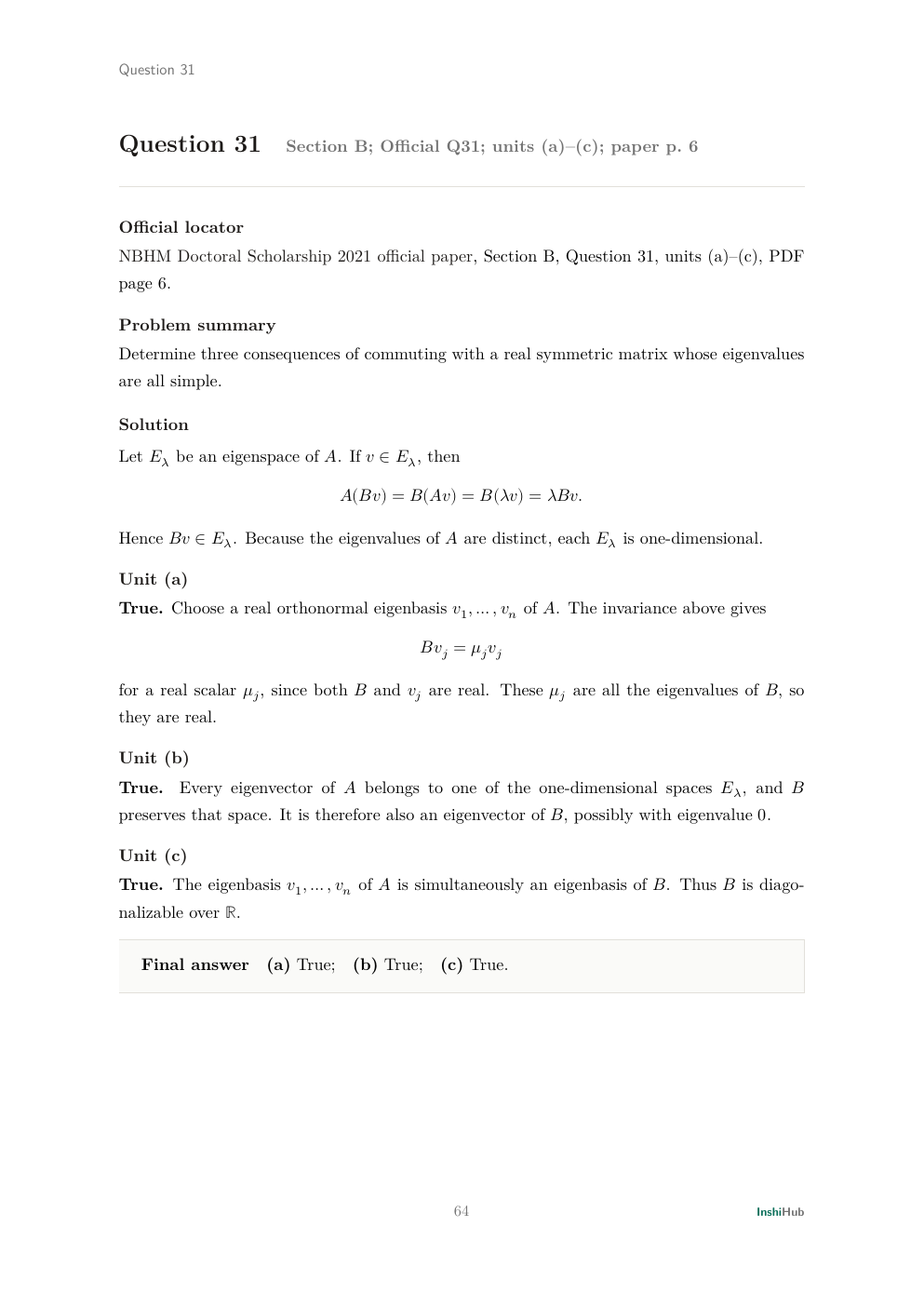
NBHM Doctoral 2021 Worked Solutions, preview page 4 of 6: Question 31 solution analysing three consequences of commuting with a simple-spectrum symmetric matrix.
Preview page 5 of 6Sample · not the official paper
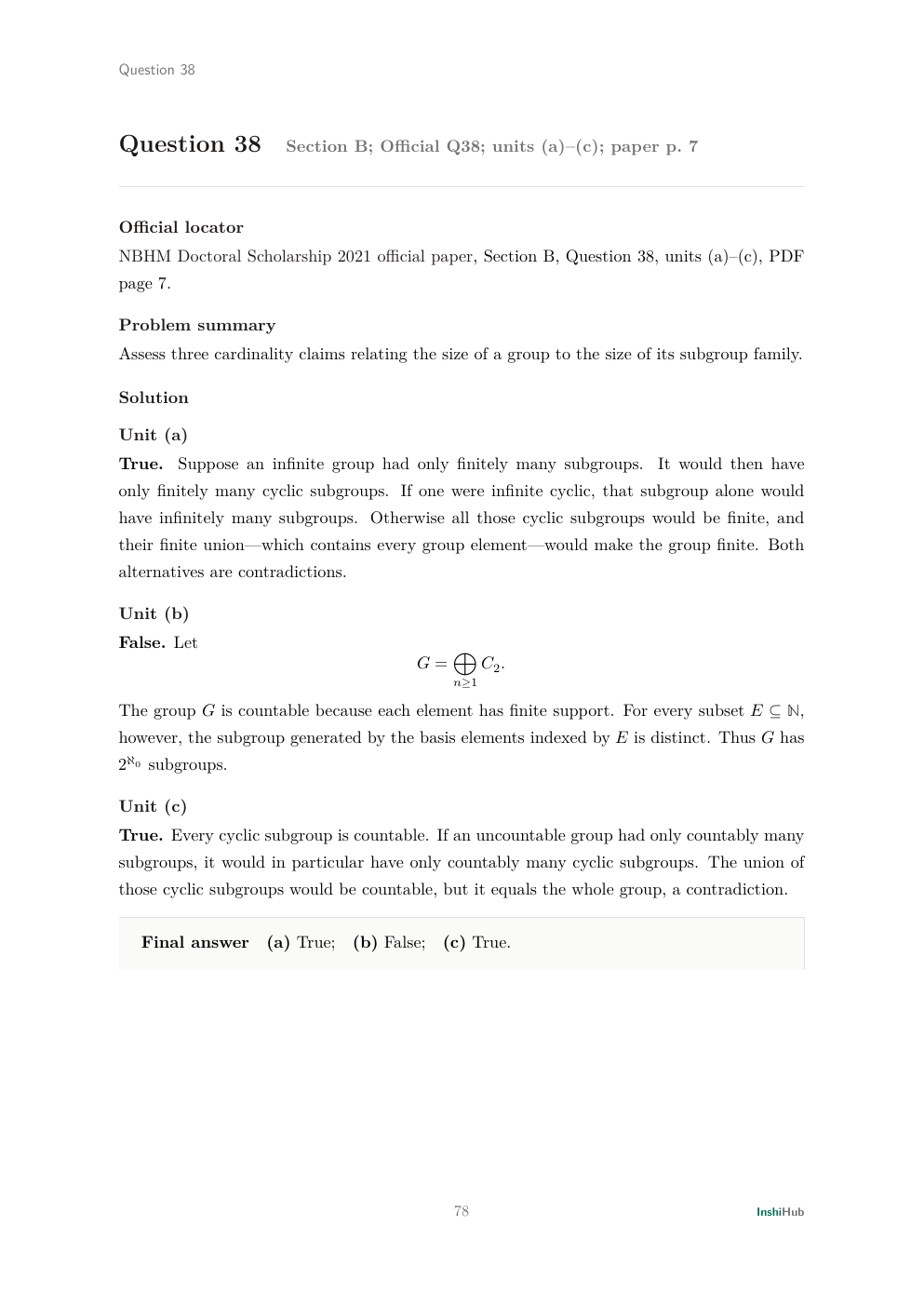
NBHM Doctoral 2021 Worked Solutions, preview page 5 of 6: Question 38 solution testing three subgroup-cardinality assertions with proofs and a counterexample.
Preview page 6 of 6Sample · not the official paper
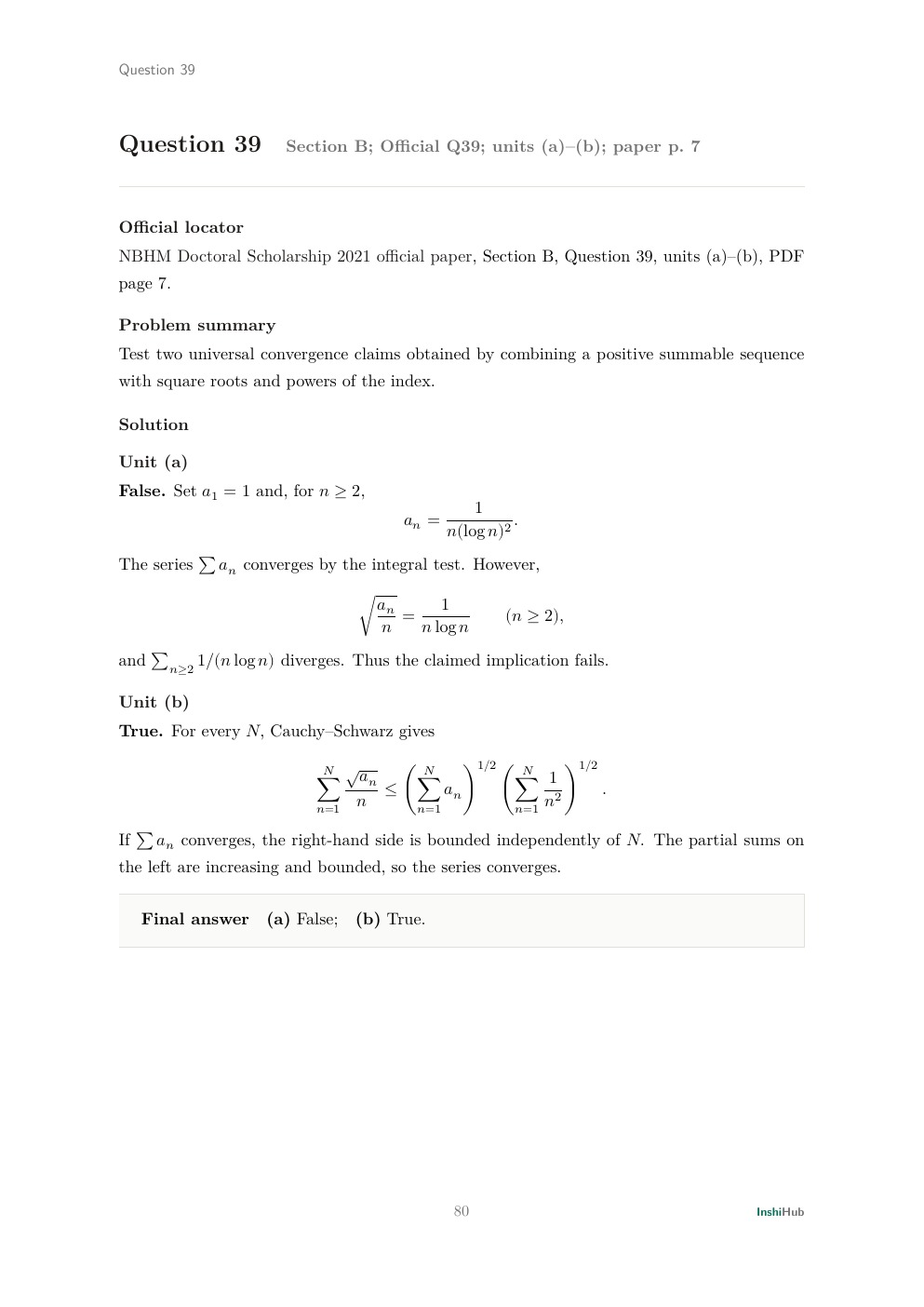
NBHM Doctoral 2021 Worked Solutions, preview page 6 of 6: Question 39 solution comparing two convergence implications for positive-term series.

Crawlable HTML samples

Three free NBHM Doctoral 2021 solutions

Each summary identifies the mathematical task without replacing the official question. Open the source paper at the precise locator, attempt the problem, and then audit your reasoning against the derivation, check, and common-error note below.

Free sample 1

Official problem 1 · A repeated-root differential equation

Review recorded
Source locator
Section A, official problem 1, paper PDF page 2
Review note
Independently derived; differential equation and initial data checked; official-key match · 2026-07-28

Problem summary

Solve a forced constant-coefficient second-order initial-value problem and evaluate the resulting solution at the requested point.

Core idea

Factor the differential operator, include a constant particular solution, and use the two initial conditions to determine both repeated-root coefficients.

Derivation

  1. 1Rewrite the operator as the square of D minus 1 and choose the constant particular solution 4.
  2. 2The repeated characteristic root contributes both exp(x) and x exp(x), so the general solution is 4 plus (C1 + C2 x) exp(x).
  3. 3The value condition gives C1 = 1.
  4. 4Differentiate once; the derivative condition then gives C2 = 1.
  5. 5Substituting x = 1 gives 4 + 2e.

Final answer

The requested value is 4 + 2e.

Free sample 2

Official problem 13 · Bounded trajectories of an autonomous cubic

Review recorded
Source locator
Section A, official problem 13, paper PDF page 3
Review note
Independently derived; literal and intended readings separated; keyed value conditionally recovered · 2026-07-28

Problem summary

Analyse the long-term limits of bounded trajectories for a one-dimensional autonomous cubic while accounting for equilibrium initial data.

Literal hypotheses versus intended reading

The equilibrium-inclusive hypotheses permit three stationary bounded trajectories, so the literal limit is not unique. The value 1 follows only under the separately labelled non-stationary reading reflected by the key. InshiHub does not describe that reading as an official correction.

Core idea

Build the phase line from the three equilibria, then test stationary boundary cases separately from non-stationary trajectories.

Derivation

  1. 1The cubic has equilibria at -2, 1, and 3.
  2. 2Its sign shows motion toward 1 from both adjacent open intervals and motion away from the outer interval boundaries.
  3. 3The three equilibrium initial values themselves produce constant bounded trajectories.
  4. 4Therefore the literal hypotheses allow limits -2, 1, and 3 and do not determine one value.
  5. 5If bounded is intended to mean a non-stationary bounded trajectory, uniqueness confines it between the outer equilibria and its limit is 1.

Final answer

Literal reading: the limit is not unique and may be -2, 1, or 3. Intended non-stationary reading: the limit is 1.

Free sample 3

Official problem 38 · Cardinalities of subgroup families

Review recorded
Source locator
Section B, official problem 38, units (a)-(c), paper PDF page 7
Review note
Independently derived; cyclic-cover proofs and direct-sum counterexample checked; official-key match · 2026-07-28

Problem summary

Assess three claims comparing the size of a group with the number of subgroups it possesses.

Core idea

Cover the group by cyclic subgroups for the positive results, then use a countable direct sum of two-element groups for the counterexample.

Derivation

  1. 1An infinite group cannot have only finitely many cyclic subgroups: an infinite cyclic subgroup has infinitely many subgroups, while a finite union of finite cyclic subgroups is finite.
  2. 2The direct sum of countably many two-element groups is countable because every element has finite support.
  3. 3Each subset of the coordinate set generates a distinct coordinate subgroup, yielding continuum many subgroups and disproving the second claim.
  4. 4Every cyclic subgroup is countable, so an uncountable group cannot be a countable union of cyclic subgroups.
  5. 5These arguments give True, False, True for the three units.

Final answer

Unit (a) is True, unit (b) is False, and unit (c) is True.

Full-edition scope

  • Original, step-by-step solutions for all 39 numbered questions
  • Separate reasoning for all 50 graded answer units
  • Verification, counterexamples, boundary cases, and problem-specific common-error notes
  • Section, question, answer-unit, and paper-page locators for every solution
  • An explicit literal-versus-intended analysis of the Question 13 bounded-trajectory ambiguity
  • A dated correction process and public correction log after release

What is not included

  • The official question paper, figures, logos, and answer-key text
  • Any claim that InshiHub's Question 13 interpretation is an official erratum
  • Coaching, admissions advice, or any score guarantee
  • Affiliation with NBHM, the Department of Atomic Energy, or IMSc

Editorial quality system

Every answer is derived, challenged, and source-mapped

1

Exact source mapping

Every solution identifies its official section, question number, answer units, and paper page without copying the question.

2

Independent mathematics

Each result is derived from first principles before the final answer is compared with the official key.

3

Ambiguity-aware review

Question 13 is analysed under the literal equilibrium-inclusive reading before the key's intended non-stationary interpretation is stated.

4

Release accountability

The edition is versioned, material corrections are dated, and paid access remains separate from editorial publication.

Review boundary

Publishing the mathematics does not activate payment

The guide page and free samples can be public while the commercial offer remains held. A separate merchant and end-to-end delivery approval is required before any purchase control can appear.

Official sources, provenance, and rights

Read the official paper alongside the independent guide

National Board for Higher Mathematics publishes the source documents, which are hosted by The Institute of Mathematical Sciences. InshiHub links to that archive but does not republish its paper, figures, logos, or answer-key text.

2021 sitting-date provenance

The official archive and logistics record identify 18 August 2021 as the actual sitting. The archived paper retains its superseded April cover date; the later official key visibly replaces that date with August. Product metadata uses the actual sitting date while preserving the discrepancy in provenance records.

Source accessed
2026-07-28
Source status
Publicly accessible source; no reuse licence located
InshiHub content
Independent writing; versioned separately
Official paper SHA-256
f53a8df8806bb5ed4cb032c989f367b612c9d271dd64786b246224b49af7c237
Official answer-key SHA-256
717a05db0cb4ed7241b8ee73ca4b75d1c33270750fc6bd1d74b68285bd6258a3

InshiHub is an independent study resource. It is not affiliated with, endorsed by, or sponsored by NBHM, the Department of Atomic Energy, or The Institute of Mathematical Sciences.

Transparent release status

Free samples are public. Paid access remains disabled.

The 2021 offer is still in validation. Publishing this page does not accept payment, reserve a purchase, or collect a release-alert address. Checkout can appear only after every recorded gate below passes for this exact edition.

  • All 39 numbered questions and 50 answer units completed
  • Independent mathematical review recorded
  • Question 13 literal-source and intended-reading labels verified
  • Rights review completed for paid distribution
  • Merchant and 2021 product approval recorded
  • Exact transaction-seller entity and India responsibility allocation confirmed
  • Current buyer terms and privacy notice linked
  • INR final-price display, payment, delivery, refund, and order reconciliation tested

Paid access is under merchant review

For NBHM Doctoral 2021, the configured one-time catalogue price is ₹999, inclusive of applicable tax. Checkout stays disabled until the merchant, transaction-seller, INR payment, delivery, and refund checks are complete.

No release-alert form is active. InshiHub is not collecting email addresses or promising a release message until a verified double-opt-in email process is available.

Bookmark this page. The purchase button will replace this notice only after every published release gate passes.

Frequently asked questions

NBHM Doctoral 2021 guide details

Does this guide reproduce the official NBHM Doctoral 2021 paper?

No. It contains independently written solutions and short, non-substituting topic summaries. Use the official IMSc archive links on this page for the question paper and answer key.

What is covered in the NBHM Doctoral 2021 solution guide?

The current 82-page edition covers all 39 numbered questions and all 50 graded answer units, with source locators, complete derivations, verification, and problem-specific error notes.

Why does the page use 18 August 2021 when the paper cover shows April?

The official archive and logistics page identify 18 August 2021 as the actual sitting. The archived paper retained the superseded April cover date, while the later official key visibly replaces it with the August date.

How does the guide handle the ambiguity in Question 13?

It reports that the literal equilibrium-inclusive hypotheses do not determine one limit, then gives 1 under the clearly labelled non-stationary bounded-trajectory interpretation reflected by the key. InshiHub does not present that interpretation as an official erratum.

Can I buy the complete 2021 guide now?

Not yet. The editorial page and free samples are published, but the offer remains in validation. Checkout is disabled until merchant, transaction-seller, payment, delivery, refund, and reconciliation checks have all passed.

What will the complete 2021 guide cost?

The configured one-time catalogue price is ₹999, inclusive of applicable tax. It is not a temporary discount or a crossed-out-price promotion. A purchase button will appear only after the 2021 offer is separately approved and the final INR total can be verified before payment.

How were the answers checked?

Every answer unit is independently derived before comparison with the official key. Mathematical review records derivations, counterexamples, boundary cases, and any source ambiguity separately.

Is InshiHub affiliated with NBHM or IMSc?

No. InshiHub is an independent study resource and is not affiliated with, endorsed by, or sponsored by NBHM, the Department of Atomic Energy, or The Institute of Mathematical Sciences.