
InshiHubIndia
2024 editionEnglish · IndiaComplete 77-page edition

NBHM Combined 2024 worked solutions

Replace a bare answer list with independent derivations for all 40 numbered questions and 50 answer units. Read three complete solutions in searchable HTML and inspect six pages from the finished guide before paid access opens.

40 worked questions · 50 answer unitsExact official source locatorsIndependent cross-audit

Six-page visual preview

Inspect six real solution pages

These pages come from the completed 2024 manuscript and cover Questions 5, 16, 29, 33, 35, and 40. Every image is an InshiHub explanation page, never a scan of the official paper or answer key.

Preview page 1 of 6Sample · not the official paper
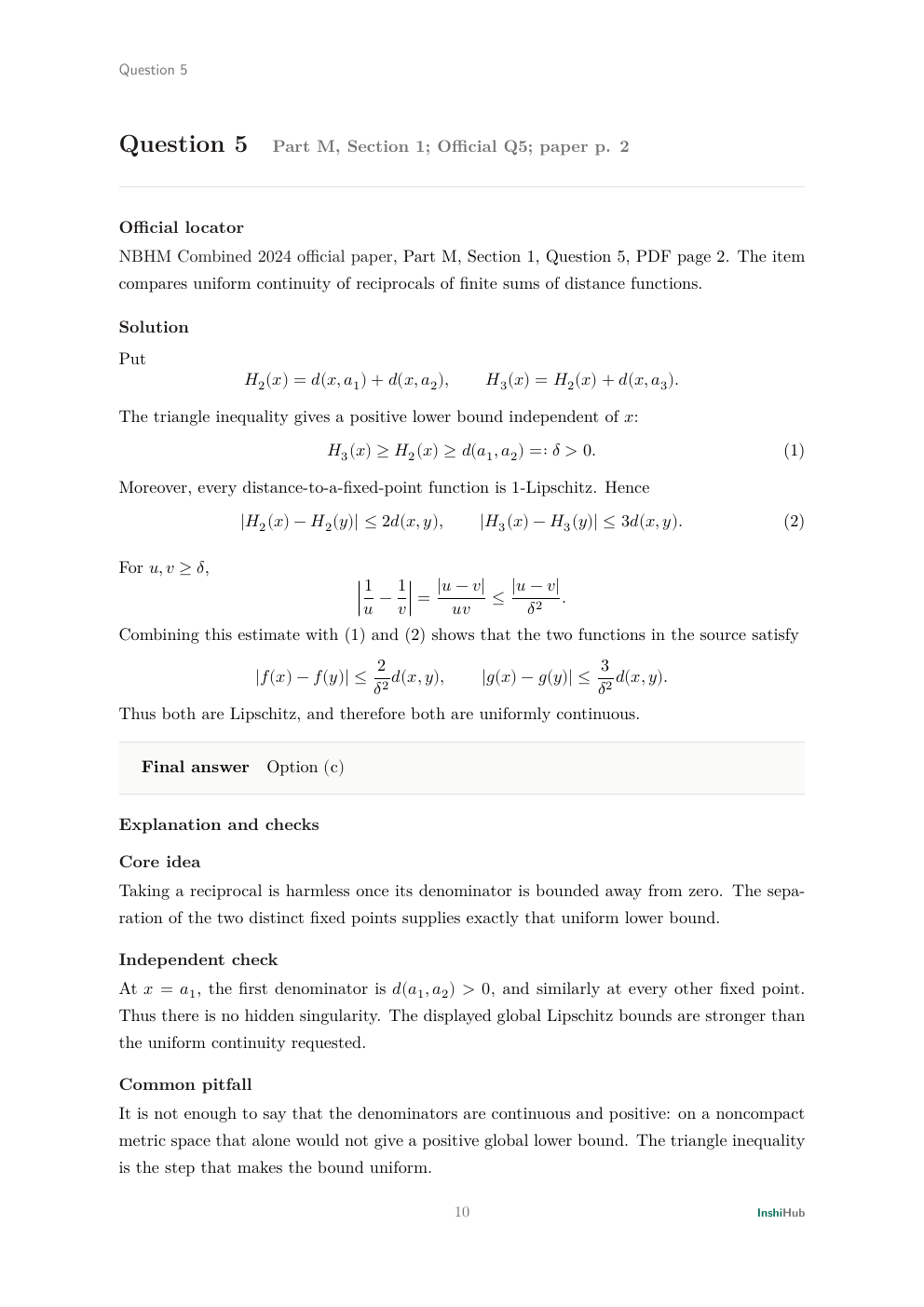
NBHM Combined 2024 Worked Solutions, preview page 1 of 6: Question 5 solution proving uniform continuity through a positive denominator bound and global Lipschitz estimates.
Preview page 2 of 6Sample · not the official paper
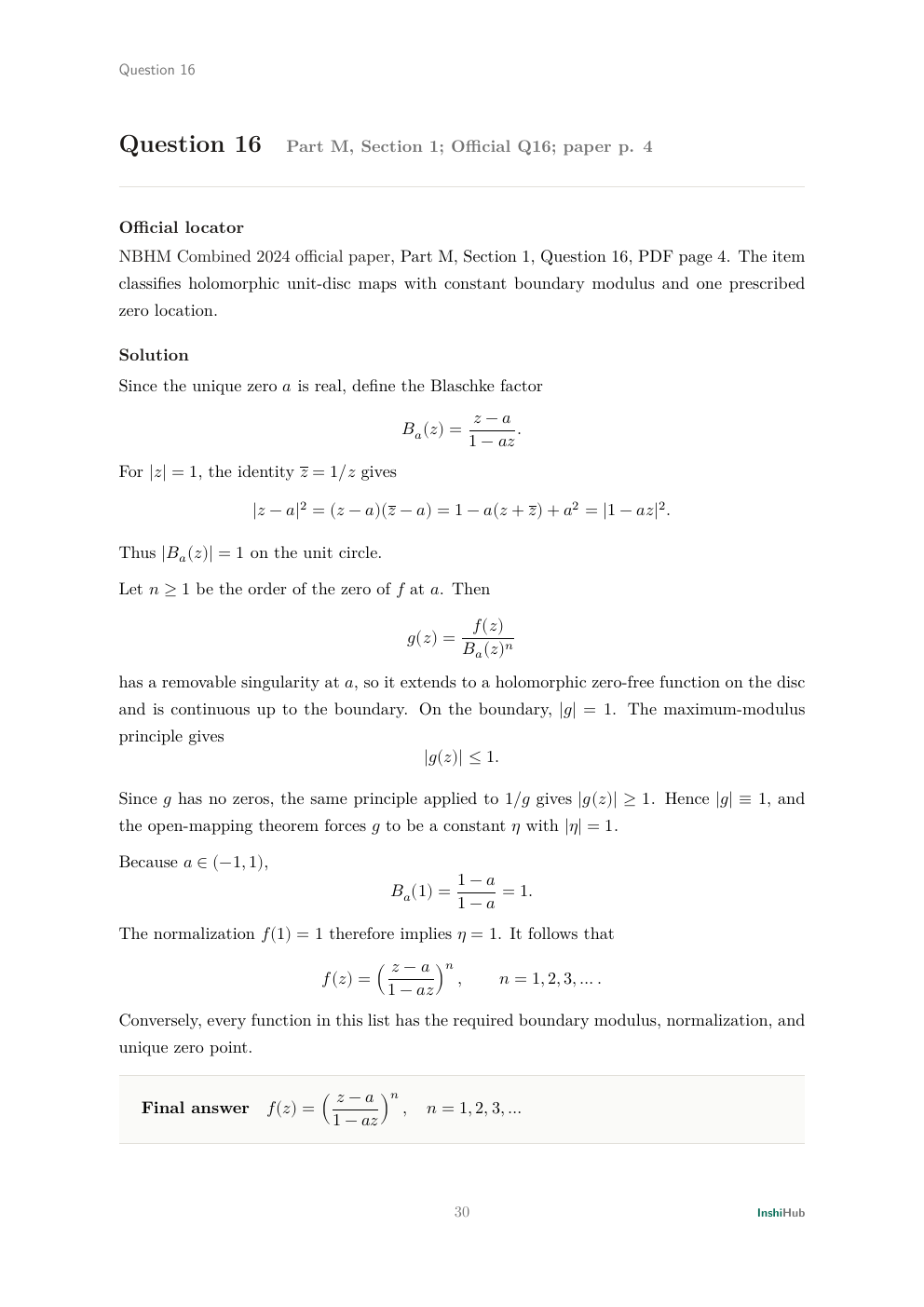
NBHM Combined 2024 Worked Solutions, preview page 2 of 6: Question 16 solution classifying unit-disc maps by dividing out a Blaschke factor with the full zero multiplicity.
Preview page 3 of 6Sample · not the official paper
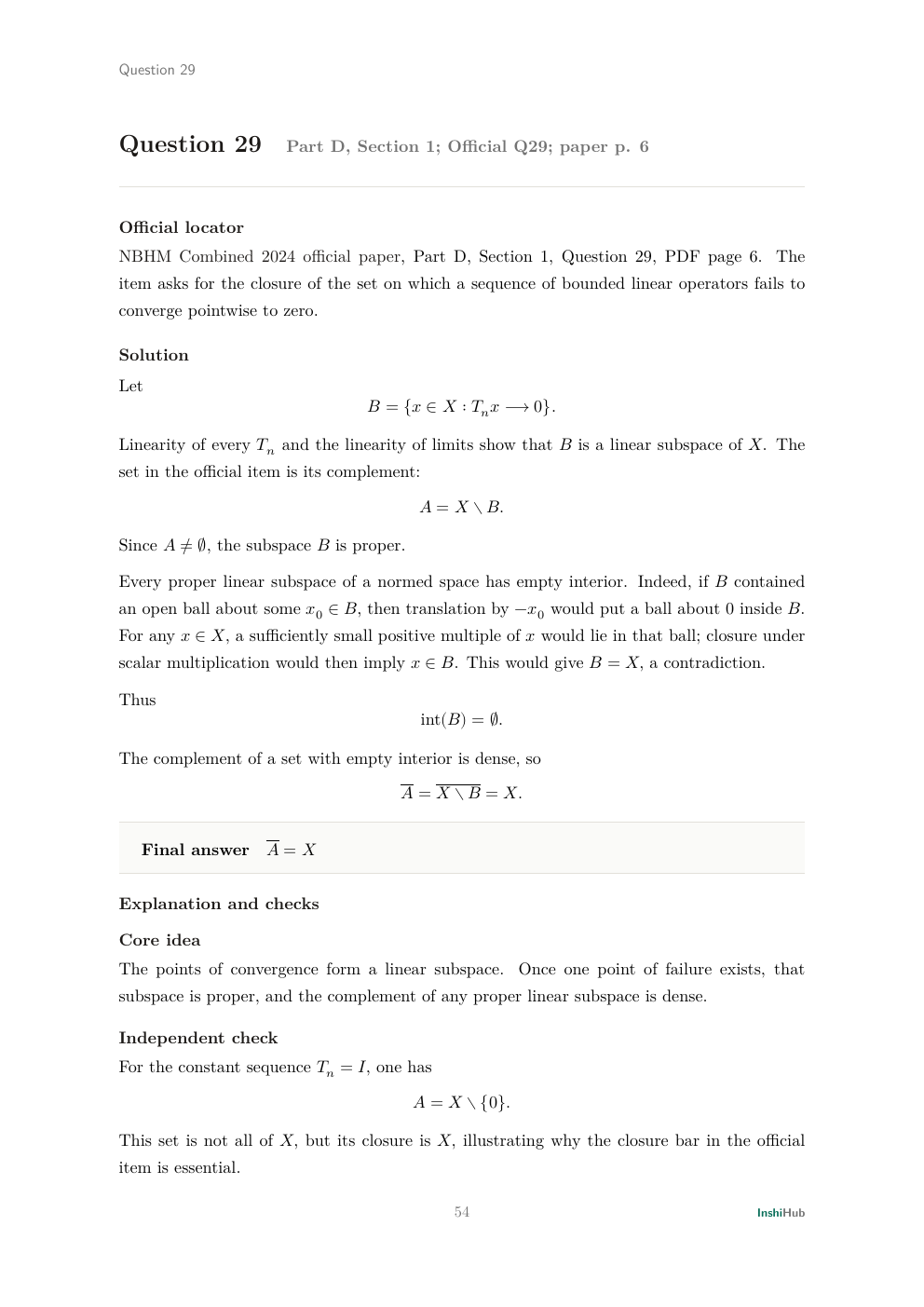
NBHM Combined 2024 Worked Solutions, preview page 3 of 6: Question 29 solution proving density of the failure set by identifying the convergence set as a proper linear subspace.
Preview page 4 of 6Sample · not the official paper
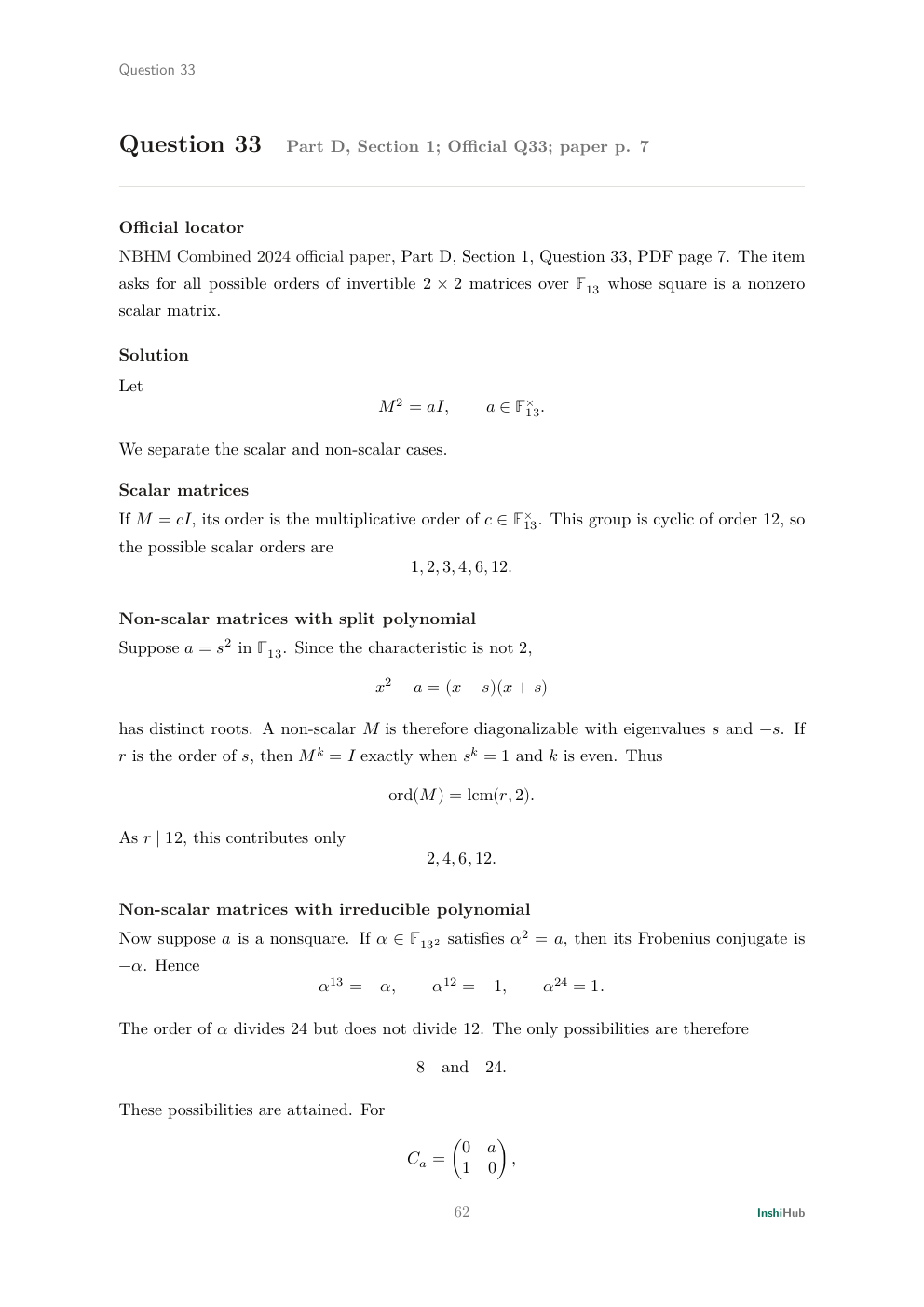
NBHM Combined 2024 Worked Solutions, preview page 4 of 6: Question 33 solution classifying matrix orders over the finite field by scalar, split, and irreducible cases.
Preview page 5 of 6Sample · not the official paper
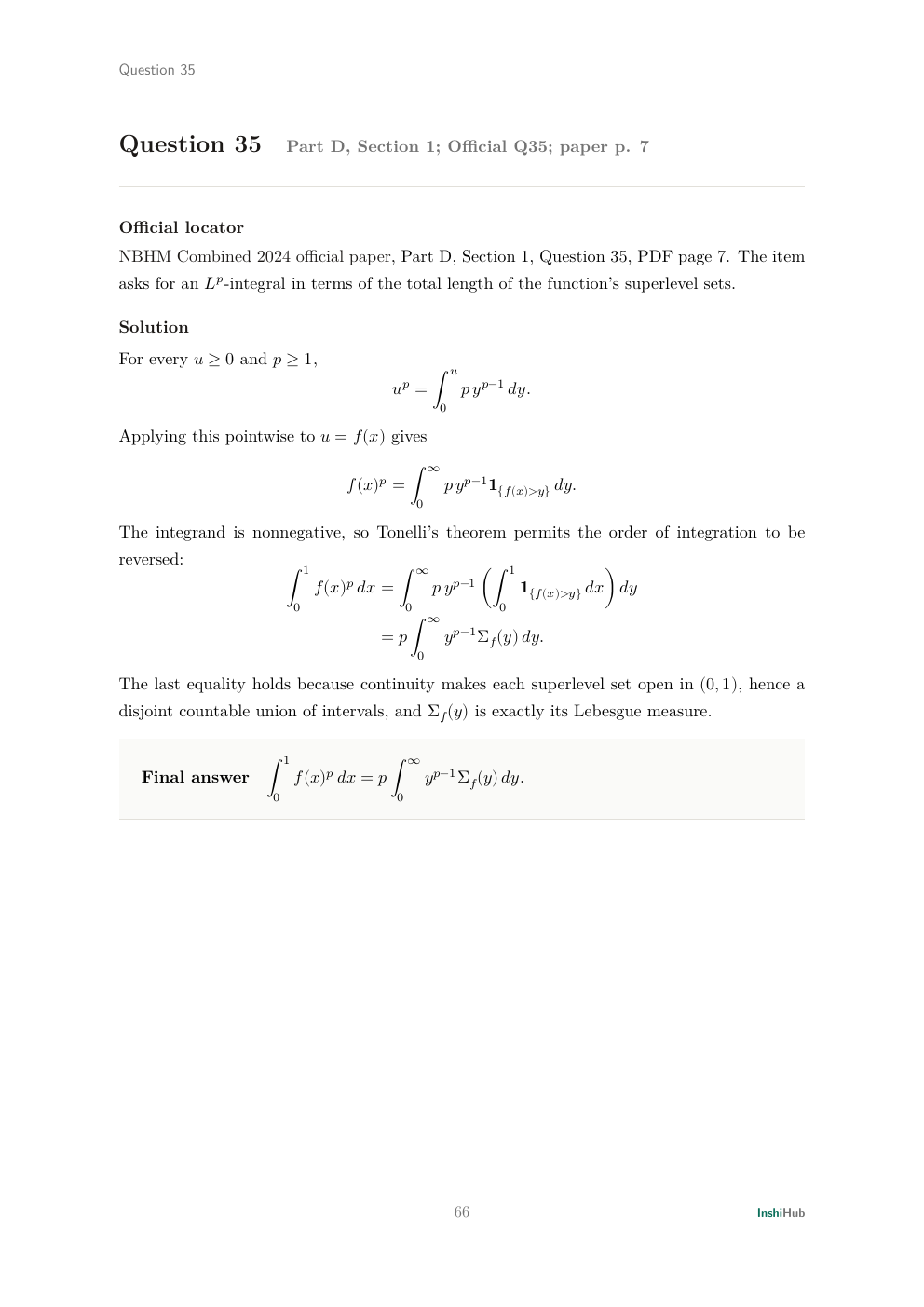
NBHM Combined 2024 Worked Solutions, preview page 5 of 6: Question 35 solution deriving the layer-cake identity by a pointwise level integral and Tonelli's theorem.
Preview page 6 of 6Sample · not the official paper
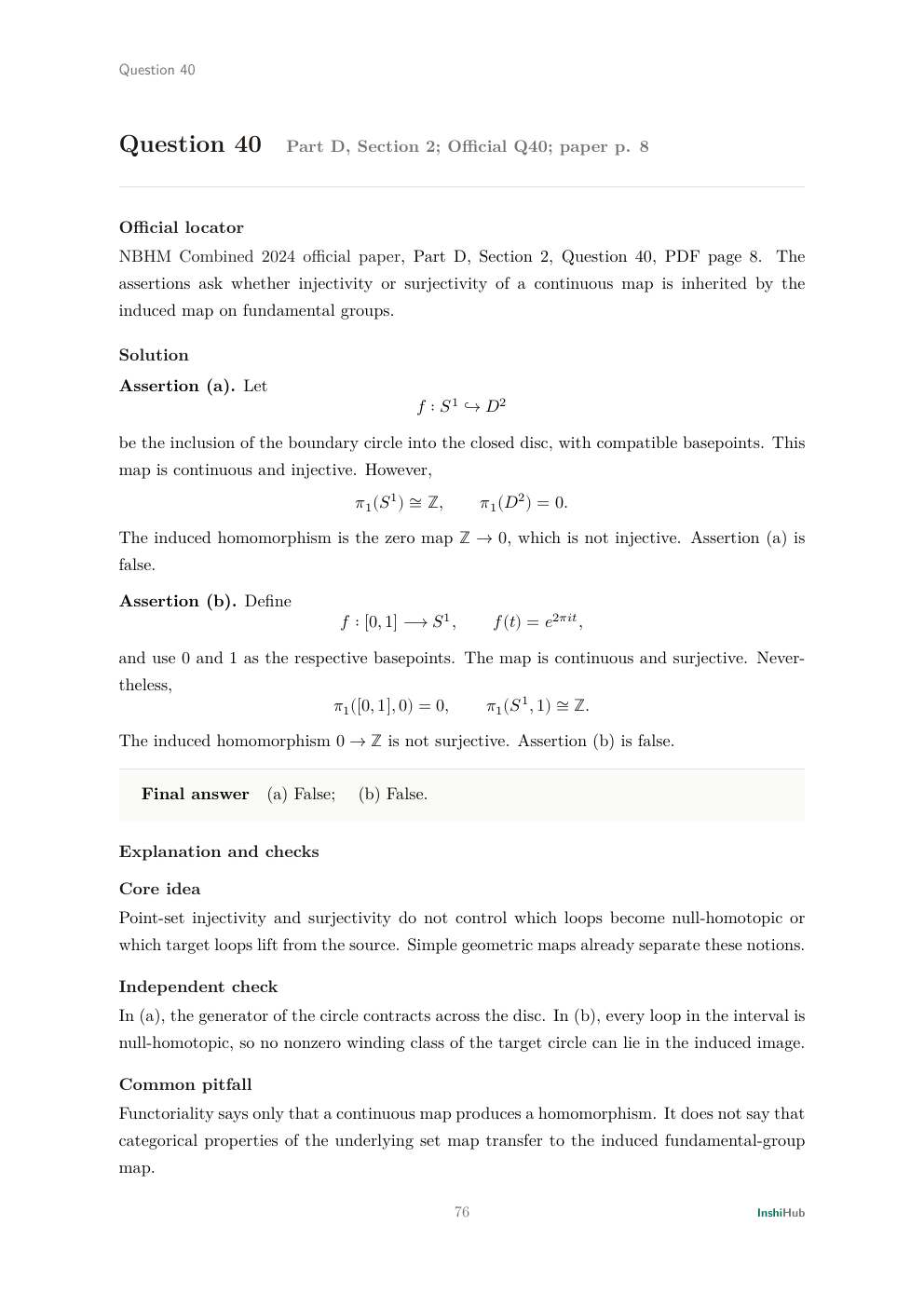
NBHM Combined 2024 Worked Solutions, preview page 6 of 6: Question 40 solution testing fundamental-group functoriality with two explicit geometric counterexamples.

Crawlable HTML samples

Three free NBHM Combined 2024 solutions

Each summary identifies the mathematical task without replacing the official question. Open the source paper at the precise locator, attempt the problem, and then audit your reasoning against the derivation, check, and common-error note below.

Free sample 1

Official problem 5 · Uniform continuity in metric spaces

Review recorded
Source locator
Part M, Section 1, official problem 5, paper PDF page 2
Review note
Independently derived; lower bound and Lipschitz constants checked; official-key match · 2026-07-28

Problem summary

Classify two reciprocal distance-sum functions by deciding whether each is uniformly continuous on an arbitrary metric space with distinct fixed points.

Core idea

Use the triangle inequality to keep each denominator uniformly away from zero, then combine the reciprocal estimate with Lipschitz bounds for distance functions.

Derivation

  1. 1The sum of the distances to the first two fixed points is at least the distance between those points, a positive constant.
  2. 2Adding a third nonnegative distance preserves that lower bound.
  3. 3A sum of two distance functions is 2-Lipschitz, while a sum of three is 3-Lipschitz.
  4. 4On values at least δ, the reciprocal map changes by at most |u − v|/δ², so both composed functions are globally Lipschitz.

Final answer

Both functions are uniformly continuous, so the correct choice is option (c).

Free sample 2

Official problem 16 · Holomorphic disc maps and Blaschke factors

Review recorded
Source locator
Part M, Section 1, official problem 16, paper PDF page 4
Review note
Independently derived; boundary identity and converse checked; official-key match · 2026-07-28

Problem summary

Classify holomorphic functions on the unit disc that have unit boundary modulus, a prescribed zero location, and a boundary normalization.

Core idea

Divide out the entire zero multiplicity with the corresponding Blaschke factor; maximum-modulus control of the quotient and its reciprocal forces the quotient to be constant.

Derivation

  1. 1For real a in (−1, 1), the factor Bₐ(z) = (z − a)/(1 − az) has modulus one on the unit circle.
  2. 2If n is the zero multiplicity at a, then g = f/Bₐⁿ extends holomorphically and has no zeros in the disc.
  3. 3Boundary modulus one gives |g| ≤ 1, while applying the same principle to 1/g gives |g| ≥ 1.
  4. 4The open-mapping theorem makes g a unimodular constant, and the normalization at z = 1 makes that constant equal to one.

Final answer

f(z) = ((z − a)/(1 − az))ⁿ for n = 1, 2, 3, … .

Free sample 3

Official problem 35 · Layer-cake representation and distribution functions

Review recorded
Source locator
Part D, Section 1, official problem 35, paper PDF page 7
Review note
Independently derived; constant-function test and Tonelli step checked; official-key match · 2026-07-28

Problem summary

Express the p-th power integral of a nonnegative function through the total lengths of its superlevel intervals.

Core idea

Rebuild each value from the indicators of the levels below it, then use Tonelli's theorem to exchange the level and spatial integrals.

Derivation

  1. 1For u ≥ 0, write uᵖ as the integral of p yᵖ⁻¹ from 0 to u.
  2. 2Replace the upper limit with an indicator of the event f(x) > y.
  3. 3Nonnegativity permits the order of integration to be reversed without assuming finite integrability.
  4. 4The inner indicator integral is exactly the total length Σ_f(y) of the superlevel set.

Final answer

∫₀¹ f(x)ᵖ dx = p ∫₀∞ yᵖ⁻¹ Σ_f(y) dy.

Full-edition scope

  • Original, step-by-step solutions for all 40 numbered questions
  • Separate reasoning for all 50 independently marked answer units
  • Verification, counterexamples, and problem-specific common-error notes
  • Part, section, question, and paper-page locators for every solution
  • A dated correction process and public correction log after release

What is not included

  • The official question paper, figures, and answer-key text
  • Coaching, admissions advice, or any score guarantee
  • Affiliation with NBHM, the Department of Atomic Energy, or IMSc

Editorial quality system

Every answer is derived, challenged, and source-mapped

1

Exact source mapping

Every solution identifies its official part, section, question number, and paper page without copying the question.

2

Independent mathematics

Each result is derived from first principles before the final answer is compared with the official key.

3

Second-person cross-audit

A reviewer who did not write the solution recomputes every answer unit and records any required correction.

4

Release accountability

The edition is versioned, material corrections are dated, and paid access remains separate from editorial publication.

Review boundary

Publishing the mathematics does not activate payment

The guide page and free samples can be public while the commercial offer remains held. A separate merchant and end-to-end delivery approval is required before any purchase control can appear.

Official sources and rights

Read the official paper alongside the independent guide

National Board for Higher Mathematics publishes the source documents, which are hosted by The Institute of Mathematical Sciences. InshiHub links to that archive but does not republish its paper, figures, logos, or answer-key text.

Source accessed
2026-07-28
Source status
Publicly accessible source; no reuse licence located
InshiHub content
Independent writing; versioned separately

InshiHub is an independent study resource. It is not affiliated with, endorsed by, or sponsored by NBHM, the Department of Atomic Energy, or The Institute of Mathematical Sciences.

Transparent release status

Free samples are public. Paid access remains disabled.

The 2024 offer is still in validation. Publishing this page does not accept payment, reserve a purchase, or collect a release-alert address. Checkout can appear only after every recorded gate below passes for this exact edition.

  • All 40 numbered questions and 50 answer units completed
  • Independent mathematical review recorded
  • Rights review completed for paid distribution
  • Dodo merchant and 2024 product approval recorded
  • Exact transaction-seller entity and India responsibility allocation confirmed
  • Current buyer terms and privacy notice linked
  • INR final-price display, payment, delivery, refund, and order reconciliation tested

Paid access is under merchant review

For NBHM Combined 2024, the configured one-time catalogue price is ₹999, inclusive of applicable tax. Checkout stays disabled until the merchant, transaction-seller, INR payment, delivery, and refund checks are complete.

No release-alert form is active. InshiHub is not collecting email addresses or promising a release message until a verified double-opt-in email process is available.

Bookmark this page. The purchase button will replace this notice only after every published release gate passes.

Frequently asked questions

NBHM Combined 2024 guide details

Does this guide reproduce the official NBHM 2024 paper?

No. It contains independently written solutions and short, non-substituting topic summaries. Use the official IMSc archive links on this page for the question paper and answer key.

What is covered in the NBHM Combined 2024 solution guide?

The 77-page edition covers all 40 numbered questions and all 50 independently marked answer units, with source locators, complete derivations, verification, and problem-specific error notes.

Can I buy the complete 2024 guide now?

Not yet. The editorial page and free samples are published, but the offer remains in validation. Checkout is disabled until merchant, transaction-seller, payment, delivery, refund, and reconciliation checks have all passed.

What will the complete 2024 guide cost?

The configured one-time catalogue price is ₹999, inclusive of applicable tax. It is not a temporary discount or a crossed-out-price promotion. A purchase button will appear only after the 2024 offer is separately approved and the final INR total can be verified before payment.

How were the answers checked?

Every answer unit was independently derived and then recomputed by a reviewer who did not write that solution. The final result was compared with the official key only after the derivation.

How are mathematical errors handled?

Confirmed material errors will be corrected in a new dated content version and logged publicly for eligible customers.

Is InshiHub affiliated with NBHM or IMSc?

No. InshiHub is an independent study resource and is not affiliated with, endorsed by, or sponsored by NBHM, the Department of Atomic Energy, or The Institute of Mathematical Sciences.