
InshiHubIndia
2023 editionEnglish · IndiaComplete 83-page edition

NBHM Combined 2023 worked solutions

Replace a bare answer list with independent derivations for all 40 numbered questions and 50 answer units. Read three complete solutions in searchable HTML and inspect six pages from the finished guide before paid access opens.

40 worked questions · 50 answer unitsExact official source locatorsIndependent cross-audit

Six-page visual preview

Inspect six real solution pages

These pages come from the completed 2023 manuscript and cover Questions 3, 10, 21, 29, 35, and 40. Every image is an InshiHub explanation page, never a scan of the official paper or answer key.

Preview page 1 of 6Sample · not the official paper
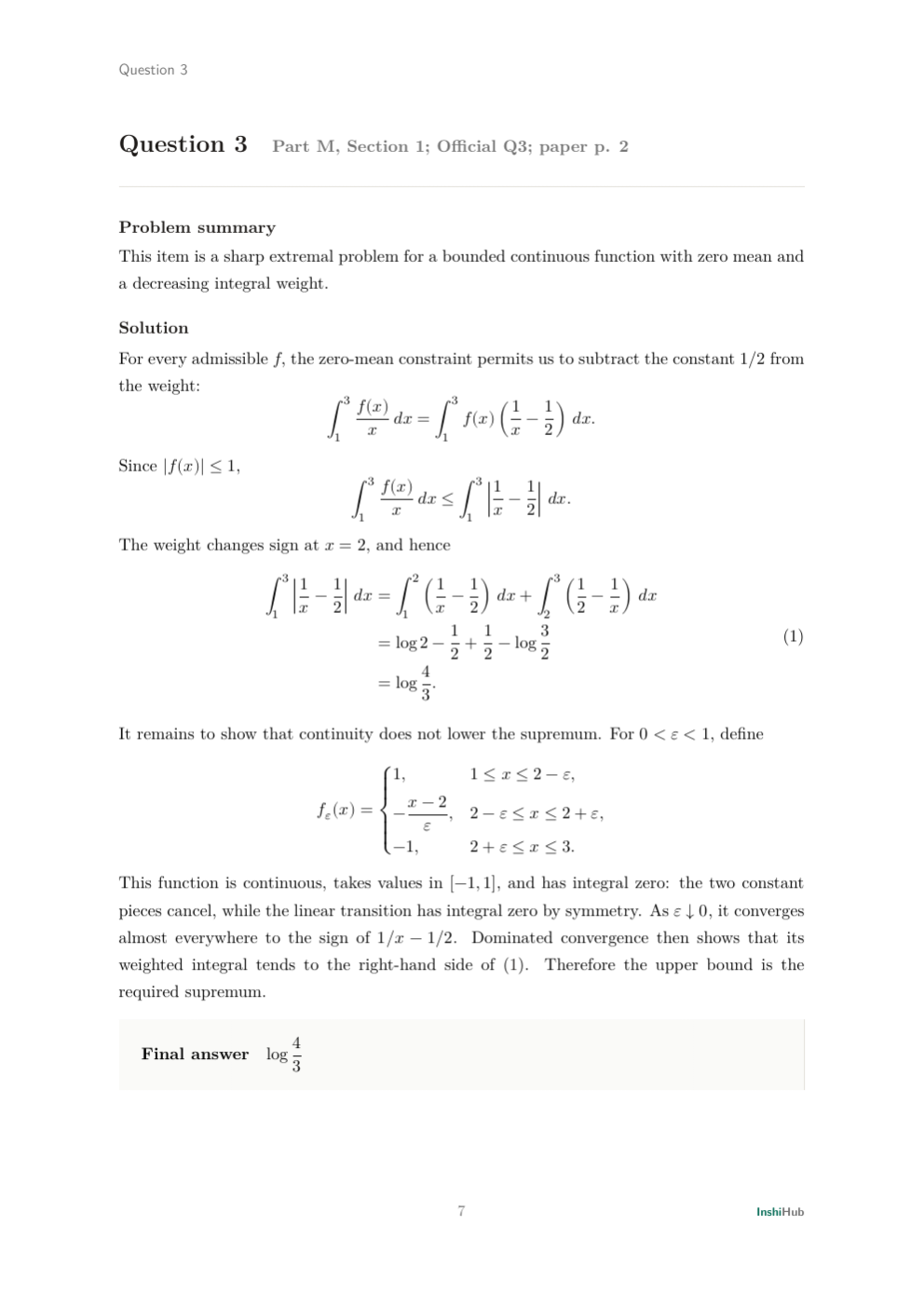
NBHM Combined 2023 Worked Solutions, preview page 1 of 6: Question 3 solution deriving the sharp zero-mean integral bound with a centred weight and continuous sign approximations.
Preview page 2 of 6Sample · not the official paper
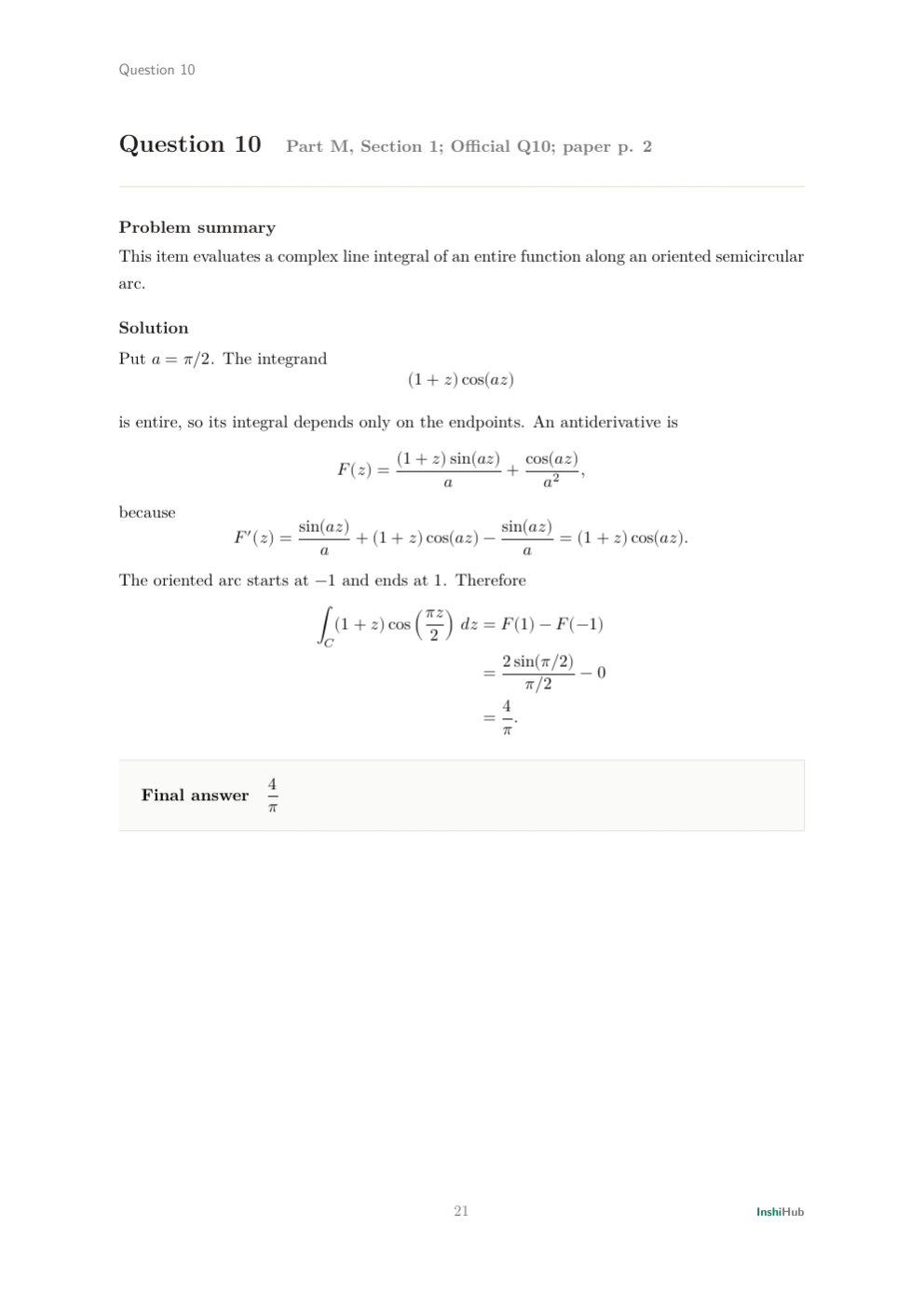
NBHM Combined 2023 Worked Solutions, preview page 2 of 6: Question 10 solution evaluating an entire complex line integral through an explicit primitive and the oriented endpoints.
Preview page 3 of 6Sample · not the official paper
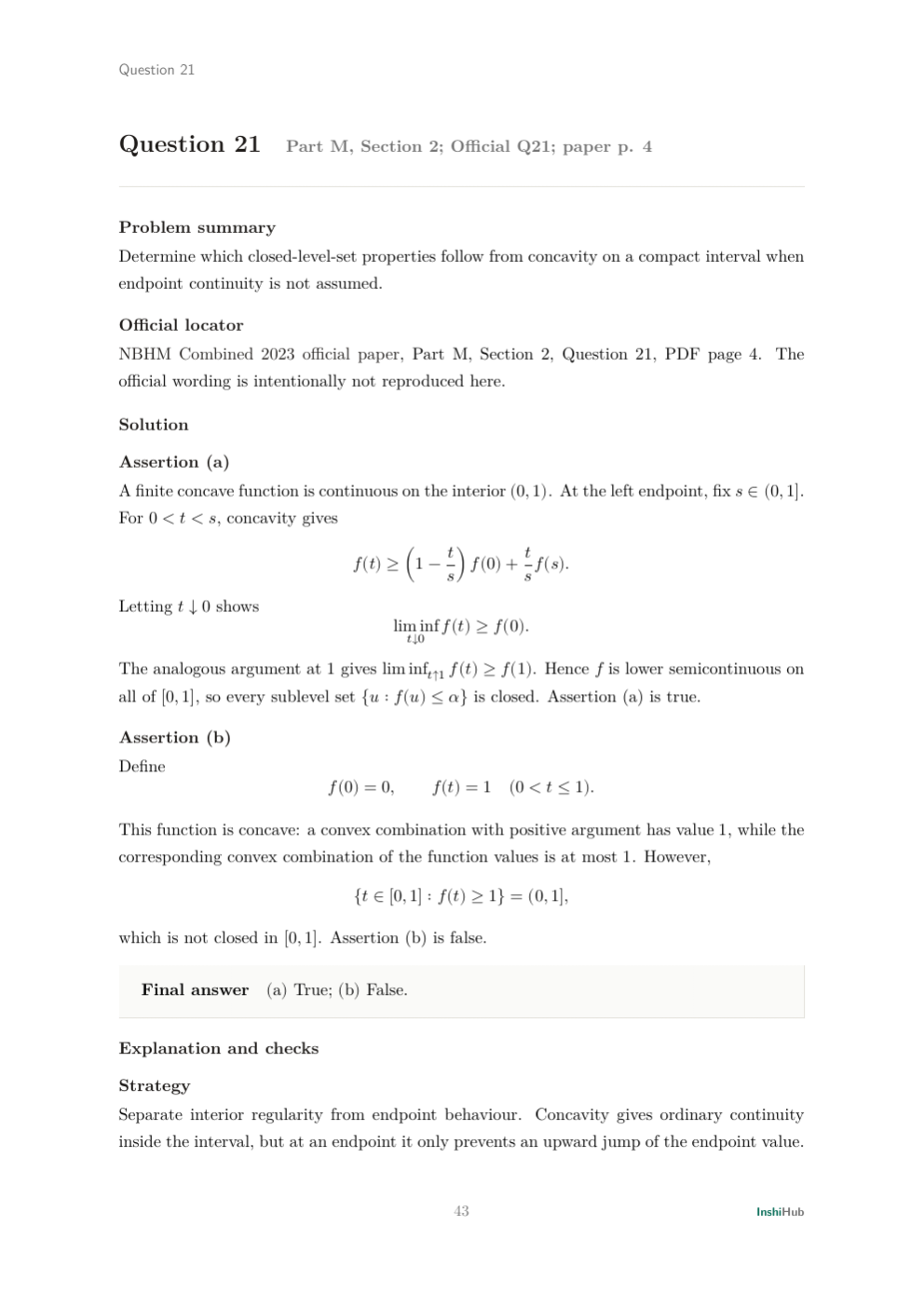
NBHM Combined 2023 Worked Solutions, preview page 3 of 6: Question 21 solution separating interior concavity from endpoint semicontinuity and testing both level-set claims.
Preview page 4 of 6Sample · not the official paper
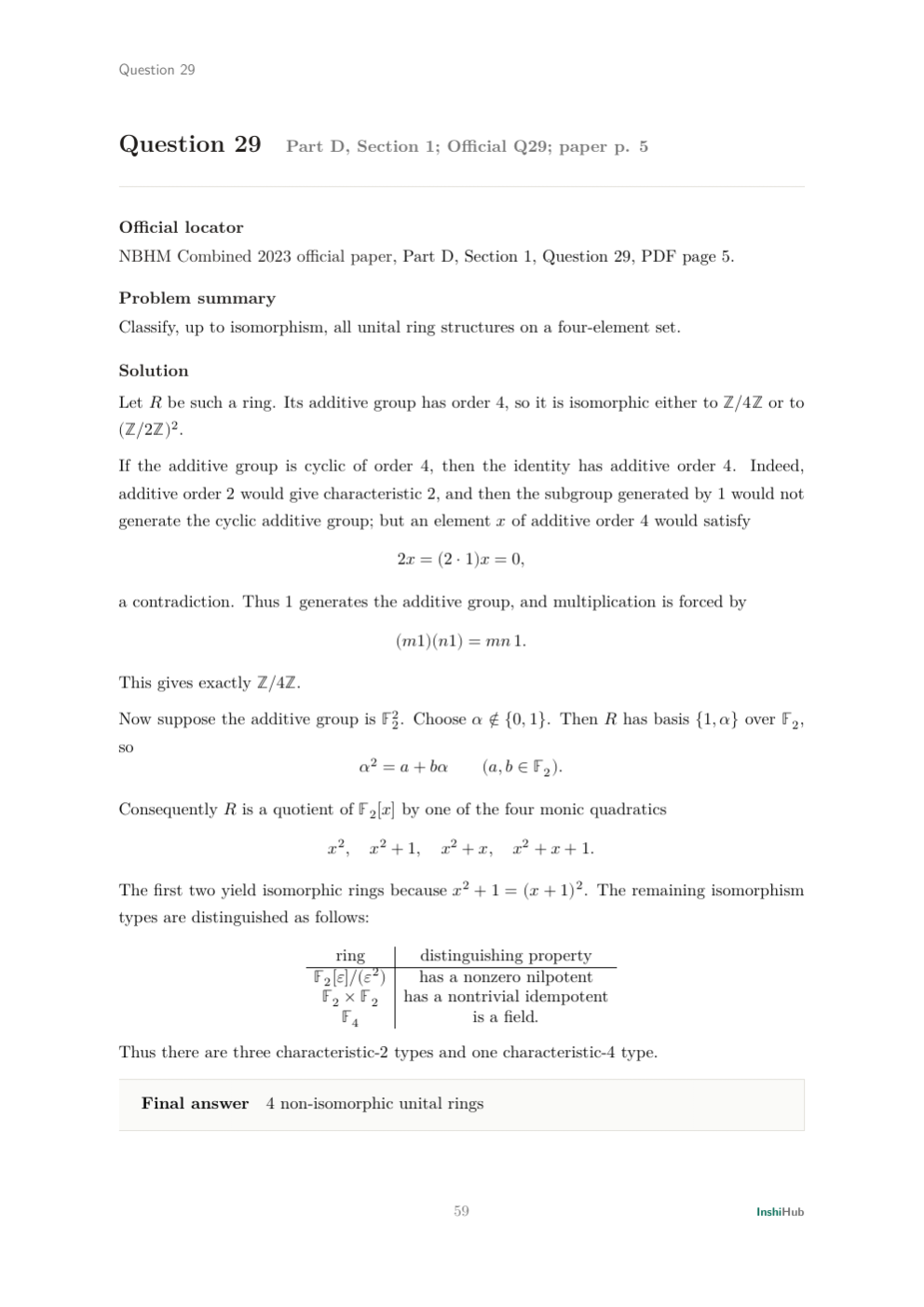
NBHM Combined 2023 Worked Solutions, preview page 4 of 6: Question 29 solution classifying every four-element unital ring through its additive group and quadratic relation.
Preview page 5 of 6Sample · not the official paper
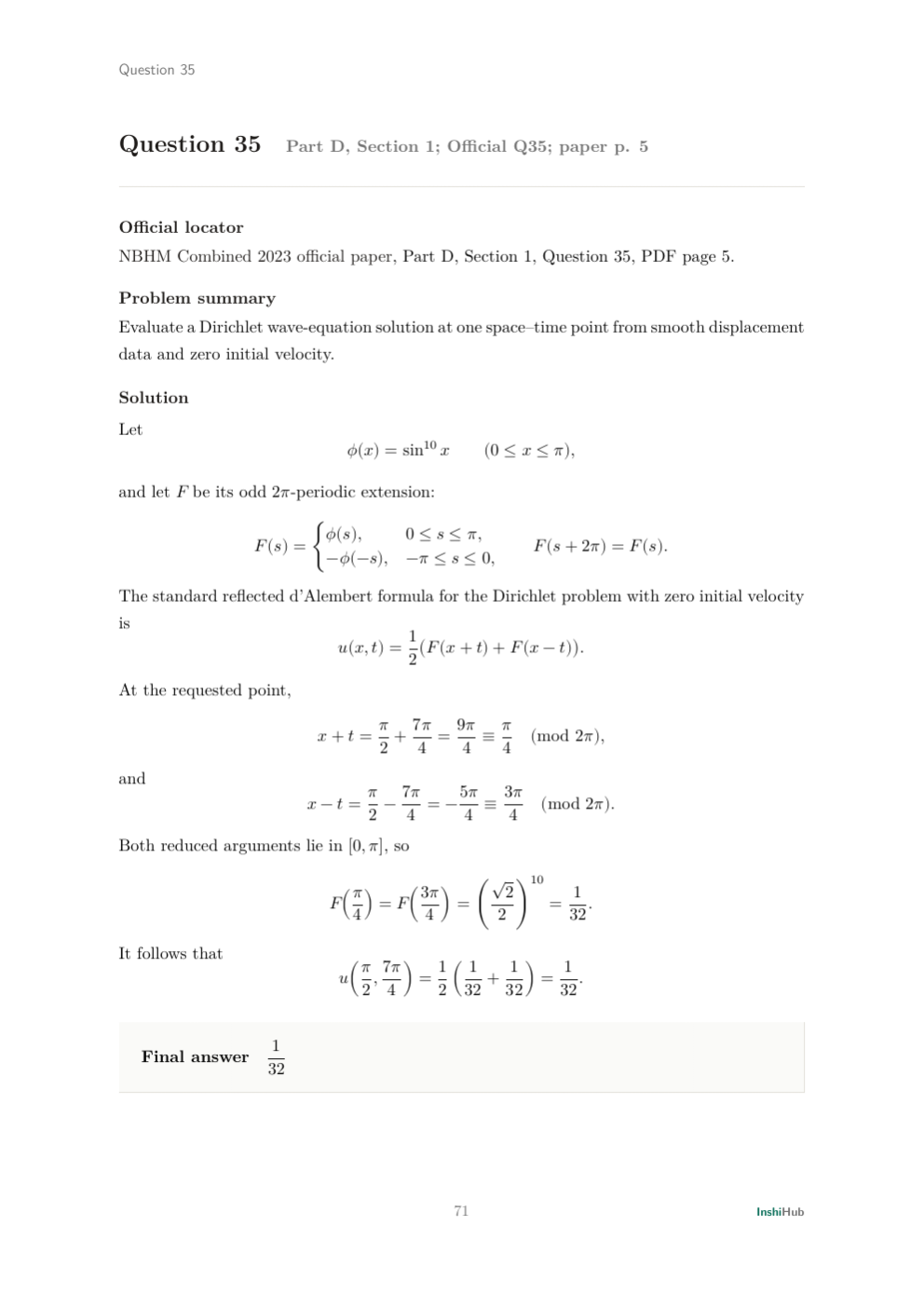
NBHM Combined 2023 Worked Solutions, preview page 5 of 6: Question 35 solution enforcing fixed endpoints with an odd periodic extension and the reflected d'Alembert formula.
Preview page 6 of 6Sample · not the official paper
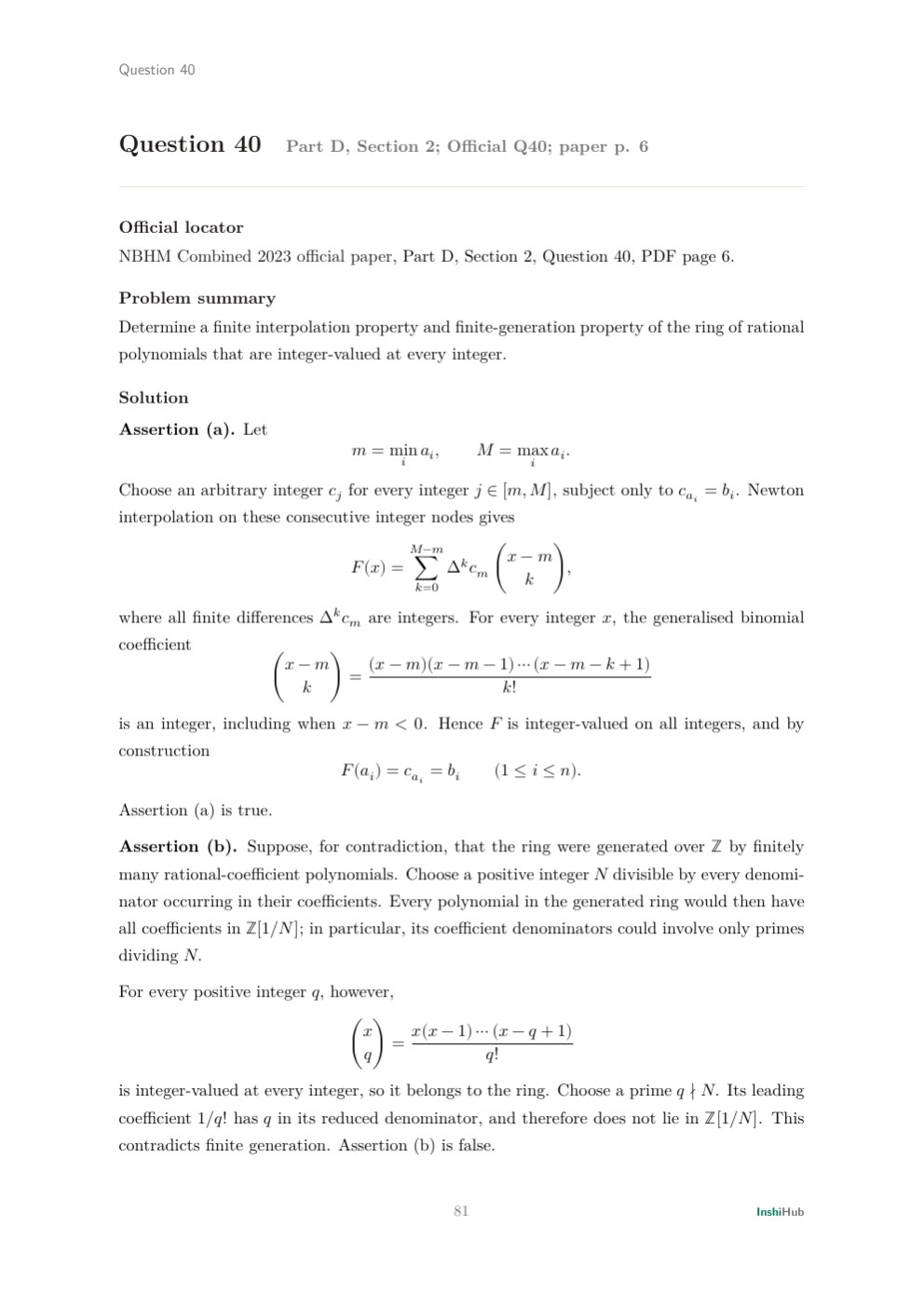
NBHM Combined 2023 Worked Solutions, preview page 6 of 6: Question 40 solution proving finite interpolation with the Newton binomial basis and ruling out finite ring generation.

Crawlable HTML samples

Three free NBHM Combined 2023 solutions

Each summary identifies the mathematical task without replacing the official question. Open the source paper at the precise locator, attempt the problem, and then audit your reasoning against the derivation, check, and common-error note below.

Free sample 1

Official problem 3 · A sharp integral bound under a zero-mean constraint

Review recorded
Source locator
Part M, Section 1, official problem 3, paper PDF page 2
Review note
Independently derived; extremising sequence and admissibility conditions checked; official-key match · 2026-07-28

Problem summary

Find the sharp weighted-integral supremum for bounded continuous functions whose ordinary integral vanishes.

Core idea

Use the zero-mean condition to subtract one half from the decreasing weight, bound the centred integral by its absolute value, and approach equality with continuous sign approximations.

Derivation

  1. 1Subtracting one half from the weight leaves the objective unchanged because the integral of the function is zero.
  2. 2The centred weight changes sign at two, and the pointwise bound gives an absolute-value integral.
  3. 3Evaluating the two elementary integrals gives log(4/3).
  4. 4A symmetric continuous transition near the sign-change point has exact zero mean and converges to the extremising sign pattern.

Final answer

The supremum is log(4/3).

Free sample 2

Official problem 29 · Classification of four-element unital rings

Review recorded
Source locator
Part D, Section 1, official problem 29, paper PDF page 5
Review note
Independently derived; all additive-group cases and isomorphisms checked; official-key match · 2026-07-28

Problem summary

Classify every unital ring structure on a four-element set up to isomorphism, without assuming commutativity in advance.

Core idea

Split by the additive group. The cyclic case forces the integers modulo four; the elementary-abelian case becomes a two-dimensional algebra over the field of two elements.

Derivation

  1. 1A ring of order four has additive group either cyclic of order four or a two-dimensional vector space over the field of two elements.
  2. 2In the cyclic case, the identity must generate the additive group, forcing the ring of integers modulo four.
  3. 3In characteristic two, choose a basis consisting of the identity and one extra element; its quadratic relation determines the multiplication.
  4. 4Translation identifies the two repeated-root quotients, leaving the dual numbers, the product ring, and the four-element field.

Final answer

There are four non-isomorphic unital rings.

Free sample 3

Official problem 35 · Dirichlet wave equation by reflected d'Alembert formula

Review recorded
Source locator
Part D, Section 1, official problem 35, paper PDF page 5
Review note
Independently derived; initial data, boundary data, and evaluation checked; official-key match · 2026-07-28

Problem summary

Evaluate a fixed-end wave solution at one space-time point from a smooth initial displacement and zero initial velocity.

Core idea

Extend the initial profile oddly across the endpoints and periodically across the real line, then evaluate the two travelling-wave terms.

Derivation

  1. 1The odd periodic extension encodes the homogeneous boundary values at both ends of the interval.
  2. 2Zero initial velocity makes the solution the average of the extension at x+t and x−t.
  3. 3Reducing both requested arguments modulo the period places them at π/4 and 3π/4.
  4. 4The initial profile has value 1/32 at both points, so their average is also 1/32.

Final answer

The requested value is 1/32.

Full-edition scope

  • Original, step-by-step solutions for all 40 numbered questions
  • Separate reasoning for all 50 independently marked answer units
  • Verification, counterexamples, and problem-specific common-error notes
  • Part, section, question, and paper-page locators for every solution
  • A dated correction process and public correction log after release

What is not included

  • The official question paper, figures, and answer-key text
  • Coaching, admissions advice, or any score guarantee
  • Affiliation with NBHM, the Department of Atomic Energy, or IMSc

Editorial quality system

Every answer is derived, challenged, and source-mapped

1

Exact source mapping

Every solution identifies its official part, section, question number, and paper page without copying the question.

2

Independent mathematics

Each result is derived from first principles before the final answer is compared with the official key.

3

Second-person cross-audit

A reviewer who did not write the solution recomputes every answer unit and records any required correction.

4

Release accountability

The edition is versioned, material corrections are dated, and paid access remains separate from editorial publication.

Review boundary

Publishing the mathematics does not activate payment

The guide page and free samples can be public while the commercial offer remains held. A separate merchant and end-to-end delivery approval is required before any purchase control can appear.

Official sources and rights

Read the official paper alongside the independent guide

National Board for Higher Mathematics publishes the source documents, which are hosted by The Institute of Mathematical Sciences. InshiHub links to that archive but does not republish its paper, figures, logos, or answer-key text.

Source accessed
2026-07-28
Source status
Publicly accessible source; no reuse licence located
InshiHub content
Independent writing; versioned separately

InshiHub is an independent study resource. It is not affiliated with, endorsed by, or sponsored by NBHM, the Department of Atomic Energy, or The Institute of Mathematical Sciences.

Transparent release status

Free samples are public. Paid access remains disabled.

The 2023 offer is still in validation. Publishing this page does not accept payment, reserve a purchase, or collect a release-alert address. Checkout can appear only after every recorded gate below passes for this exact edition.

  • All 40 numbered questions and 50 answer units completed
  • Independent mathematical review recorded
  • Rights review completed for paid distribution
  • Dodo merchant and 2023 product approval recorded
  • Exact transaction-seller entity and India responsibility allocation confirmed
  • Current buyer terms and privacy notice linked
  • INR final-price display, payment, delivery, refund, and order reconciliation tested

Paid access is under merchant review

For NBHM Combined 2023, the configured one-time catalogue price is ₹999, inclusive of applicable tax. Checkout stays disabled until the merchant, transaction-seller, INR payment, delivery, and refund checks are complete.

No release-alert form is active. InshiHub is not collecting email addresses or promising a release message until a verified double-opt-in email process is available.

Bookmark this page. The purchase button will replace this notice only after every published release gate passes.

Frequently asked questions

NBHM Combined 2023 guide details

Does this guide reproduce the official NBHM 2023 paper?

No. It contains independently written solutions and short, non-substituting topic summaries. Use the official IMSc archive links on this page for the question paper and answer key.

What is covered in the NBHM Combined 2023 solution guide?

The 83-page edition covers all 40 numbered questions and all 50 independently marked answer units, with source locators, complete derivations, verification, and problem-specific error notes.

Can I buy the complete 2023 guide now?

Not yet. The editorial page and free samples are published, but the offer remains in validation. Checkout is disabled until merchant, transaction-seller, payment, delivery, refund, and reconciliation checks have all passed.

What will the complete 2023 guide cost?

The configured one-time catalogue price is ₹999, inclusive of applicable tax. It is not a temporary discount or a crossed-out-price promotion. A purchase button will appear only after the 2023 offer is separately approved and the final INR total can be verified before payment.

How were the answers checked?

Every answer unit was independently derived and then recomputed by a reviewer who did not write that solution. The final result was compared with the official key only after the derivation.

How are mathematical errors handled?

Confirmed material errors will be corrected in a new dated content version and logged publicly for eligible customers.

Is InshiHub affiliated with NBHM or IMSc?

No. InshiHub is an independent study resource and is not affiliated with, endorsed by, or sponsored by NBHM, the Department of Atomic Energy, or The Institute of Mathematical Sciences.