
InshiHubIndia
2026 editionEnglish · IndiaComplete 62-page edition

NBHM Combined 2026 worked solutions

The complete edition contains 40 worked problems and 50 answer units. Three solutions are fully readable in HTML, alongside a six-page visual preview.

40 worked problems · 50 answer unitsOfficial source locatorsDated review notes
Jump to the three free solutionsExplore the 2025 worked solutions

Visual preview

See the guide before any sale opens

These six pages come from the completed edition and cover Questions 1, 12, 23, 26, and 37. They are InshiHub solution pages, not scans of the official paper.

Preview page 1 of 6Sample · not the official paper
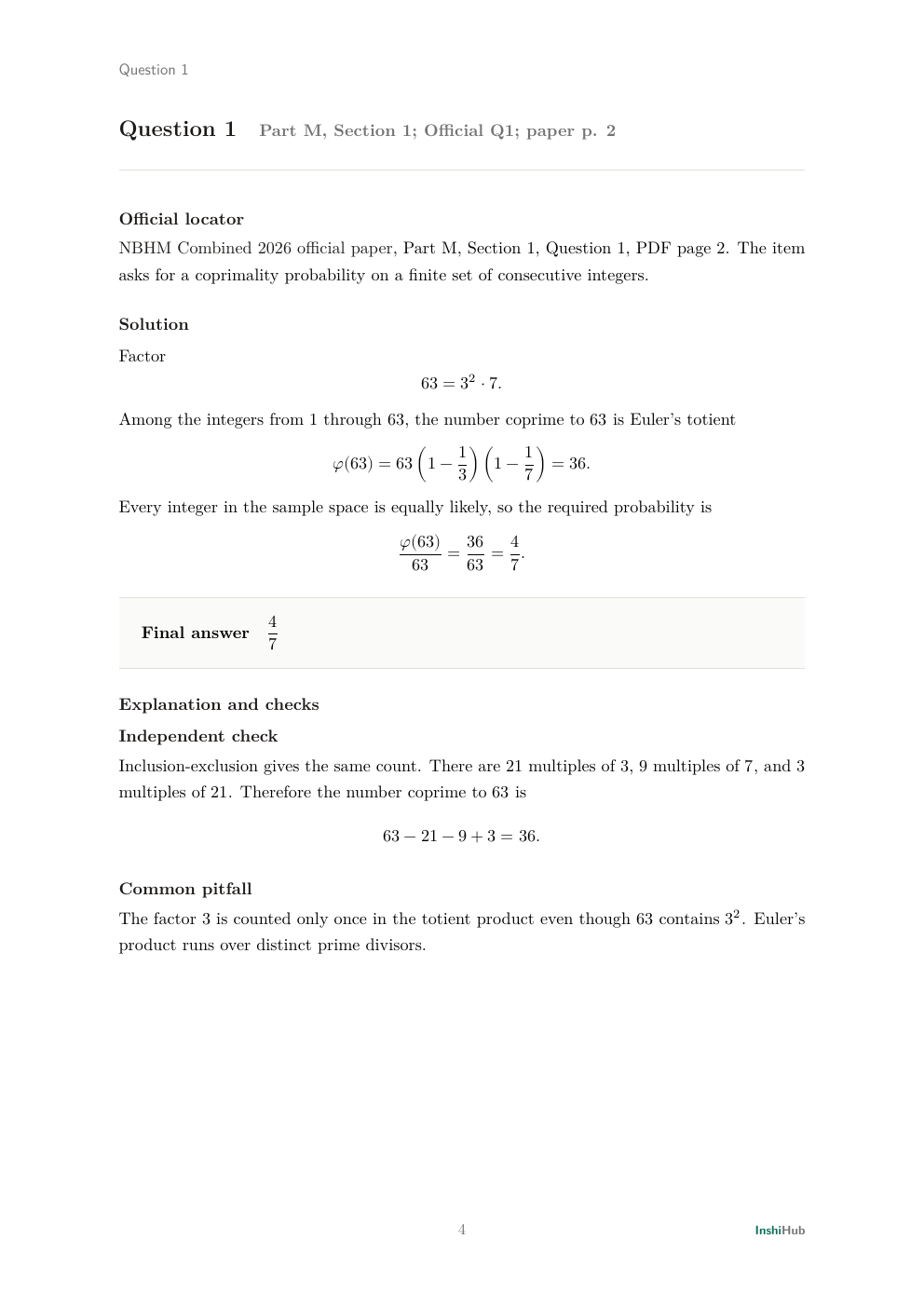
NBHM Combined 2026 Worked Solutions, preview page 1 of 6: Question 1 solution using Euler's totient formula to obtain the coprimality probability 4/7, followed by verification and a common-error note.
Preview page 2 of 6Sample · not the official paper
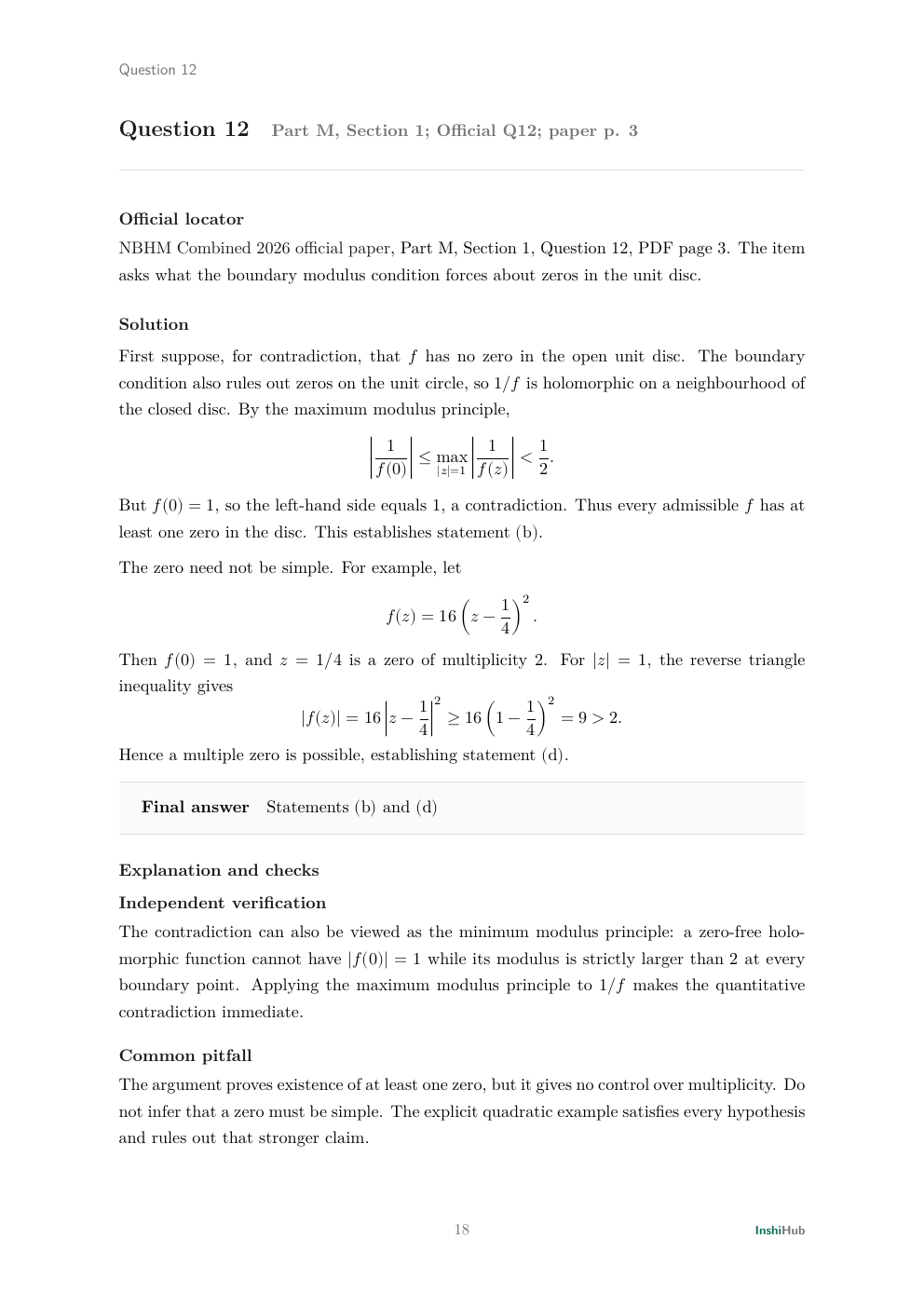
NBHM Combined 2026 Worked Solutions, preview page 2 of 6: Question 12 solution proving a zero exists in the unit disc and constructing an example with a double zero under the stated boundary condition.
Preview page 3 of 6Sample · not the official paper
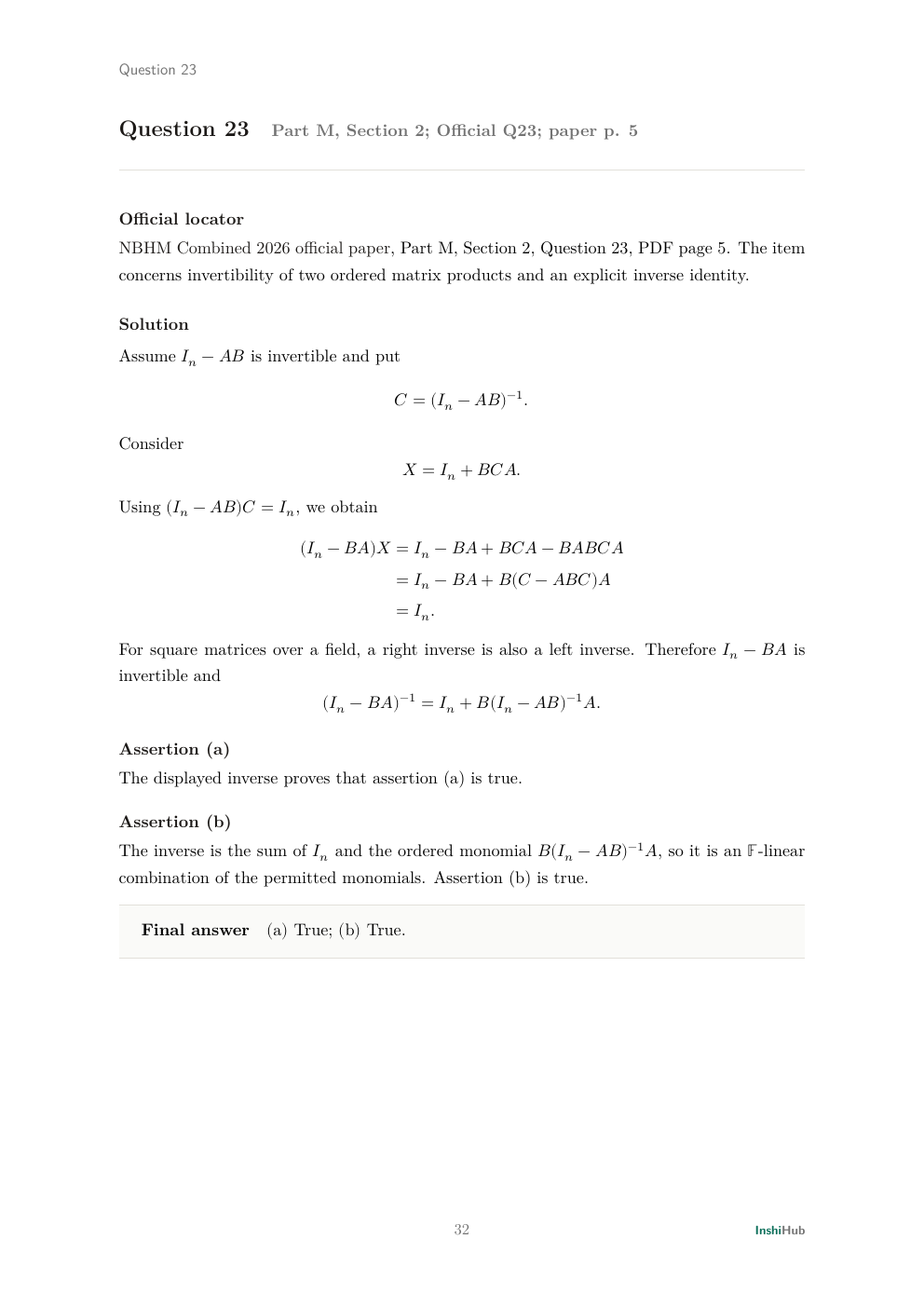
NBHM Combined 2026 Worked Solutions, preview page 3 of 6: Question 23 solution deriving the inverse identity for I minus BA from the invertibility of I minus AB.
Preview page 4 of 6Sample · not the official paper
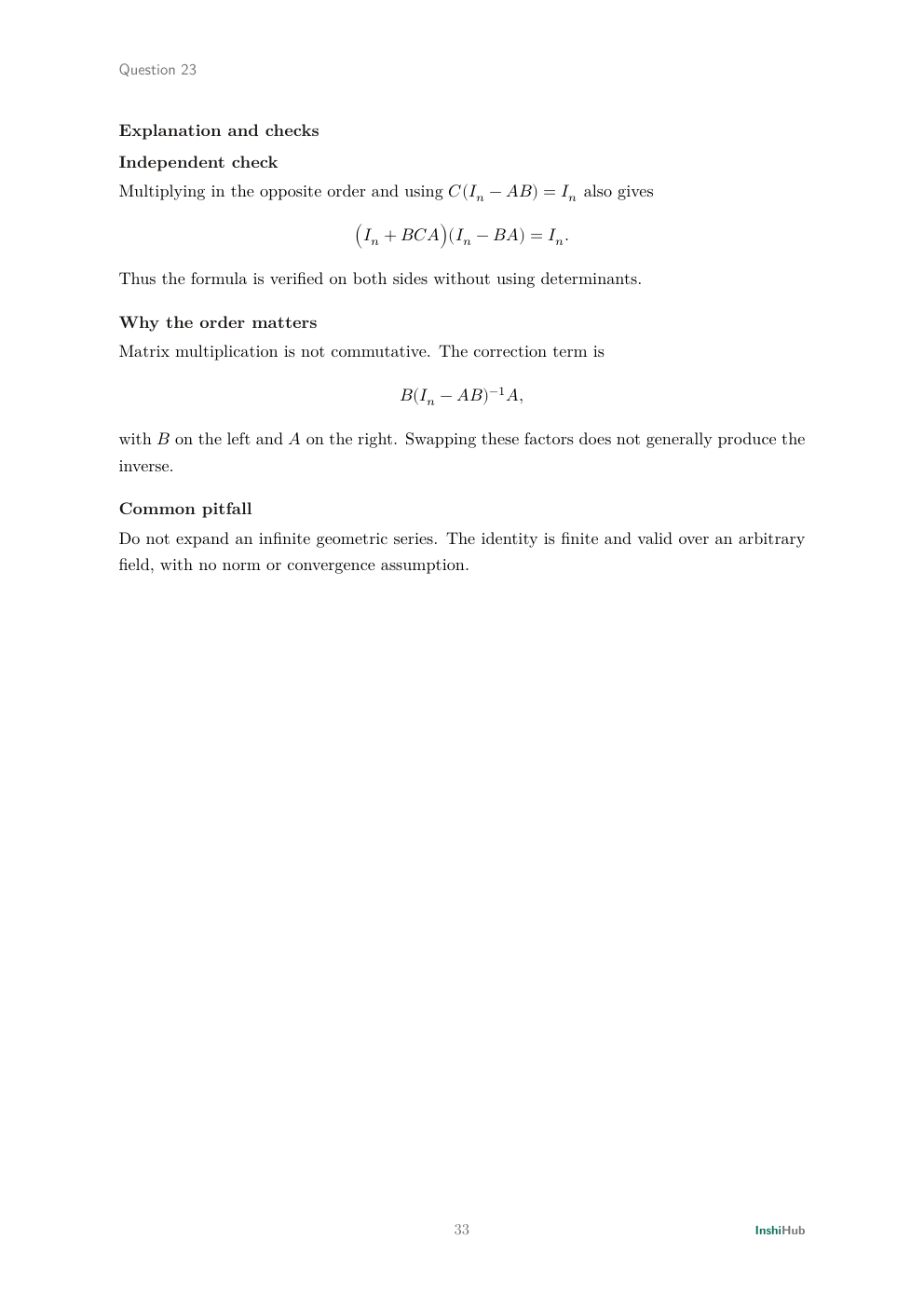
NBHM Combined 2026 Worked Solutions, preview page 4 of 6: Question 23 continuation verifying the matrix identity from both sides and explaining why factor order matters.
Preview page 5 of 6Sample · not the official paper
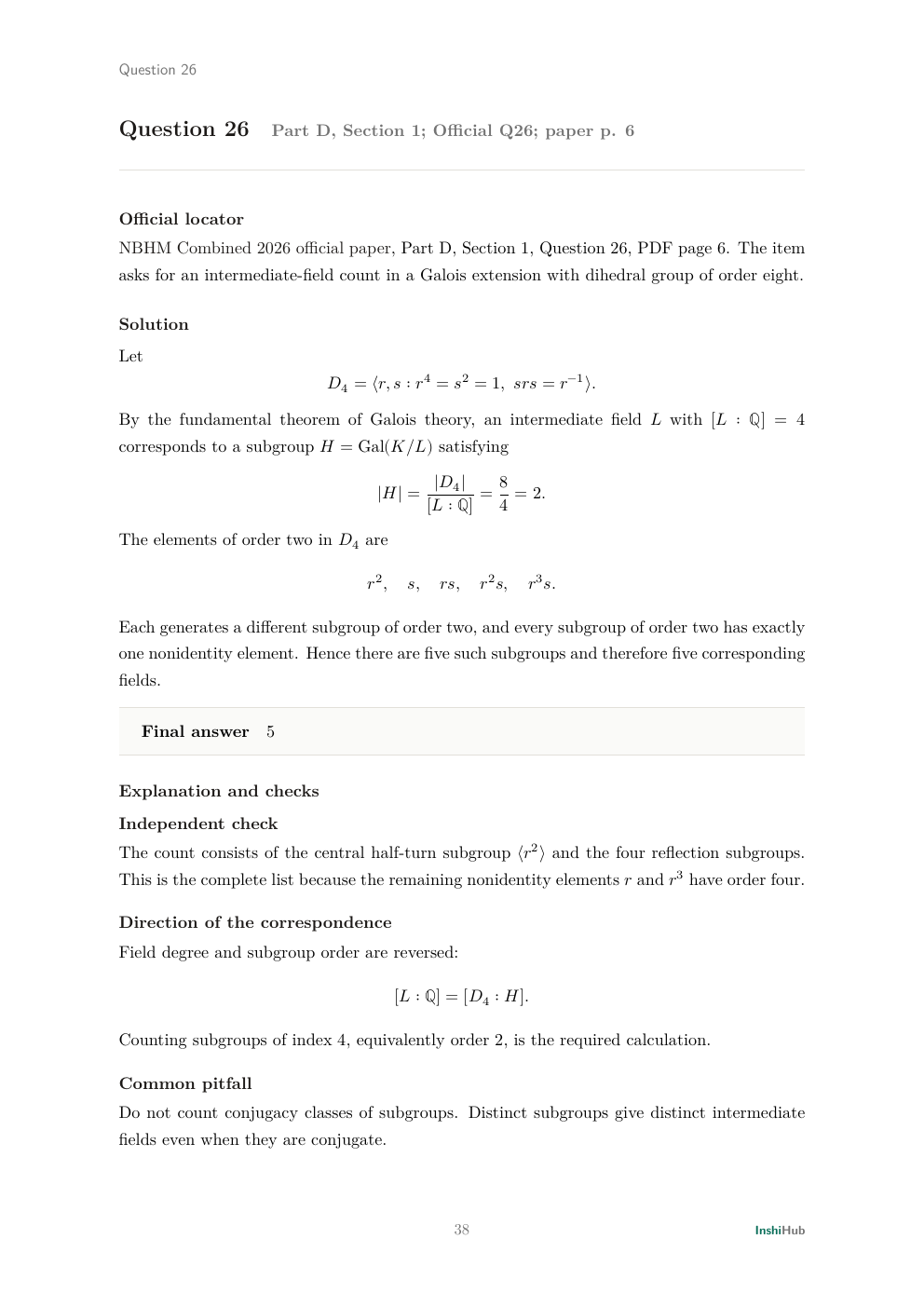
NBHM Combined 2026 Worked Solutions, preview page 5 of 6: Question 26 solution counting degree-four intermediate fields through the order-two subgroups of the dihedral Galois group D4.
Preview page 6 of 6Sample · not the official paper
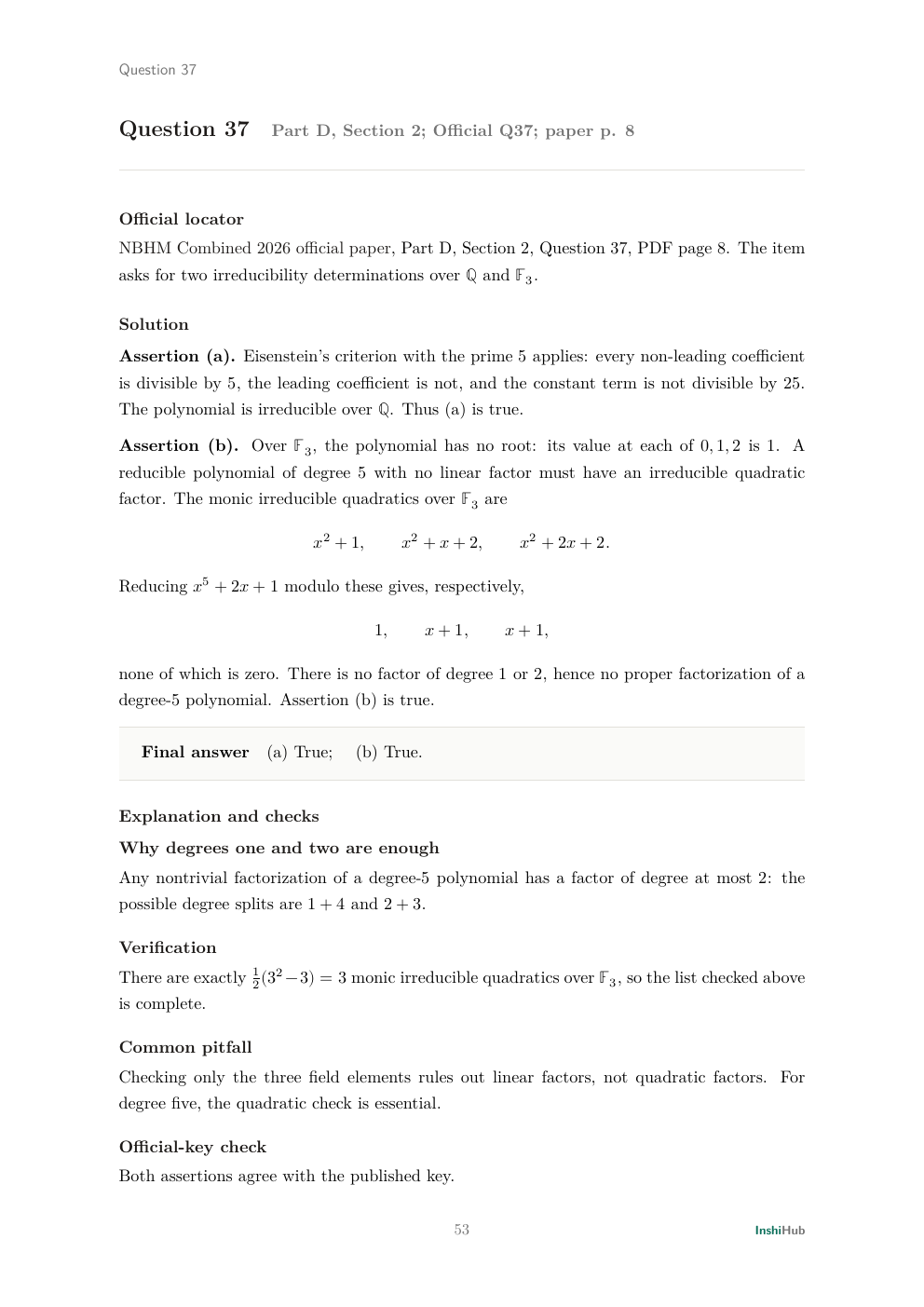
NBHM Combined 2026 Worked Solutions, preview page 6 of 6: Question 37 solution applying Eisenstein's criterion over the rationals and testing irreducible quadratic factors over the field with three elements.

Crawlable HTML samples

Three free NBHM Combined 2026 solutions

The summaries below are intentionally short and do not substitute for the official questions. Open the official paper from the source section, locate the stated problem, then use each sample as a worked explanation.

Free sample 1

Official problem 1 · Elementary number theory and probability

Review recorded
Source locator
Part M, Section 1, official problem 1, paper PDF page 2
Review note
Independently derived; exact enumeration checked; official-key match · 2026-07-27

Problem summary

Find the proportion of integers in the stated finite range that are relatively prime to the range endpoint.

Core idea

Count integers coprime to 63 with Euler's totient formula, then divide by the number of equally likely choices.

Derivation

  1. 1Factor the endpoint as 63 = 3² × 7.
  2. 2Euler's totient formula gives φ(63) = 63(1 − 1/3)(1 − 1/7) = 36.
  3. 3All 63 choices are equally likely, so the required probability is 36/63.
  4. 4Reduce the fraction to obtain 4/7.

Final answer

4/7

Free sample 2

Official problem 12 · Complex analysis and Rouché's theorem

Review recorded
Source locator
Part M, Section 1, official problem 12, paper PDF page 3
Review note
Editorial derivation checked against the official key · 2026-07-27

Problem summary

Use a strict boundary-modulus condition and one interior value to determine what must hold about zeros in the unit disc, and what multiplicity can occur.

Core idea

Compare f and f − 1 on the unit circle with Rouché's theorem, then construct an explicit function to test whether a multiple zero is possible.

Derivation

  1. 1On the unit circle, |f| > 2, so |f − (f − 1)| = 1 < |f|.
  2. 2Rouché's theorem says that f and f − 1 have the same number of zeros in the unit disc, counted with multiplicity.
  3. 3Because f(0) = 1, the function f − 1 has a zero at 0. Therefore f must have at least one zero in the disc.
  4. 4A double zero is possible: for a = 1/4, take f(z) = ((z − a)/a)². Then f(0) = 1 and, on |z| = 1, |f(z)| is at least 9, which is greater than 2.

Final answer

A zero in the unit disc is forced, and a double zero is possible; these correspond to statements (b) and (d) in the official paper.

Free sample 3

Official problem 23 · Linear algebra and matrix identities

Review recorded
Source locator
Part M, Section 2, official problem 23, paper PDF page 5
Review note
Editorial derivation checked against the official key · 2026-07-27

Problem summary

Transfer invertibility between I − AB and I − BA and express the second inverse using the first.

Core idea

Set C = (I − AB)⁻¹ and verify the candidate inverse I + BCA by direct multiplication.

Derivation

  1. 1Let C = (I − AB)⁻¹. From (I − AB)C = I, obtain C − I = ABC.
  2. 2Multiply (I − BA)(I + BCA).
  3. 3The non-identity terms combine as B(C − I − ABC)A, which is zero.
  4. 4Thus I + BCA is a right inverse of I − BA. For square matrices over a field, a right inverse is also the inverse.

Final answer

Both assertions in the official paper are true, with (I − BA)⁻¹ = I + B(I − AB)⁻¹A.

Full-edition scope

  • Original, step-by-step solution writing for all 40 problems
  • Reasoning and decisive derivation steps for every problem
  • Answer checks and common-error notes
  • Source locators that map every solution to the official paper
  • A dated correction process and public correction log after release

What is not included

  • The official question paper, figures, and answer-key text
  • Coaching, admissions advice, or a score guarantee
  • Affiliation with NBHM, the Department of Atomic Energy, or IMSc

Editorial quality system

Quality is a visible process, not a marketing adjective

1

Source mapping

Every entry carries a part, section, official problem number, and paper-page locator.

2

Independent derivation

Solutions are written from mathematical principles and checked against the official answer key without reproducing the paper.

3

Verification

Each entry includes a second check, a limiting case, or a reverse calculation wherever the problem permits.

4

Correction trail

Material corrections receive a dated note and a new content version.

Published-key discrepancy

Question 40 receives a separate proof, not a silent key match

The printed assumptions permit an exponent-integrability set equal to {1}. Read the complete baseline-and-spikes construction and compare it with the published response.

Read the Question 40 editorial note

Source and rights

Use the official paper alongside this guide

The source documents are published by National Board for Higher Mathematics and hosted by The Institute of Mathematical Sciences. InshiHub does not republish the paper, its figures, or its answer-key text.

Source accessed
2026-07-27
Source status
Publicly accessible source; no reuse licence located
InshiHub content
Independent writing; versioned separately

InshiHub is an independent study resource. It is not affiliated with, endorsed by, or sponsored by NBHM, the Department of Atomic Energy, or The Institute of Mathematical Sciences.

Transparent release status

Samples are public. The full offer is still in validation.

Publishing a useful page is not the same as accepting payment. Checkout will appear only after every gate below has recorded approval.

  • All 40 problem entries and 50 answer units completed
  • Independent mathematical review recorded
  • Rights review completed for paid distribution
  • Dodo merchant and product approval recorded
  • Exact Dodo transaction-seller entity and India responsibility allocation confirmed
  • Current Dodo Buyer Terms and privacy notice linked
  • INR, UPI or card, final tax display, delivery, refund, and order reconciliation tested

Paid access is under merchant review

For NBHM Combined 2026, the configured one-time catalogue price is ₹999, inclusive of applicable tax. Checkout stays disabled until the merchant, transaction-seller, INR payment, delivery, and refund checks are complete.

No release-alert form is active. InshiHub is not collecting email addresses or promising a release message until a verified double-opt-in email process is available.

Bookmark this page. The purchase button will replace this notice only after every published release gate passes.

Frequently asked questions

Before you use the samples

Does the guide include the official NBHM question paper?

No. It contains independently written solutions and short non-substituting summaries. Use the official IMSc repository for the question paper and answer key.

Can I buy the full 2026 guide now?

The 62-page edition is complete and the public samples are available. The purchase panel on this page is the authoritative source for current availability. It opens only after the transaction seller, price, consent, payment, delivery, portal-recovery, refund, and reconciliation checks have passed.

What will the full guide cost?

The standard catalogue price is ₹999 for a one-time purchase of this edition, inclusive of applicable tax. This is not a discount or a temporary crossed-out-price offer. Subject to merchant approval and live verification, checkout can be configured to display the final INR total before payment. Fermion will fulfil automatic PDF delivery through Dodo-hosted file access and customer-portal recovery.

How are mathematical errors handled?

Each released version will carry a dated correction trail. Confirmed material errors will be corrected in a new content version and communicated to eligible customers.

Is InshiHub affiliated with NBHM or IMSc?

No. InshiHub is an independent study resource and is not affiliated with, endorsed by, or sponsored by NBHM, the Department of Atomic Energy, or The Institute of Mathematical Sciences.