
InshiHubIndia
Doctoral 2020 editionEnglish · IndiaComplete 76-page edition

NBHM Doctoral 2020 worked solutions

Prepare for NBHM Doctoral and PhD-level mathematics with independent derivations for all 36 numbered questions and 93 addressable response units. Read three complete solutions in searchable HTML and inspect six pages from the current guide while paid access remains under validation.

36 worked questions · 93 response unitsExact official source locatorsSection-aware mathematical review

Six-page visual preview

Inspect six pages from the Doctoral guide

The six preview slots cover Questions 1, 15, 19, 23, 31, and 36 from the current 76-page manuscript. Every preview is an InshiHub explanation page, never a scan of the official paper or answer key.

Preview page 1 of 6Sample · not the official paper
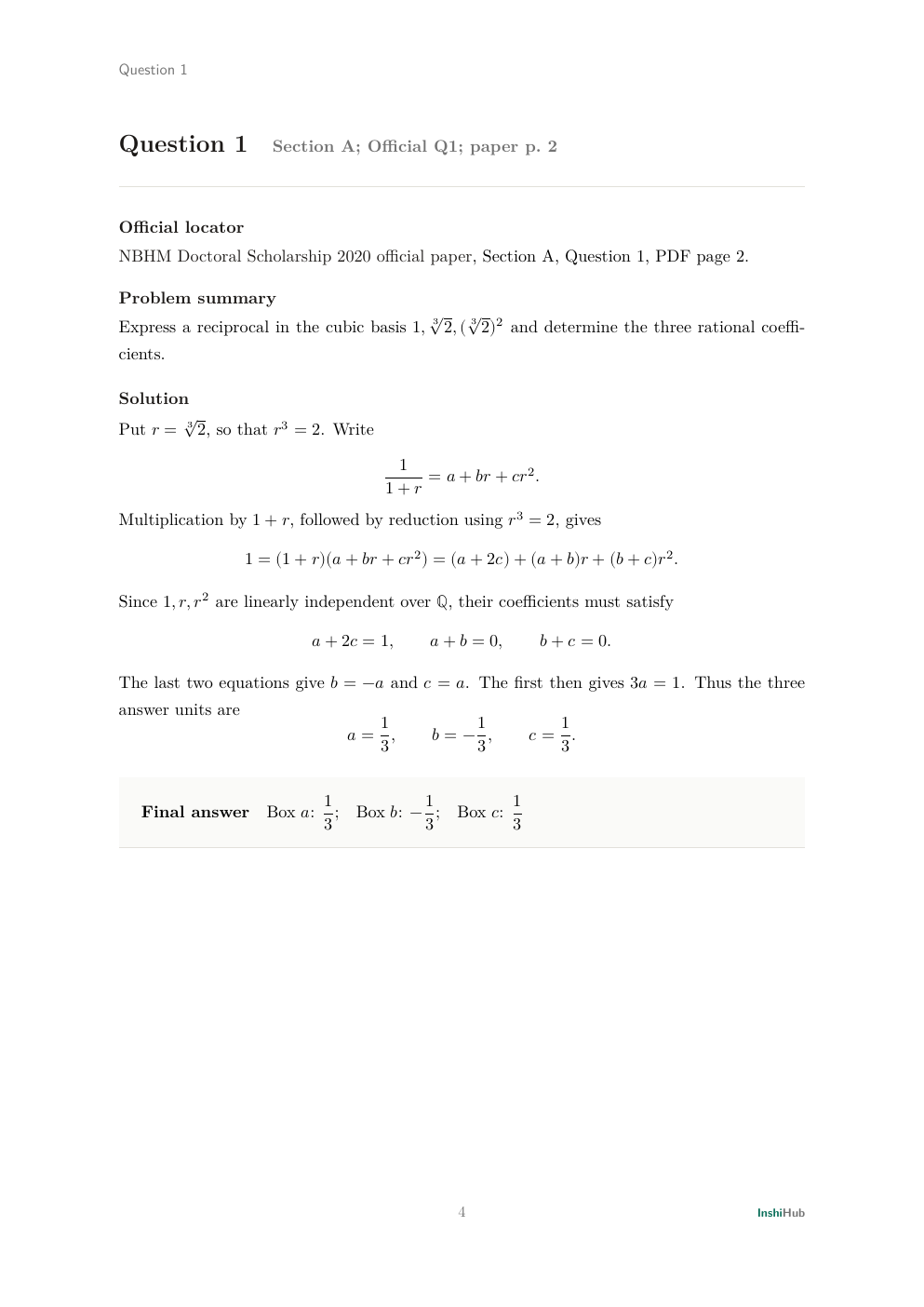
NBHM Doctoral 2020 Worked Solutions, preview page 1 of 6: Question 1 solution deriving three rational coefficients in a cubic number field.
Preview page 2 of 6Sample · not the official paper
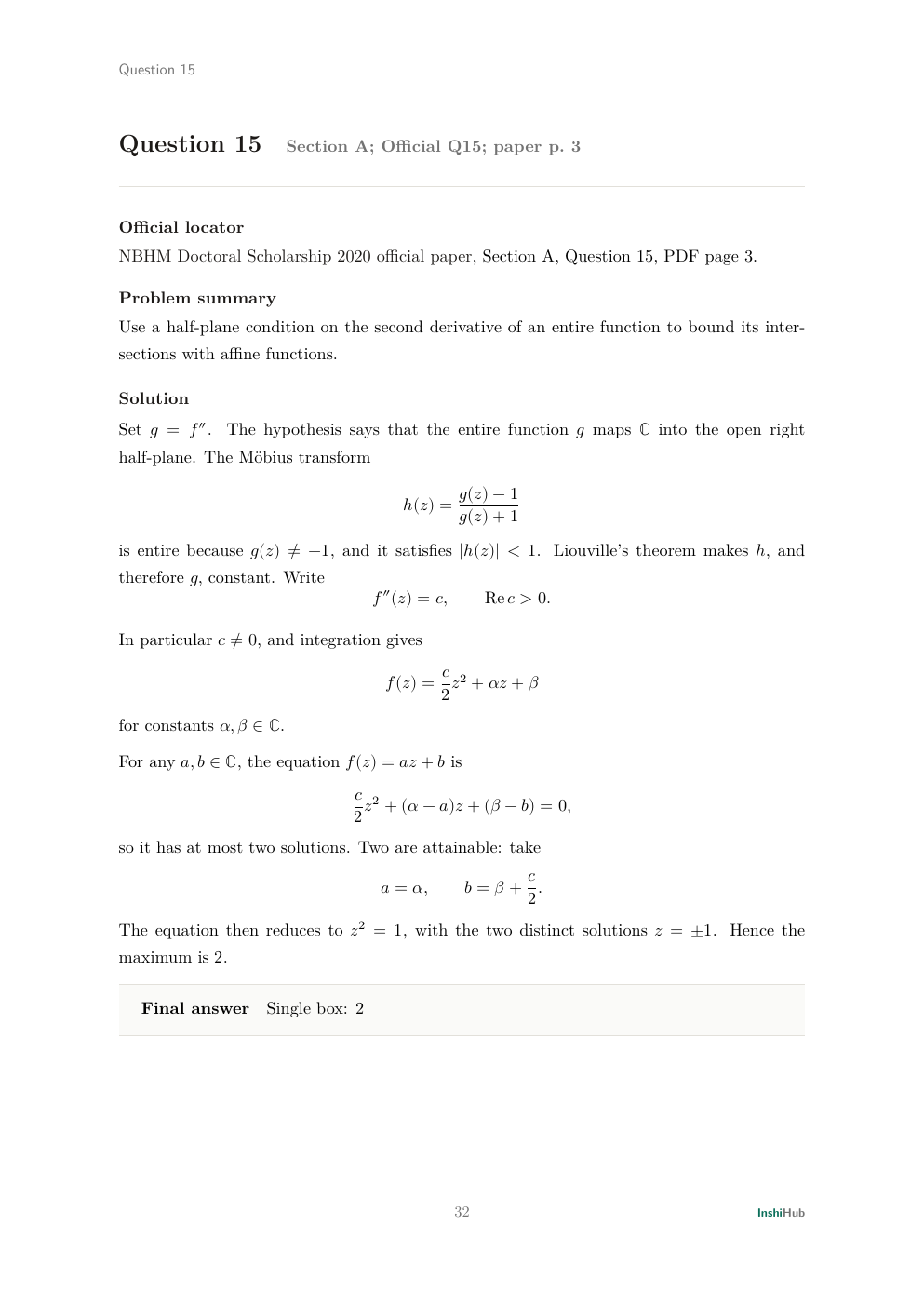
NBHM Doctoral 2020 Worked Solutions, preview page 2 of 6: Question 15 solution using a half-plane transform and Liouville's theorem.
Preview page 3 of 6Sample · not the official paper
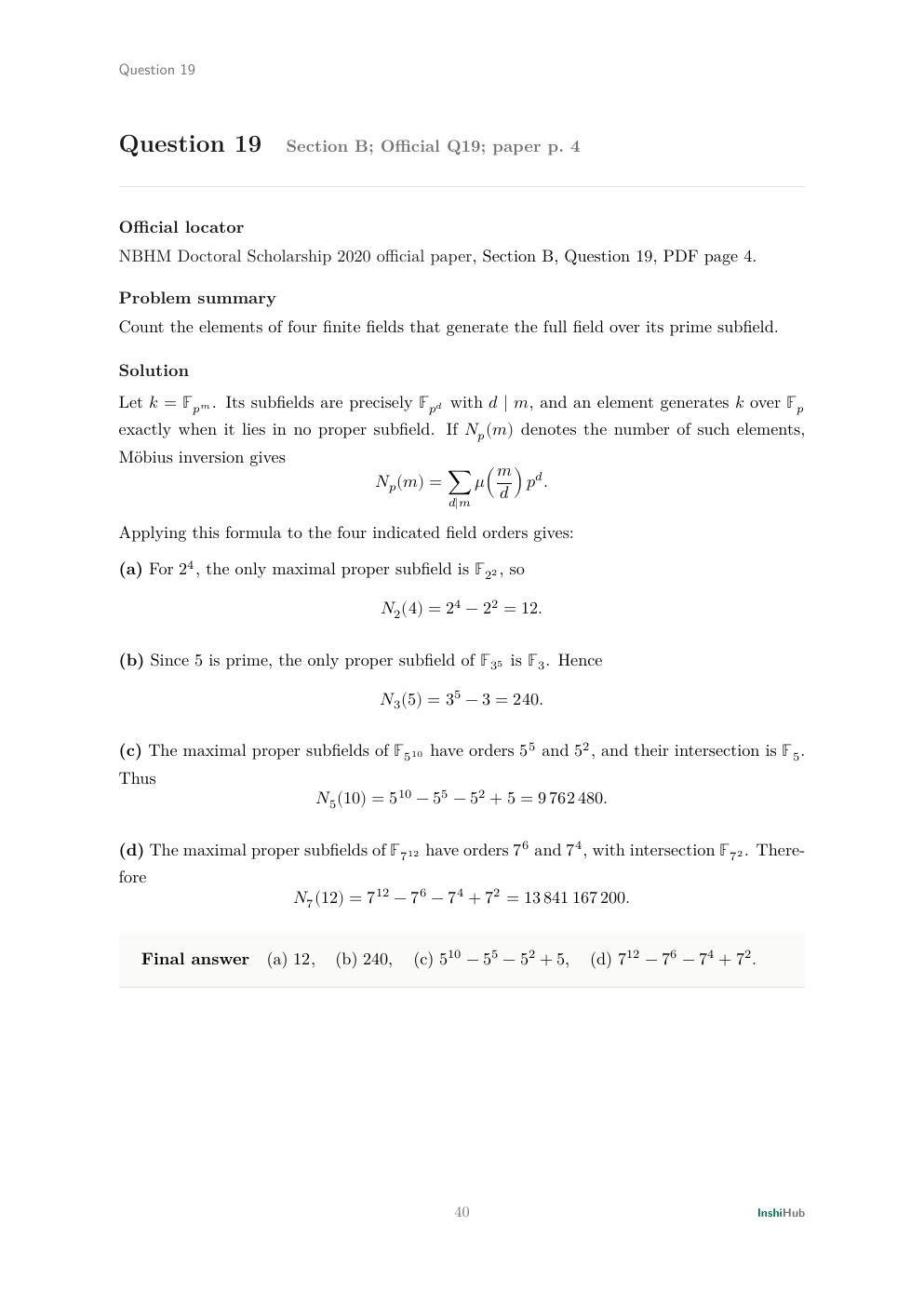
NBHM Doctoral 2020 Worked Solutions, preview page 3 of 6: Question 19 solution counting full-degree generators of four finite fields.
Preview page 4 of 6Sample · not the official paper
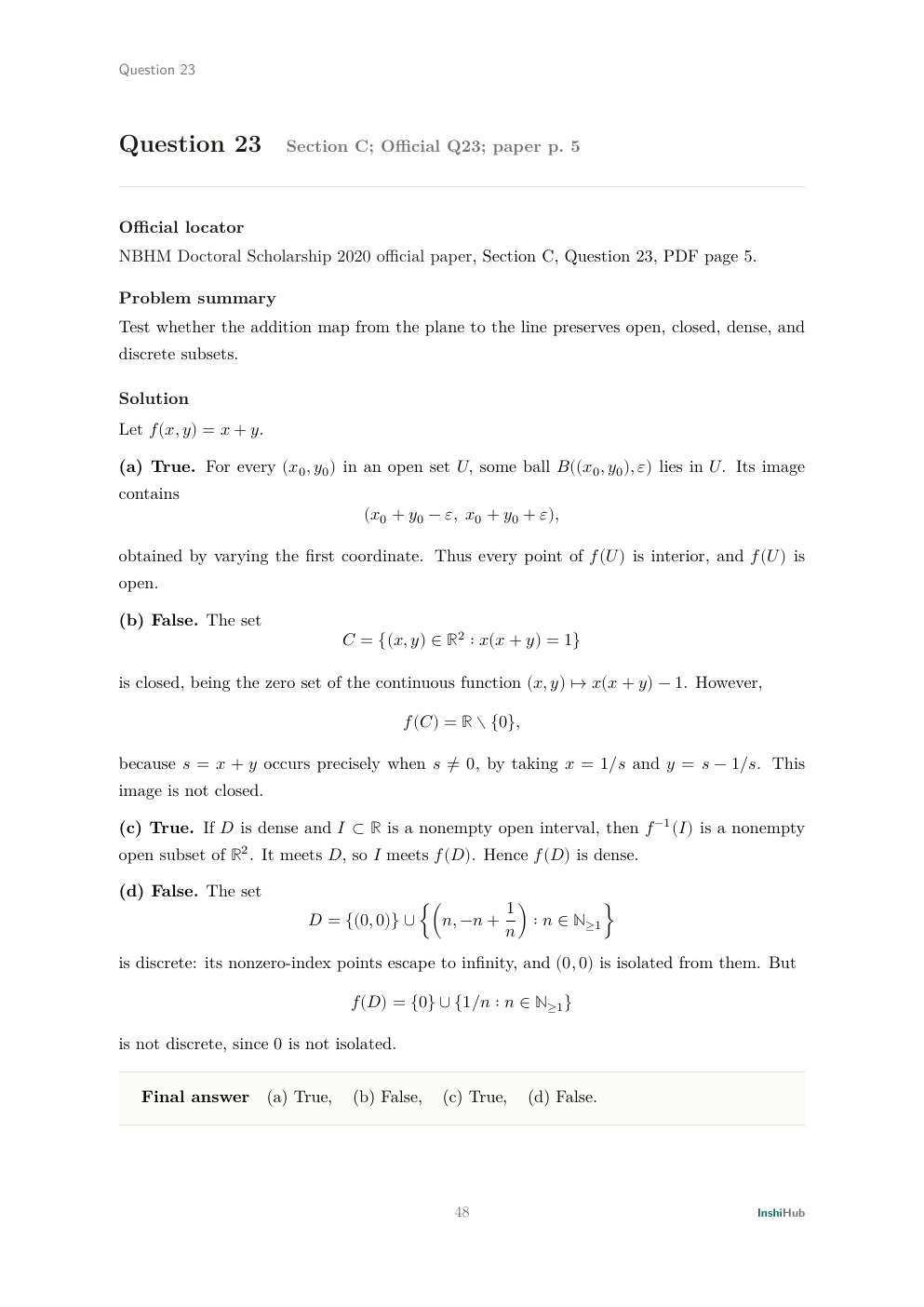
NBHM Doctoral 2020 Worked Solutions, preview page 4 of 6: Question 23 solution testing how a linear map treats open, closed, dense, and discrete sets.
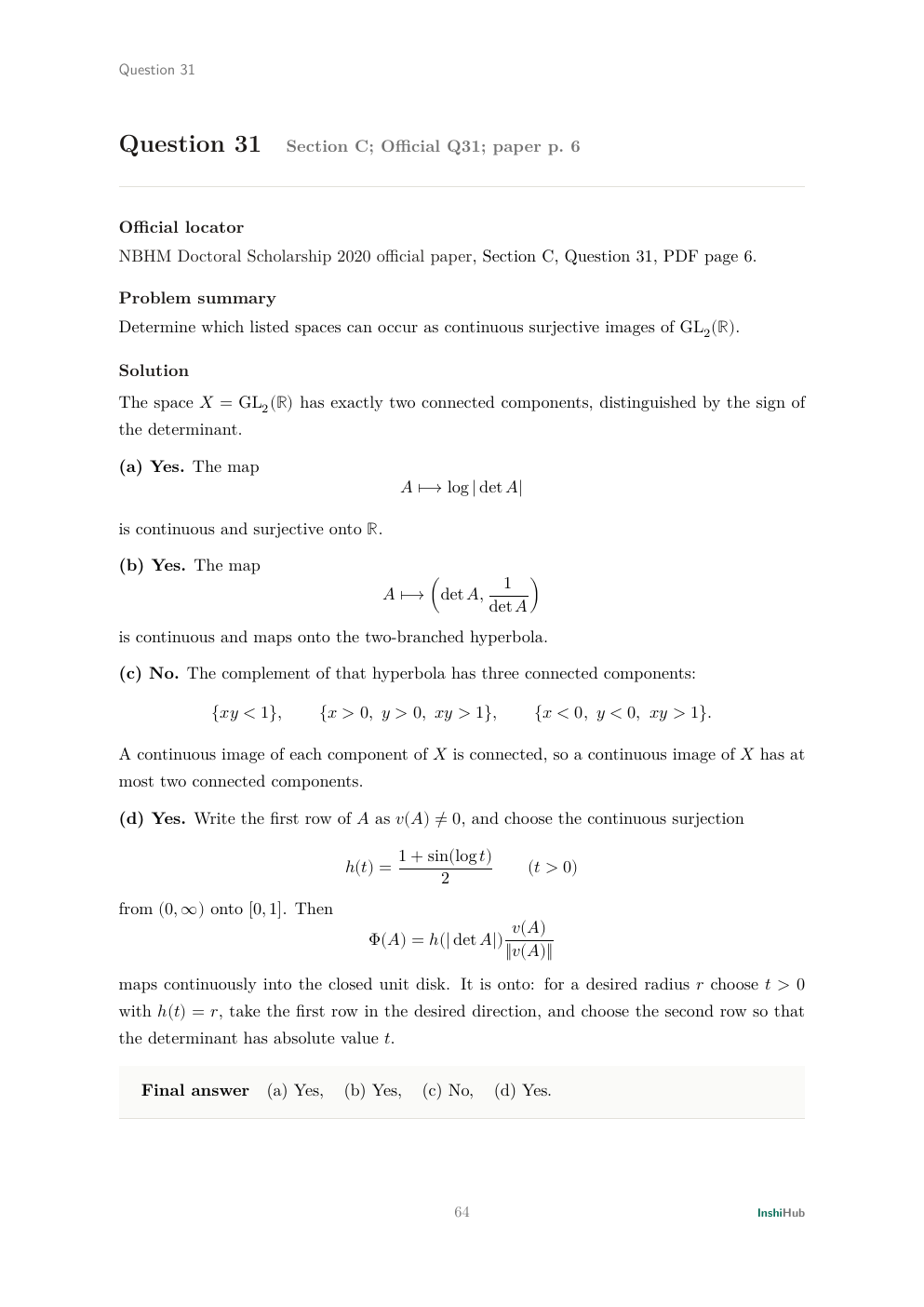
Preview page 5 of 6Sample · not the official paper
NBHM Doctoral 2020 Worked Solutions, preview page 5 of 6: Question 31 solution constructing continuous images of the real general linear group.
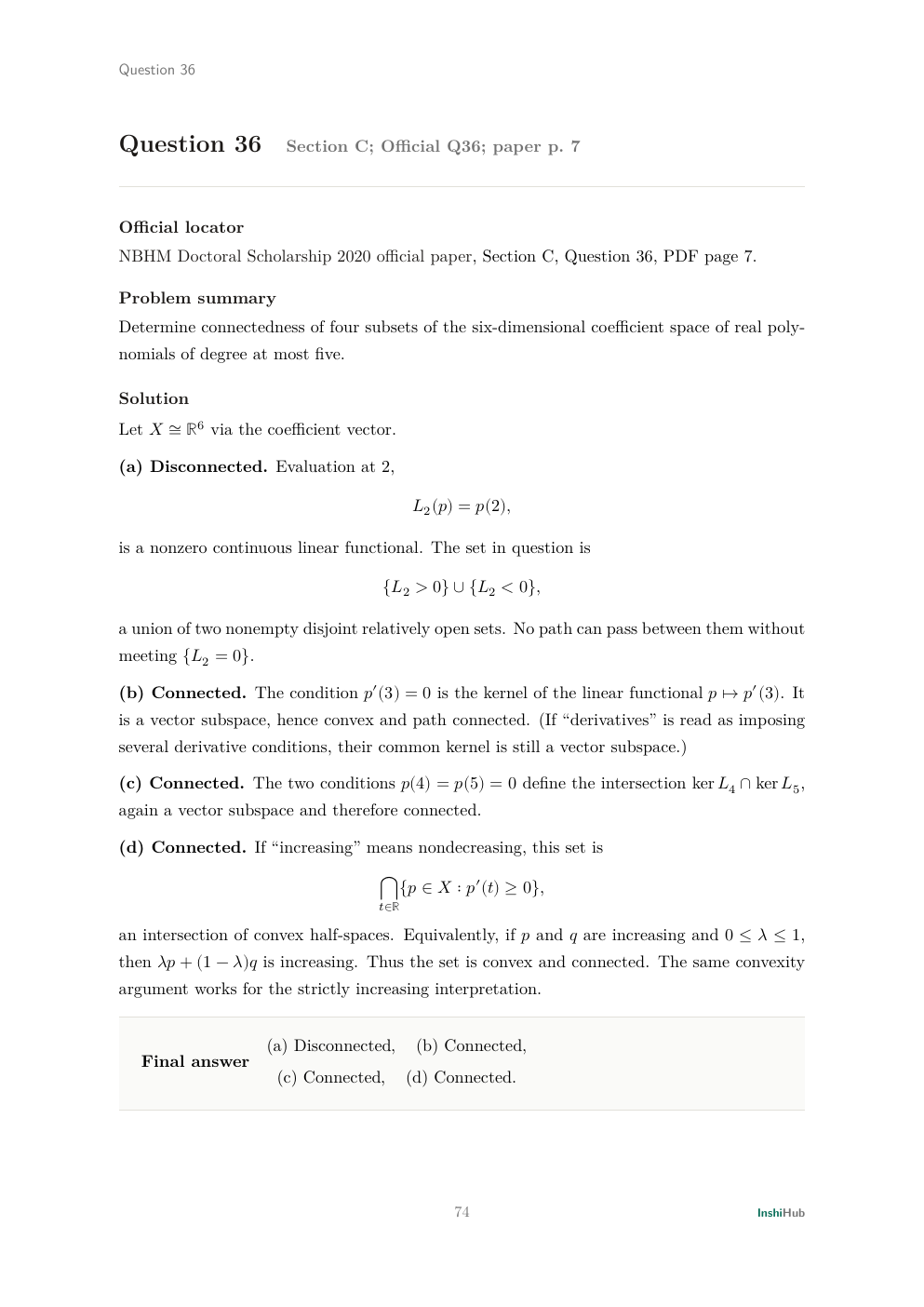
Preview page 6 of 6Sample · not the official paper
NBHM Doctoral 2020 Worked Solutions, preview page 6 of 6: Question 36 solution classifying connected subsets of a polynomial coefficient space.

Crawlable HTML samples

Three free NBHM Doctoral 2020 solutions

Each summary identifies the mathematical task without replacing the official question. Open the source paper at the precise locator, attempt the problem, and then audit your reasoning against the derivation, check, and common-error note below.

Free sample 1

Official problem 1 · A reciprocal in a cubic number field

Review recorded
Source locator
Section A, official problem 1, three response boxes, paper PDF page 2
Review note
Independently derived; all three response boxes checked; official-key match · 2026-07-28

Problem summary

Express a reciprocal in the rational basis generated by a real cube root and determine the three coefficients.

Core idea

Treat the cube root as a degree-three algebraic element, multiply by the denominator, reduce the cubic power, and compare coefficients in the basis 1, r, r squared.

Derivation

  1. 1Let r be the real cube root of 2 and write the reciprocal as a + br + cr squared.
  2. 2Multiplication by 1 + r and reduction using r cubed = 2 gives constant coefficient a + 2c, r coefficient a + b, and r-squared coefficient b + c.
  3. 3Independence of 1, r, and r squared gives the system a + 2c = 1, a + b = 0, and b + c = 0.
  4. 4The last two equations give b = -a and c = a; the first then gives 3a = 1.
  5. 5Therefore a = 1/3, b = -1/3, and c = 1/3.

Final answer

The three boxes are a = 1/3, b = -1/3, and c = 1/3.

Free sample 2

Official problem 21 · Arithmetic of the residue ring modulo 2020

Review recorded
Source locator
Section B, official problem 21, units (a)-(d), paper PDF page 4
Review note
Independently derived; divisor, totient, torsion, and nilpotent counts checked; official-key match · 2026-07-28

Problem summary

Count four algebraic classes in a finite residue ring: ideals, units, elements with a power equal to one, and nilpotents.

Core idea

Factor the modulus as 2 squared times 5 times 101, then combine divisor counting, Euler's totient, finite-group torsion, and the radical criterion for nilpotence.

Derivation

  1. 1The factorisation 2020 = 2 squared times 5 times 101 gives (2 + 1)(1 + 1)(1 + 1) = 12 ideals.
  2. 2Euler's product gives 2020 times 1/2 times 4/5 times 100/101 = 800 units.
  3. 3An element whose positive power is one is a unit; conversely every unit lies in the finite group of units and has finite order, so this count is also 800.
  4. 4A nilpotent residue must be divisible by every prime divisor of 2020, hence by 1010.
  5. 5Only the classes 0 and 1010 satisfy that condition, so there are 2 nilpotents.

Final answer

Units (a)-(d): 12, 800, 800, and 2.

Free sample 3

Official problem 33 · Fixed points of surjective self-maps

Review recorded
Source locator
Section C, official problem 33, units (a)-(d), paper PDF page 7
Review note
Independently derived; fixed-point proofs and component-swap counterexample checked; official-key match · 2026-07-28

Problem summary

Decide which connected or disconnected subspaces of the real line force every continuous surjective self-map to have a fixed point.

Core idea

Use the sign of f(x) - x on intervals and rays, construct a component-swapping counterexample for two compact intervals, and use compactness to block a swap with an unbounded component.

Derivation

  1. 1On a compact interval, endpoint signs for f(x) - x force a zero by the intermediate value theorem.
  2. 2Two compact interval components can be exchanged by explicit affine maps, producing a continuous surjection with no fixed point.
  3. 3On a closed ray, a fixed-point-free difference would have constant sign; the endpoint rules out the negative sign and surjectivity rules out the positive sign.
  4. 4For a compact interval joined disjointly to a ray, the compact component cannot cover the unbounded component.
  5. 5The components must therefore map to themselves, and the compact interval restriction has a fixed point.

Final answer

Units (a)-(d): Yes, No, Yes, and Yes.

Examination structure

Why 36 questions contain 93 response units

The official booklet combines multi-box short answers with independently marked classification parts. The guide preserves both the numbered-question count and the response-field count so that every derivation maps to the correct scoring context.

Questions 1–18

Section A

21 response fields

Each numbered question is worth four marks. Multi-box questions are scored jointly, with no partial credit.

Questions 19–22

Section B

16 independently marked parts

Each part is worth one mark. Partial credit is available and incorrect responses have no penalty.

Questions 23–36

Section C

56 independently marked parts

Each correct part earns one mark, each incorrect response loses one mark, and an unanswered part earns zero.

Full-edition scope

  • Original, step-by-step solutions for all 36 numbered questions
  • Separate reasoning for all 93 addressable response units
  • Section-aware treatment of all-or-nothing, partial-credit, and negative-marking rules
  • Verification, counterexamples, boundary cases, and problem-specific common-error notes
  • Section, question, response-unit, and paper-page locators for every solution
  • An explicit first-derivative interpretation note for the wording of Question 36(b)
  • A dated correction process and public correction log after release

What is not included

  • The official question paper, figures, logos, and answer-key text
  • Any claim that InshiHub's Question 36(b) interpretation is an official erratum
  • Coaching, admissions advice, or any score guarantee
  • Affiliation with NBHM, the Department of Atomic Energy, or IMSc

Editorial quality system

Every answer is derived, challenged, and source-mapped

1

Exact source mapping

Every solution identifies its official section, question number, response units, and paper page without copying the question.

2

Independent mathematics

Each result is derived from first principles before the final answer is compared with the official key.

3

Scoring-aware review

The guide distinguishes Section A's jointly scored boxes from the independently marked parts and negative marking in Sections B and C.

4

Release accountability

The edition is versioned, material corrections are dated, and paid access remains separate from editorial publication.

Review boundary

Public mathematics and paid access are separate states

The guide page and free samples can be public while commercial validation remains incomplete. Seller accountability and end-to-end delivery approval are required before any payment control may be introduced.

Official sources, provenance, and rights

Read the official paper alongside the independent guide

National Board for Higher Mathematics publishes the source documents, which are hosted by The Institute of Mathematical Sciences. InshiHub links to that archive but does not republish its paper, figures, logos, or answer-key text.

Question 36(b) interpretation note

The source phrase is read as the single first-derivative condition p'(3) = 0. Under that reading the admissible set is a linear subspace and is connected. A stronger reading that imposes several derivative conditions still gives an intersection of linear kernels and the same classification. InshiHub does not present this as an official correction.

Source accessed
2026-07-28
Source status
Publicly accessible source; no reuse licence located
InshiHub content
Independent writing; versioned separately
Official paper SHA-256
7503f20c5db5e141364dd9753e382c27cc82afeebd114156f75e10e20a9e06e4
Official answer-key SHA-256
f9181d98f0d5d5c6a2d81c11dbf90937ba442ef9730032f49c1722fbe5adc692

InshiHub is an independent study resource. It is not affiliated with, endorsed by, or sponsored by NBHM, the Department of Atomic Energy, or The Institute of Mathematical Sciences.

Transparent release status

Free samples are public. Paid access remains disabled.

The 2020 edition remains in validation. Publishing this page does not accept payment or create an order. Paid access may appear only after every recorded gate below passes for this exact edition.

  • All 36 numbered questions and 93 response units completed
  • Independent mathematical review recorded across all sections
  • Question 36(b) interpretation and source label verified
  • Rights review completed for paid distribution
  • Merchant and 2020 edition approval recorded
  • Exact transaction-seller entity and India responsibility allocation confirmed
  • Current buyer terms and privacy notice linked
  • INR final-price display, payment, delivery, refund, and order reconciliation tested

Frequently asked questions

NBHM Doctoral 2020 guide details

Does this guide reproduce the official NBHM Doctoral 2020 paper?

No. It contains independently written solutions and short, non-substituting topic summaries. Use the official IMSc archive links on this page for the question paper and answer key.

What is covered in the NBHM Doctoral 2020 solution guide?

The current 76-page edition covers all 36 numbered questions and all 93 addressable response units, with source locators, complete derivations, verification, and problem-specific error notes.

Why does the guide show both questions and response units?

The paper has 36 numbered questions but 93 physical response fields. Section A includes multi-box questions that are jointly scored, while Sections B and C mark their four parts independently.

How does the guide handle the wording of Question 36(b)?

It states the natural first-derivative reading p'(3) = 0 and notes that the connectedness conclusion remains unchanged under a stronger multiple-derivative reading. InshiHub does not present this as an official erratum.

Is the complete 2020 guide available for paid access now?

Not yet. The editorial page and free samples are public, but paid access remains disabled while seller, tax, payment, delivery, refund, and reconciliation validation is incomplete.

What is the configured price for the complete 2020 guide?

The configured one-time catalogue price is ₹999, inclusive of applicable tax. It is not a temporary discount or a crossed-out-price promotion. Paid access can appear only after the exact 2020 edition passes every recorded release gate.

How were the answers checked?

Every response unit was independently derived before comparison with the official key. Mathematical review records derivations, counterexamples, boundary cases, and source interpretations separately.

Is InshiHub affiliated with NBHM or IMSc?

No. InshiHub is an independent study resource and is not affiliated with, endorsed by, or sponsored by NBHM, the Department of Atomic Energy, or The Institute of Mathematical Sciences.