
Free sample 1
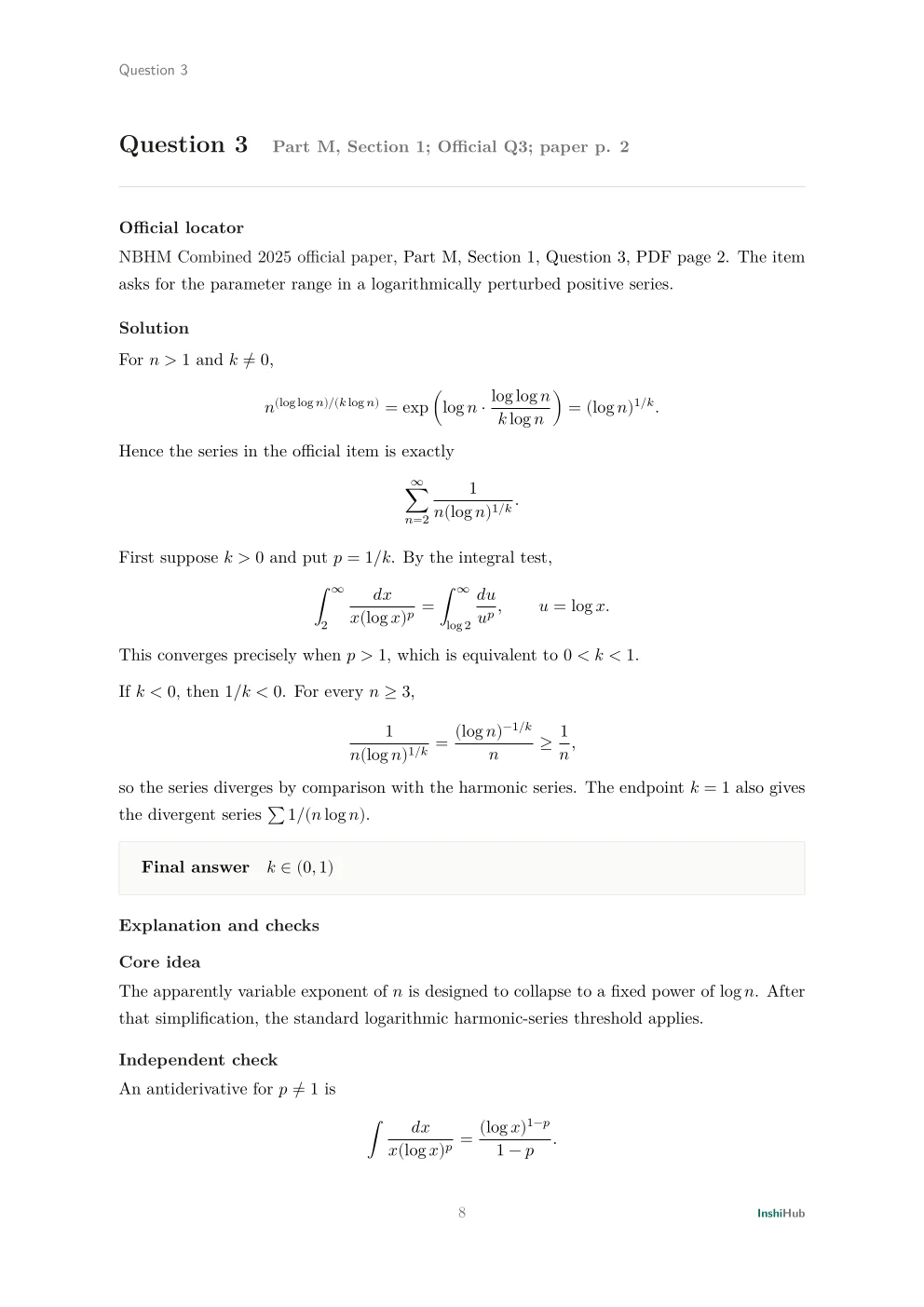
Official problem 3 · Series convergence and logarithmic thresholds
- Source locator
- Part M, Section 1, official problem 3, paper PDF page 2
- Review note
- Independently derived; integral threshold checked; official-key match · 2026-07-28
Problem summary
Determine the nonzero parameter range for convergence of a positive series whose exponent contains both log n and log log n.
Core idea
Collapse the variable exponent into a fixed power of log n, then apply the logarithmic harmonic-series threshold.
Derivation
- 1Exponentiation gives n^((log log n)/(k log n)) = (log n)^(1/k).
- 2The series therefore becomes the standard form sum 1/[n(log n)^(1/k)].
- 3For k > 0, the integral test converges exactly when 1/k > 1, giving 0 < k < 1.
- 4For k < 0 the terms dominate 1/n, while k = 1 gives the divergent boundary series 1/(n log n).
Final answer
The series converges exactly for k in (0, 1).