
Section 1
Algebra
1.1–1.10
Groups, rings, linear algebra, field structure, and spectral arguments.
Prepare for NBHM Doctoral and PhD-level mathematics with independent derivations for all 50 numbered questions and 51 addressable solution prompts. Read three complete solutions in searchable HTML, inspect six guide pages, and understand the original best-four-of-five scoring rule before practising.
Direct format answer
The 150-minute paper contained five subject sections of ten one-point questions. All 50 questions could be attempted, but only the best four section totals counted, giving a maximum counted score of 40. When one numbered question requested multiple answers, every requested answer was required for that point; no partial credit was provided.
Test date
20 January 2018
Working time
150 minutes
Paper structure
5 sections × 10 questions
Question value
1 point per numbered question
Counted result
Best 4 section scores
Maximum counted score
40 points
Question count is not a physical-answer-field count
The guide has 51 addressable solution prompts. This is because Question 5.1 contains separately explained parts inside the numbered, one-point question entries. The archived paper refers to a separate answer booklet but does not establish its physical field count, so this page does not invent one.
Each section contributes ten numbered questions. The guide keeps the printed dotted labels so a learner can move directly between an official question and the matching explanation.
Section 1
1.1–1.10
Groups, rings, linear algebra, field structure, and spectral arguments.
Section 2
2.1–2.10
Real and complex analysis, measure, sequences, series, and function spaces.
Section 3
3.1–3.10
Continuity, compactness, connectedness, quotient ideas, and metric spaces.
Section 4
4.1–4.10
Multivariable calculus, integration, ordinary differential equations, and boundary-value problems.
Section 5
5.1–5.10
Probability, combinatorics, geometry, optimisation, and mixed reasoning.
Six-page visual preview
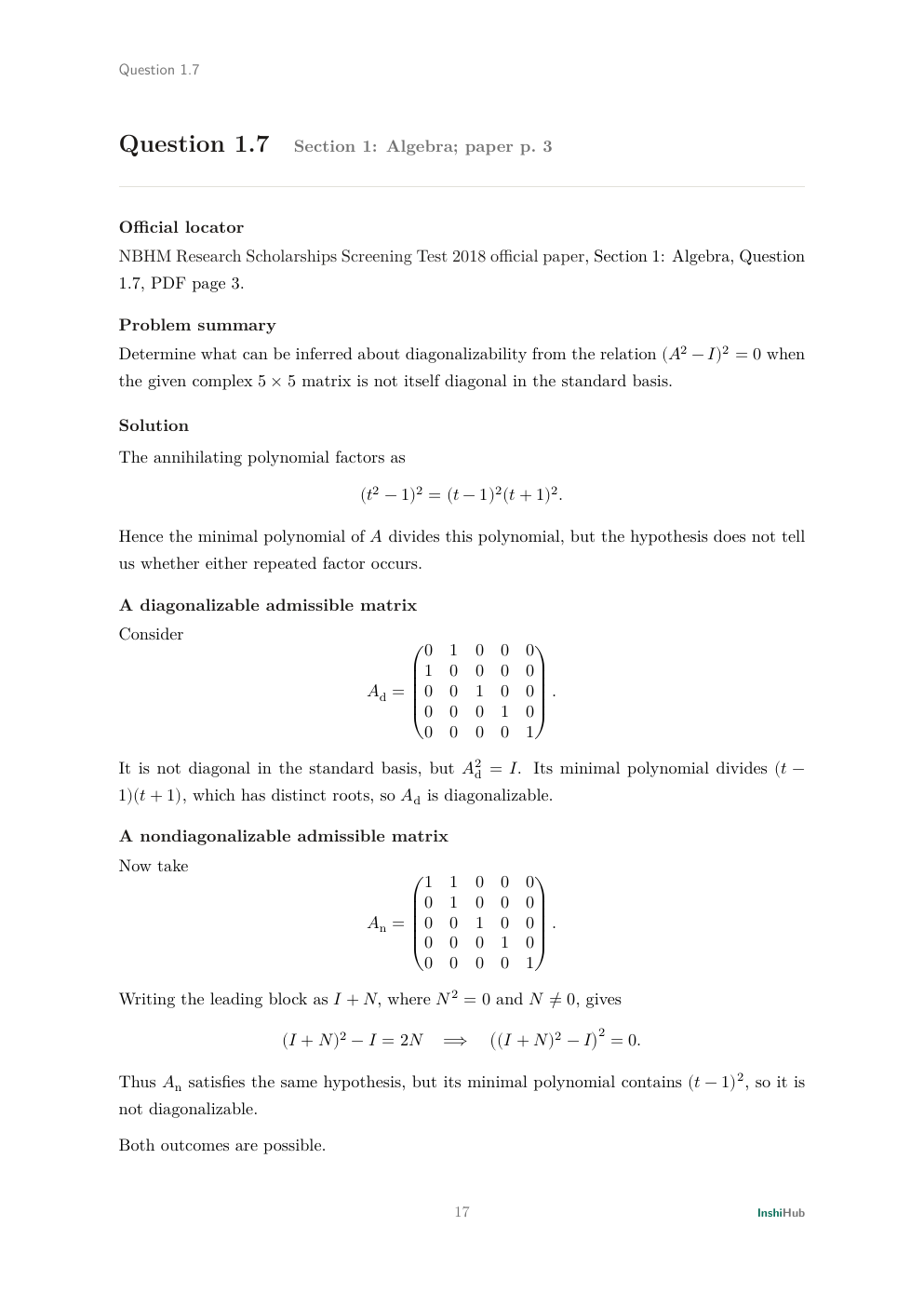
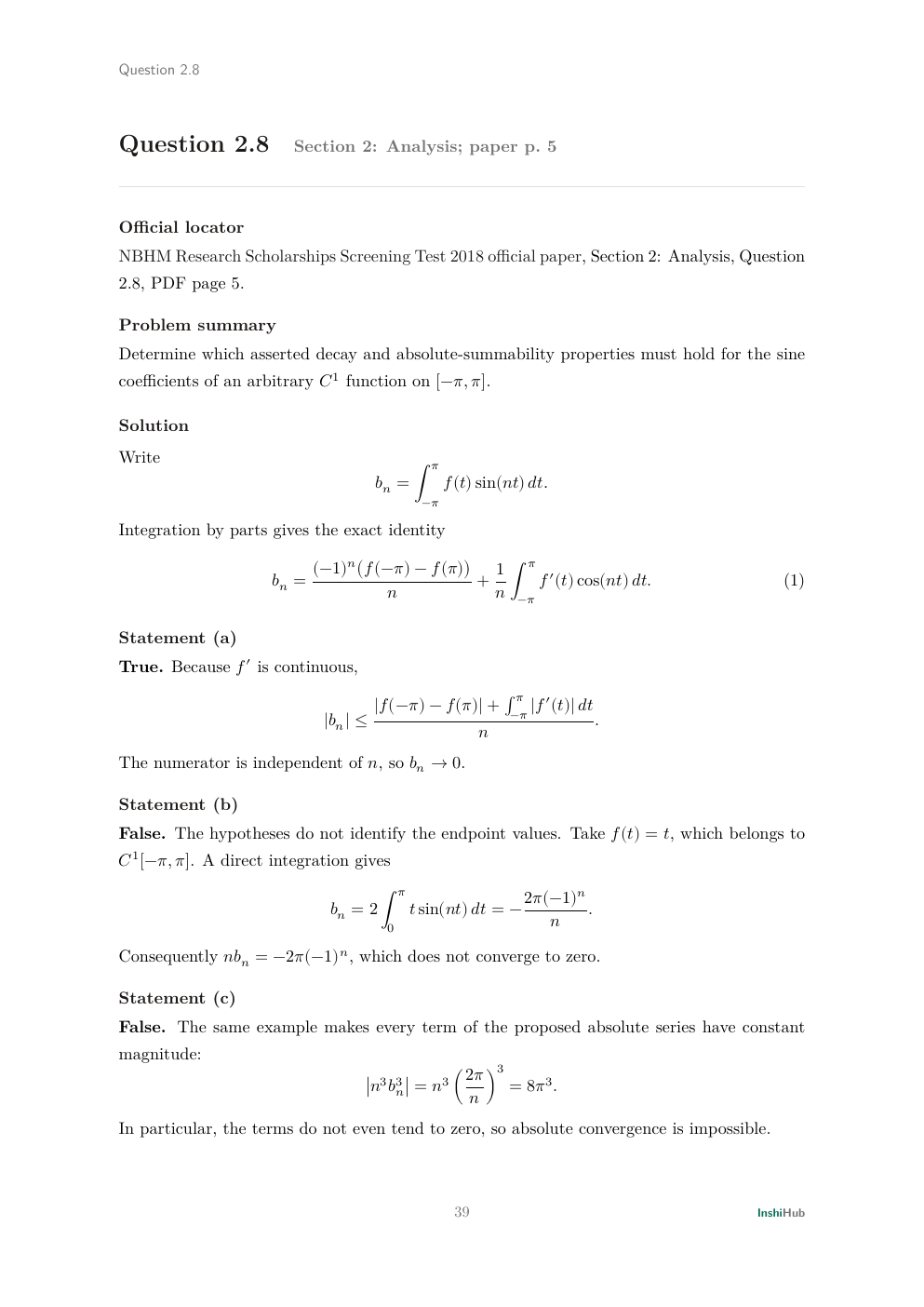
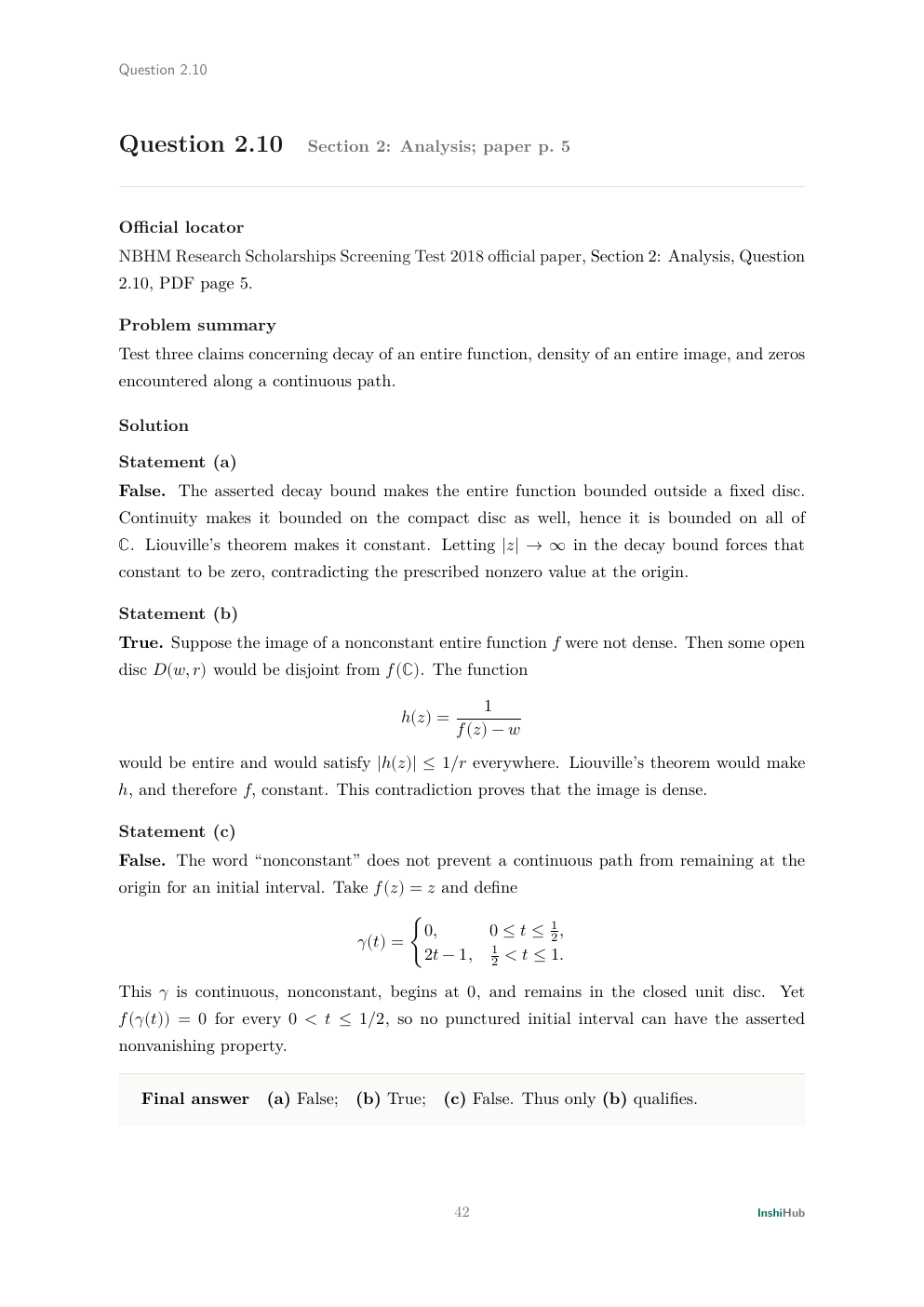
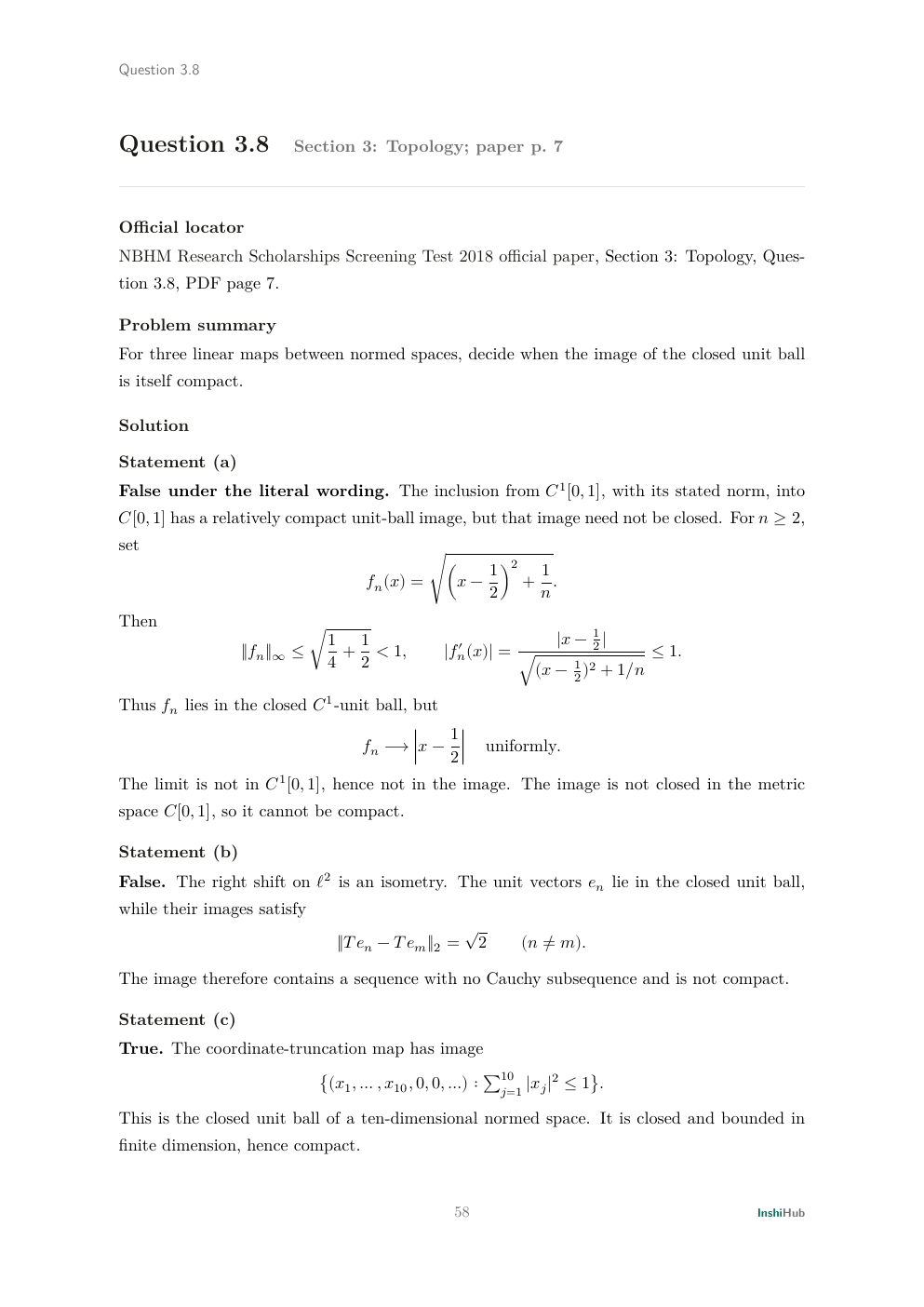
The preview covers Questions 1.7, 2.8, 2.10, 3.8, 4.9, 5.10 from the current 103-page manuscript. Every image is an InshiHub explanation page, never a scan of the official paper or answer key.
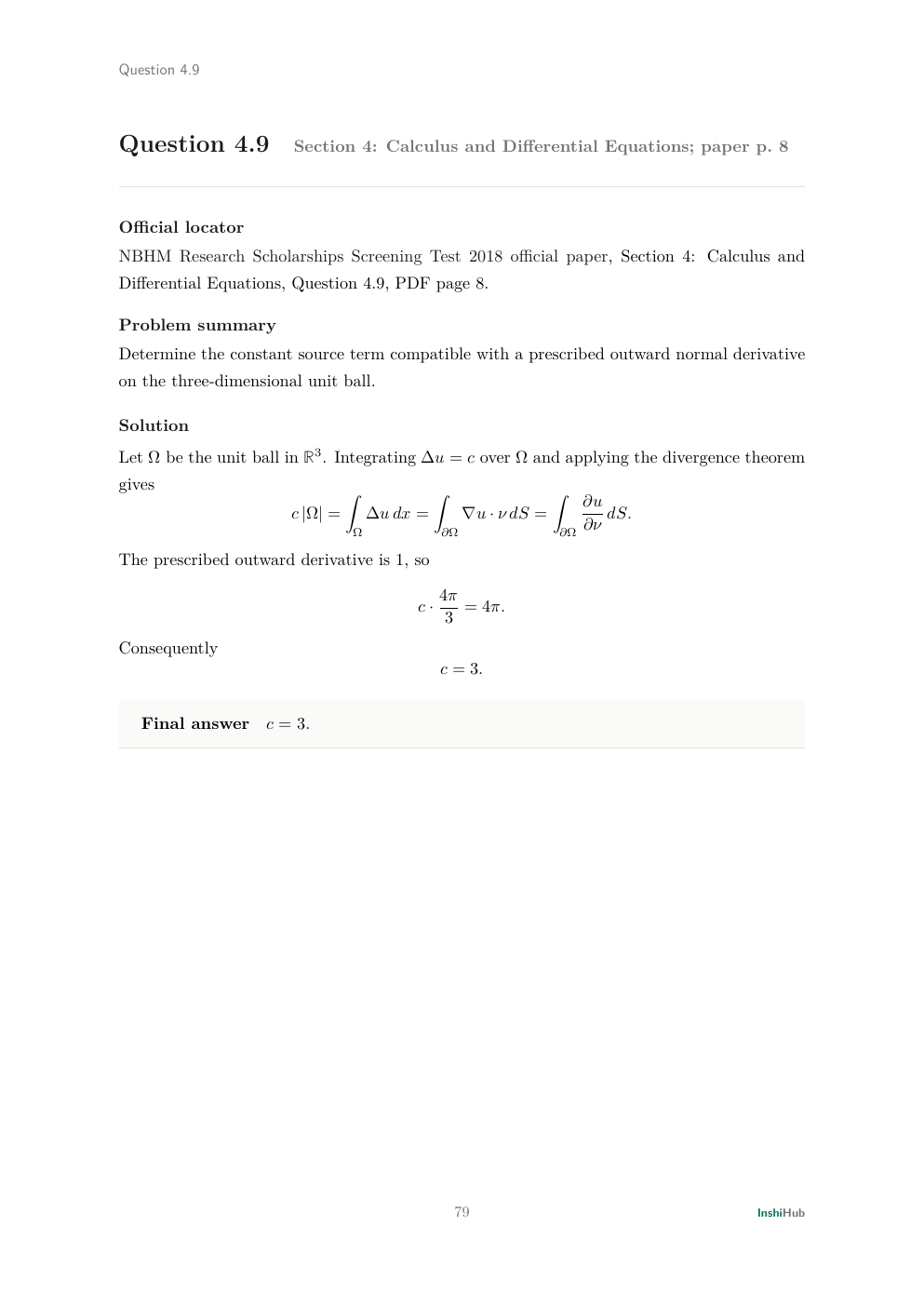
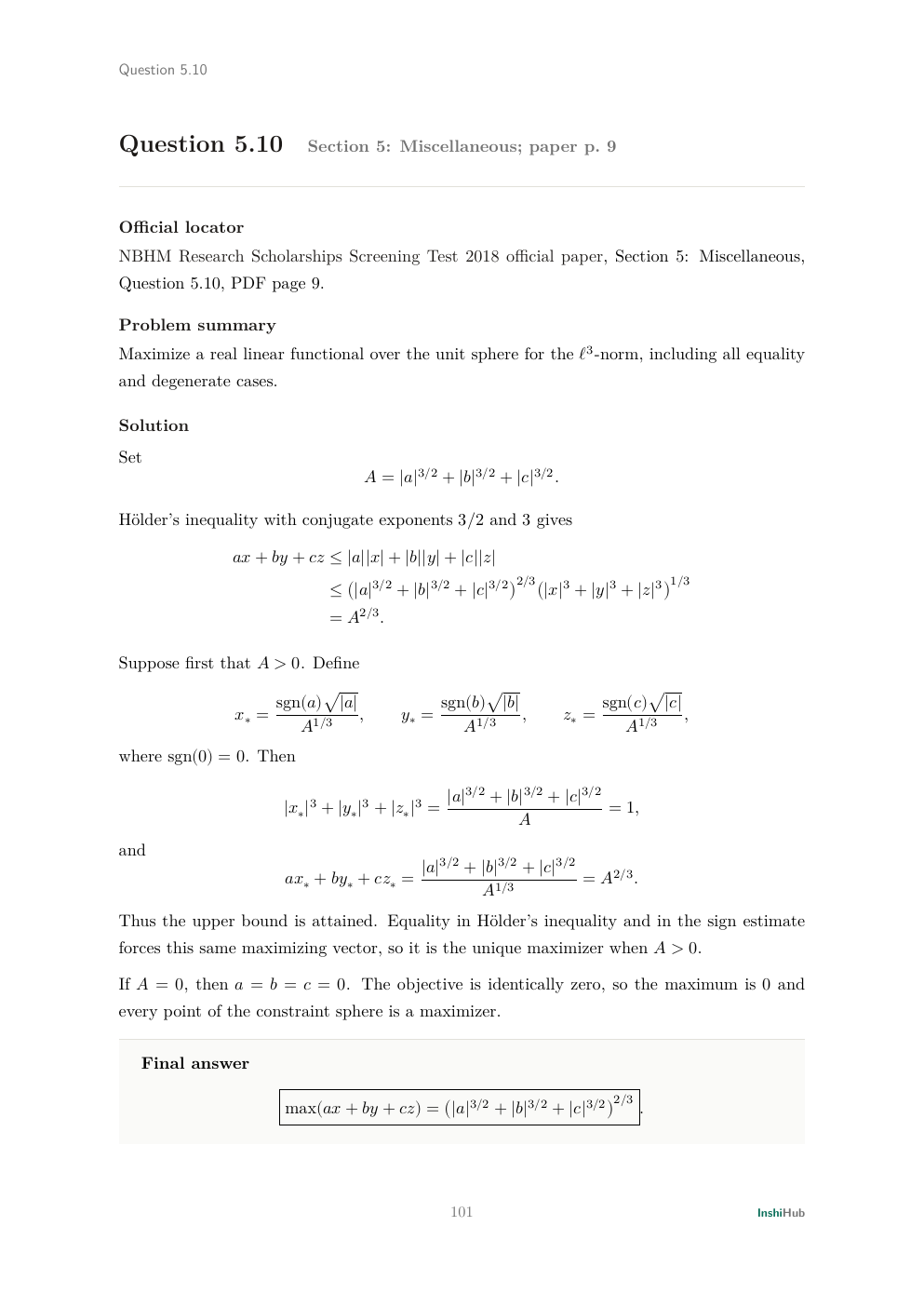
Crawlable HTML samples
These summaries identify the mathematical task without substituting for the official question. Open the source paper at the precise locator, attempt the problem, and then audit your work against the derivation, verification, and common-error note.
Free sample 1
Decide which decay and absolute-summability claims are forced for the sine coefficients of an arbitrary continuously differentiable function on the stated closed interval.
Integration by parts leaves an endpoint term of order one over n. Because the hypotheses do not identify the two endpoint values, that term can prevent the stronger conclusions.
Under the literal printed hypotheses, statement (a) is true and statements (b) and (c) are false; only (a) qualifies.
Free sample 2
Determine which of three linear maps sends the stated closed unit ball to a set that is itself compact.
Arzelà–Ascoli can establish relative compactness without making an image closed. An explicit smooth sequence whose uniform limit is not continuously differentiable separates the two notions.
Under the literal phrase that the image T(B) is compact, statements (a) and (b) are false and statement (c) is true; only (c) qualifies.
Free sample 3
Maximise a real linear functional on the unit sphere for the cubic norm, including the equality vector and the all-zero coefficient case.
Hölder's inequality with conjugate exponents three halves and three gives the sharp bound, and its equality condition determines the maximising coordinates.
The maximum is (|a|^(3/2) + |b|^(3/2) + |c|^(3/2))^(2/3). For a nonzero coefficient vector the normalised signed square-root vector is the unique maximiser; if all coefficients vanish, every feasible point maximises.
Editorial quality system
Every solution identifies its official section, dotted question label, and paper page without copying the question.
Each result is proved or disproved from the printed hypotheses before the final answer is compared with the official key.
A reviewer who did not write the solution rechecks the theorem use, algebra, counterexamples, edge cases, and final conclusion.
Where literal hypotheses and the official key lead to different conclusions, the guide states the difference, gives a reproducible counterexample, and does not invent an official erratum.
Review boundary
The guide page and free samples can be public while commercial validation remains incomplete. Seller accountability and end-to-end delivery approval are required before any payment control may be introduced.
Official sources, provenance, and rights
The paper itself is titled “Research Scholarships Screening Test.” The official NBHM past-paper archive classifies the file dated 20 January 2018 under Doctoral. This page uses “NBHM Doctoral 2018” as the searchable edition name while preserving the paper's historical title.
Independent answer-key comparison
Questions 2.8, 2.10, and 3.8 were independently rederived from the literal printed hypotheses before the official key was consulted. Reproducible counterexamples show that one or more labels in each key entry are not forced as written. The guide records the mathematical conclusion and the key comparison separately. No official erratum was located, and InshiHub does not present these findings as an official correction.
National Board for Higher Mathematics publishes the source documents, which are hosted by The Institute of Mathematical Sciences. InshiHub links to that archive but does not republish its paper, answer choices, logos, or answer-key text.
InshiHub is independent and is not affiliated with, endorsed by, or sponsored by the National Board for Higher Mathematics, the Department of Atomic Energy, or The Institute of Mathematical Sciences. Official names identify the examination source only.
Transparent release status
The 2018 edition remains in validation. Publishing this page does not accept payment or create an order. Paid access may appear only after every recorded gate below passes for this exact edition.
Frequently asked questions
No. It contains independently written solutions and short, non-substituting topic summaries. Use the official IMSc archive links on this page for the question paper and answer key.
The current 103-page edition covers all 50 numbered questions and 51 addressable solution prompts, with dotted source labels, complete derivations, independent checks, and problem-specific error notes.
The paper has five sections of ten one-point questions. Its printed rule counts the best four section scores, so the maximum counted score is 40.
Question 5.1 asks for two separately labelled results. The guide explains both while preserving the paper's one-point, no-partial-credit treatment of that numbered question.
For Questions 2.8, 2.10, and 3.8, direct derivation from the literal printed hypotheses produces explicit counterexamples to one or more key labels. The guide shows each construction and records the difference transparently. No separate official erratum was located, so InshiHub does not describe the differences as official corrections.
Not yet. The editorial page and free samples are public, but paid access remains disabled while seller, tax, payment, delivery, refund, and reconciliation validation is incomplete.
The configured one-time catalogue price is ₹999, inclusive of applicable tax. It is not a temporary discount or crossed-out-price promotion, and no payment control is present while validation remains incomplete.
Each solution was independently derived before comparison with the official key, then cross-reviewed by someone who did not author that range. Review covers theorem use, calculations, counterexamples, boundary cases, source locators, and rendered PDF layout.
No. InshiHub is an independent publisher of worked explanations. IMSc hosts the official source files; this guide links to them and does not reproduce the official question text, answer choices, figures, logos, or key wording.