InshiHubIndia
Doctoral archive · 2017English · IndiaComplete 102-page edition

NBHM Doctoral 2017 worked solutions

Prepare for NBHM Doctoral and PhD-level mathematics with independent derivations for all 50 numbered questions and 51 addressable solution prompts. Read three complete solutions in searchable HTML, inspect six guide pages, and understand the original best-four-of-five scoring rule before practising.

50 questions · 51 addressable promptsDotted official source locatorsIndependent cross-review

Direct format answer

How was the NBHM Doctoral 2017 paper scored?

The 150-minute paper contained five subject sections of ten one-point questions. All 50 questions could be attempted, but only the best four section totals counted, giving a maximum counted score of 40. When one numbered question requested multiple answers, every requested answer was required for that point; no partial credit was provided.

Test date

21 January 2017

Working time

150 minutes

Paper structure

5 sections × 10 questions

Question value

1 point per numbered question

Counted result

Best 4 section scores

Maximum counted score

40 points

Question count is not a physical-answer-field count

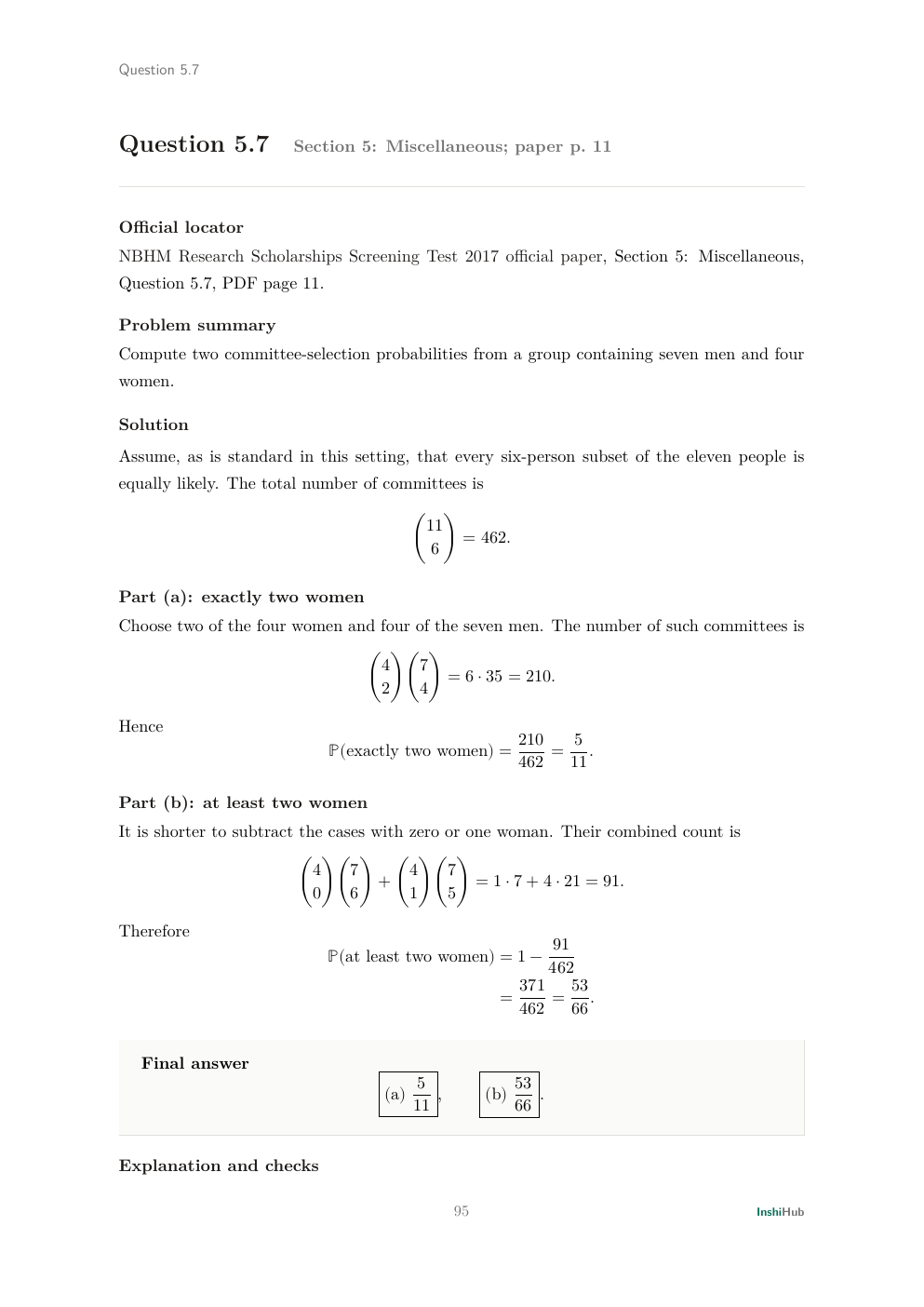
The guide has 51 addressable solution prompts. This is because Question 5.7 contains separately explained parts inside the numbered, one-point question entries. The archived paper refers to a separate answer booklet but does not establish its physical field count, so this page does not invent one.

Five-section subject map

Each section contributes ten numbered questions. The guide keeps the printed dotted labels so a learner can move directly between an official question and the matching explanation.

Section 1

Algebra

1.1–1.10

Groups, rings, linear algebra, field structure, and spectral arguments.

Section 2

Analysis

2.1–2.10

Real and complex analysis, measure, sequences, series, and function spaces.

Section 3

Topology

3.1–3.10

Continuity, compactness, connectedness, quotient ideas, and metric spaces.

Section 4

Calculus and Differential Equations

4.1–4.10

Multivariable calculus, integration, ordinary differential equations, and boundary-value problems.

Section 5

Miscellaneous

5.1–5.10

Probability, combinatorics, geometry, optimisation, and mixed reasoning.

Six-page visual preview

Inspect representative pages before deciding

The preview covers Questions 1.3, 2.8, 3.3, 4.9, 5.7, 5.10 from the current 102-page manuscript. Every image is an InshiHub explanation page, never a scan of the official paper or answer key.
Preview page 1 of 6Sample · not the official paper
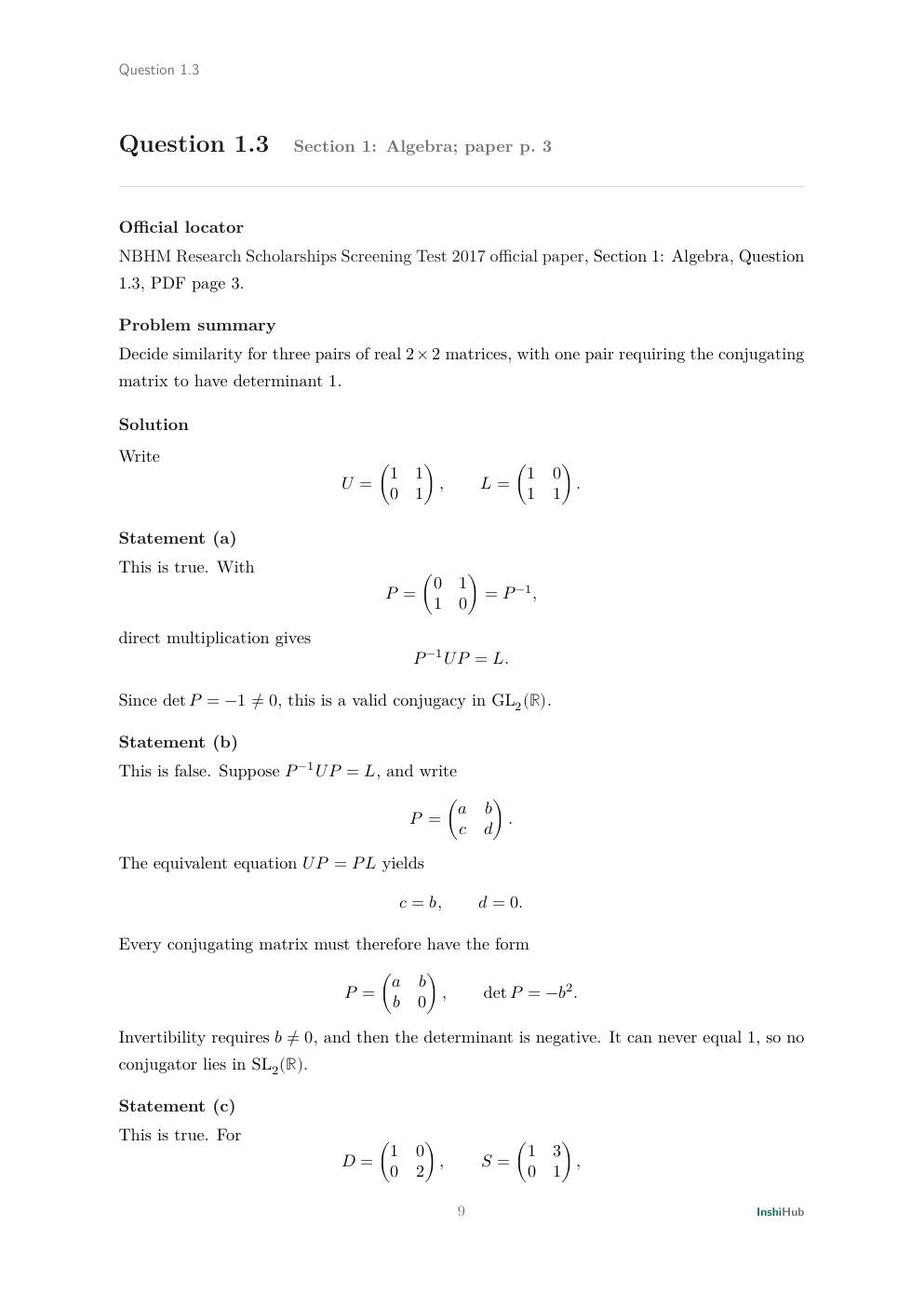
NBHM Doctoral 2017 Worked Solutions, preview page 1 of 6: Question 1.3 solution distinguishing ordinary similarity from determinant-one conjugacy by solving the full intertwining equation.
Preview page 2 of 6Sample · not the official paper
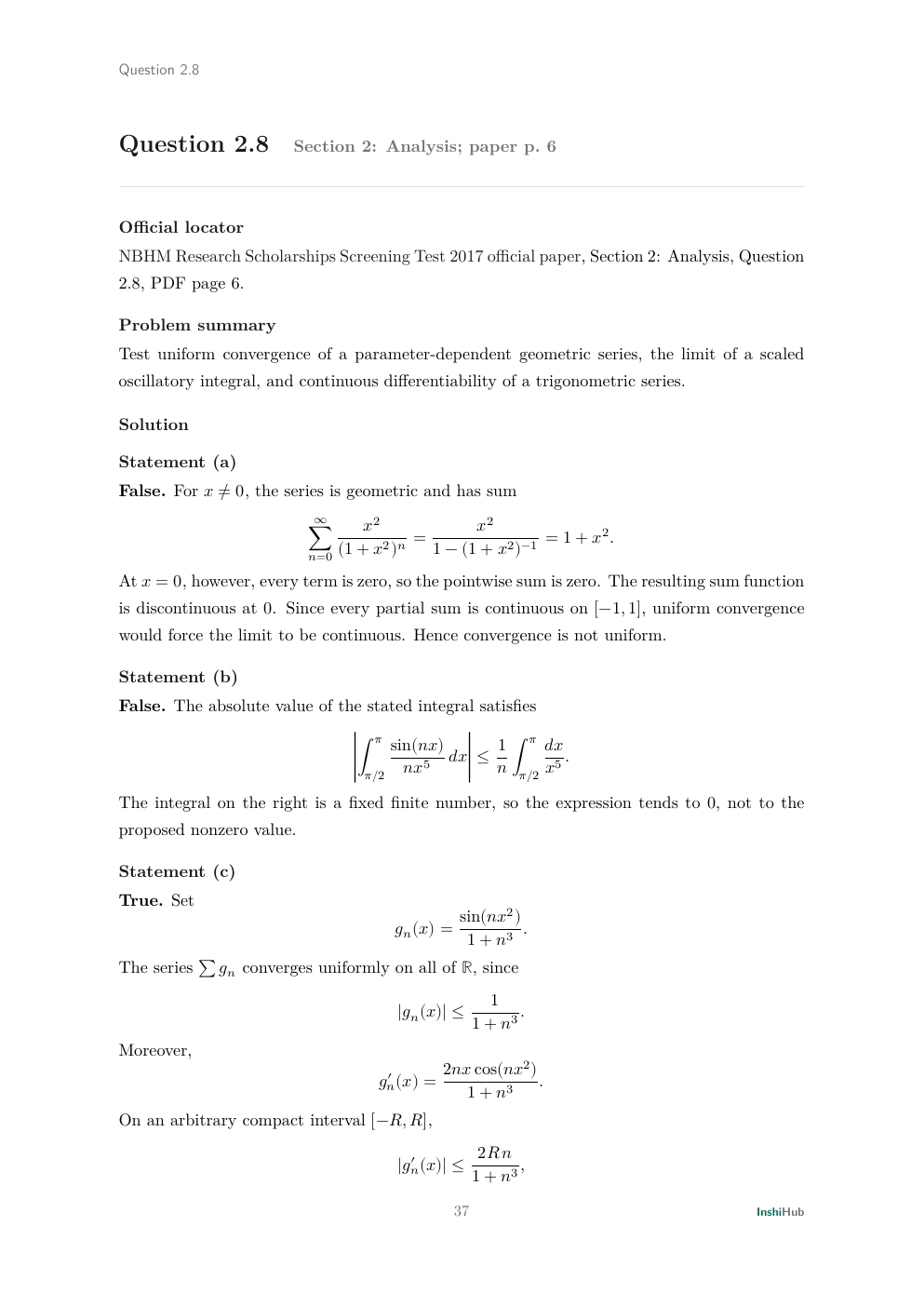
NBHM Doctoral 2017 Worked Solutions, preview page 2 of 6: Question 2.8 solution separating a discontinuous pointwise geometric sum, an oscillatory integral bound, and locally uniform derivative convergence.
Preview page 3 of 6Sample · not the official paper
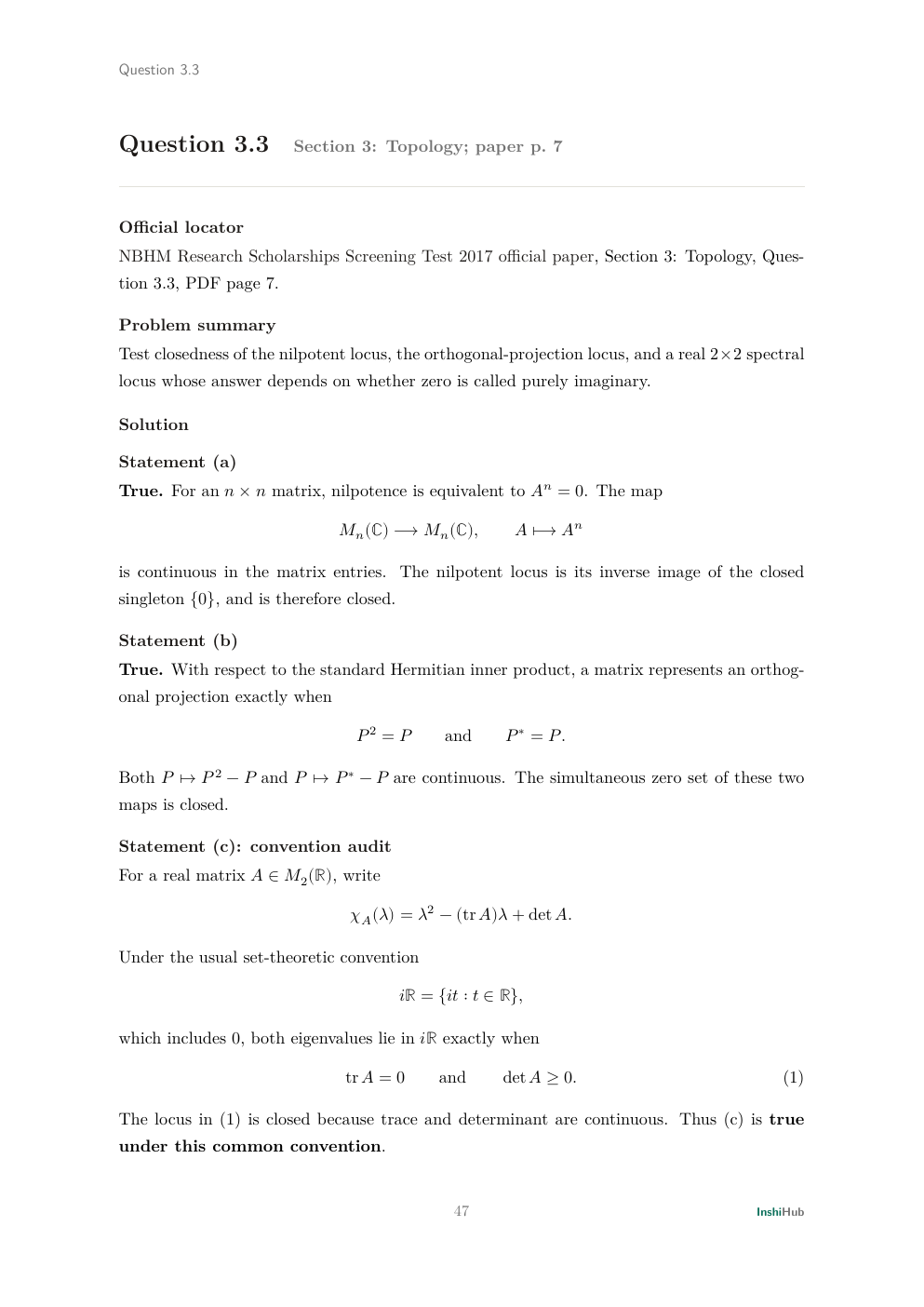
NBHM Doctoral 2017 Worked Solutions, preview page 3 of 6: Question 3.3 solution auditing closed matrix loci under the two conventions for whether zero is purely imaginary.
Preview page 4 of 6Sample · not the official paper
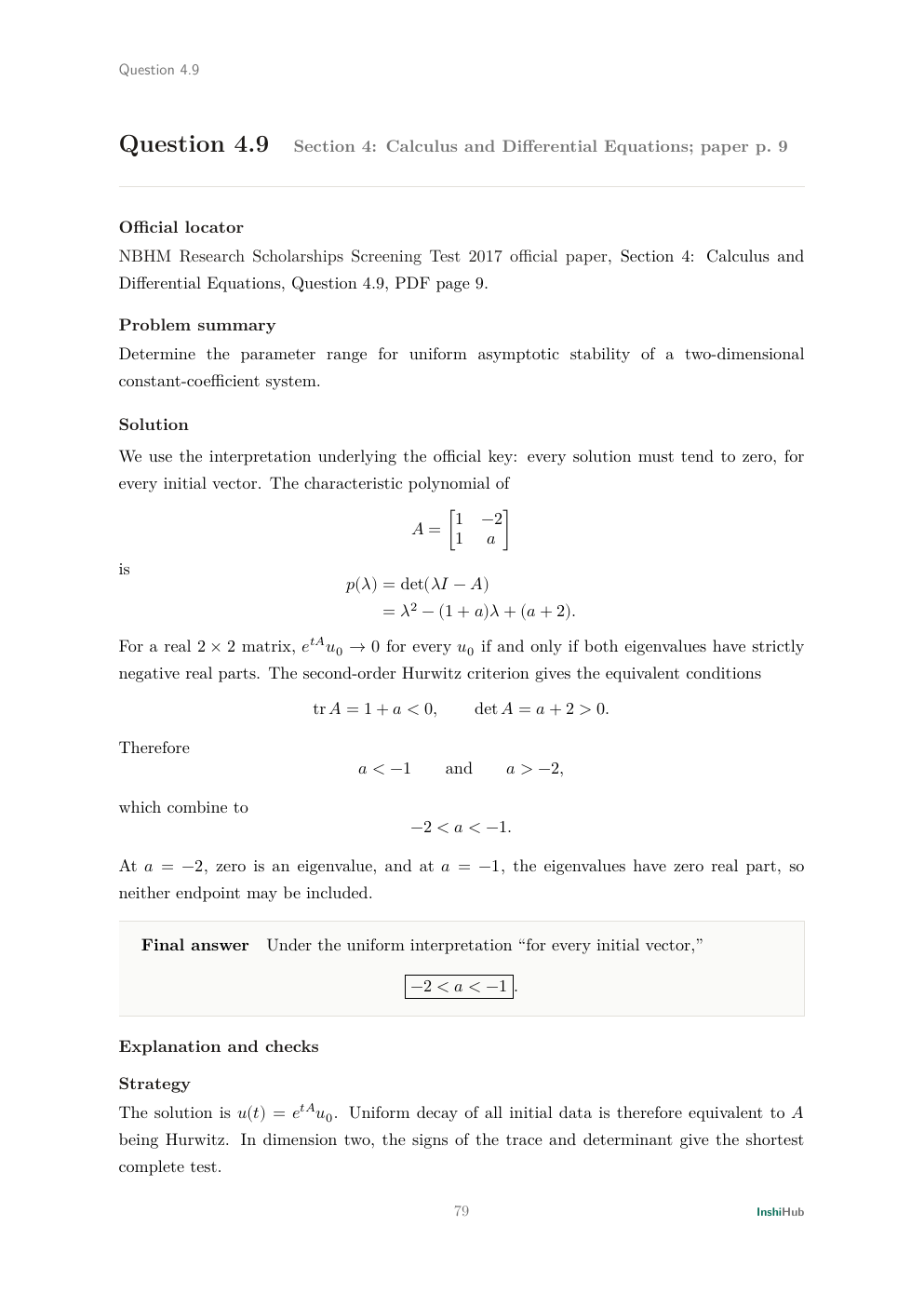
NBHM Doctoral 2017 Worked Solutions, preview page 4 of 6: Question 4.9 solution deriving the Hurwitz interval and separating universal decay from fixed-initial-vector exceptions.
Preview page 5 of 6Sample · not the official paper
NBHM Doctoral 2017 Worked Solutions, preview page 5 of 6: Question 5.7 solution computing both committee probabilities under an explicit uniform-selection model.
Preview page 6 of 6Sample · not the official paper
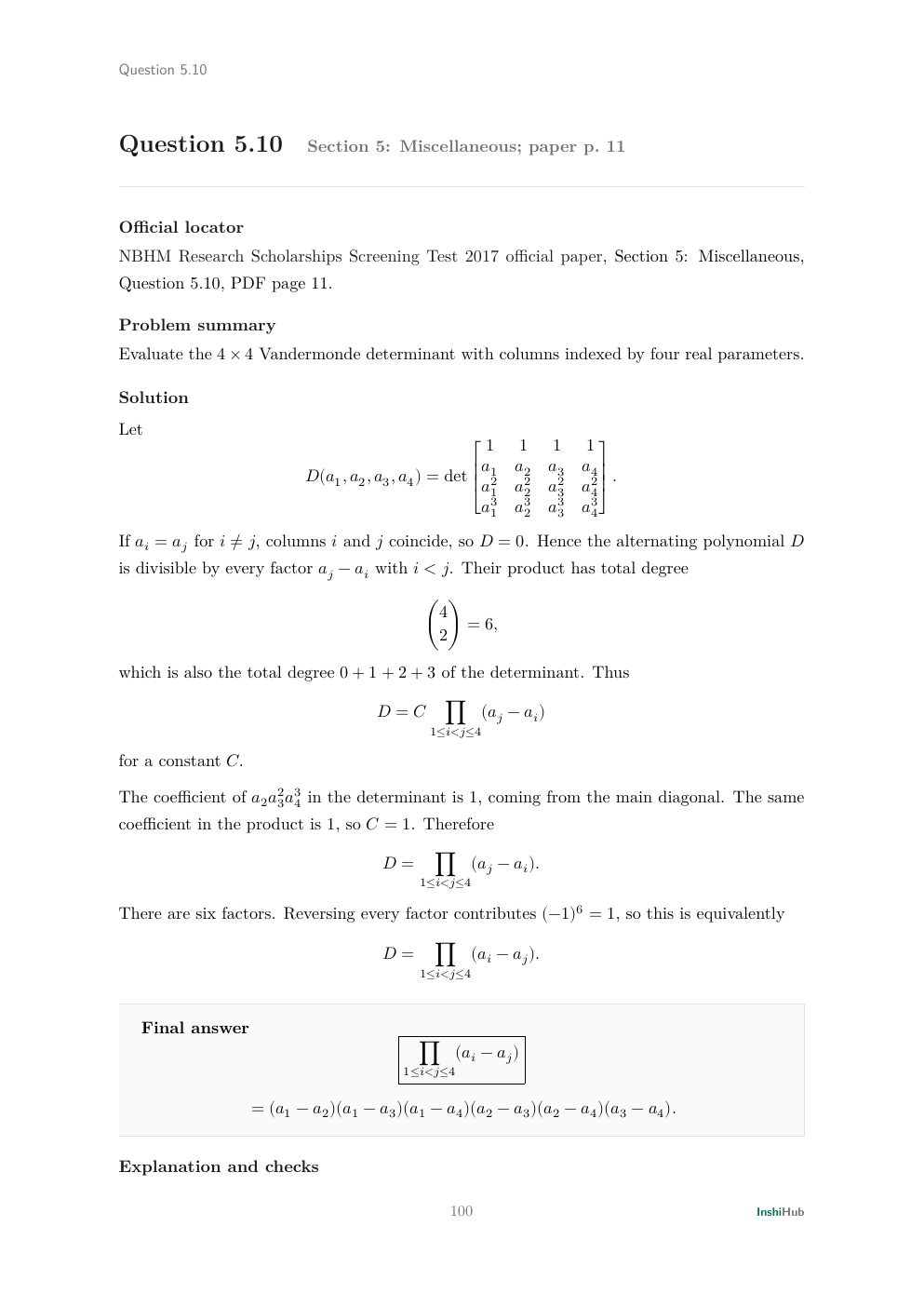
NBHM Doctoral 2017 Worked Solutions, preview page 6 of 6: Question 5.10 solution deriving the four-variable Vandermonde determinant and checking the six-factor sign.

Crawlable HTML samples

Three free NBHM Doctoral 2017 solutions

These summaries identify the mathematical task without substituting for the official question. Open the source paper at the precise locator, attempt the problem, and then audit your work against the derivation, verification, and common-error note.

Free sample 1

Official question 2.8 · Uniform convergence, oscillatory decay, and a continuously differentiable series

Cross-review recorded
Source locator
Section 2: Analysis, official question 2.8, paper PDF page 6
Review note
Independently derived and cross-reviewed; pointwise-sum, uniform-Cauchy, integral-bound, and derivative-series checks passed; official-key match · 2026-07-28

Problem summary

Test three convergence claims involving a parameter-dependent geometric series, a scaled oscillatory integral, and a trigonometric function series.

Core idea

Compute the pointwise geometric sum before testing uniformity, use the visible reciprocal-n factor to control the integral, and justify differentiation of the function series through locally uniform derivative convergence.

Derivation

  1. 1For nonzero x, the geometric series sums to 1 + x squared, while at x = 0 every term vanishes. The pointwise limit is therefore discontinuous at zero.
  2. 2Every partial sum is continuous on the closed interval, so uniform convergence would force a continuous limit. This disproves statement (a).
  3. 3The absolute value of the scaled oscillatory integral is at most a fixed integral of 1 over x to the fifth power, divided by n. It tends to zero, disproving the proposed nonzero limit in statement (b).
  4. 4For statement (c), the function terms are bounded by 1 over 1 + n cubed, which gives uniform convergence on the real line.
  5. 5On each compact interval, the derivative terms are bounded by 2R n over 1 + n cubed. That summable majorant permits termwise differentiation and yields a continuous derivative.

Final answer

Statement (a) is false, statement (b) is false, and statement (c) is true. Only (c) qualifies.

Free sample 2

Official question 3.3 · Closed matrix loci and the zero-eigenvalue convention

Cross-review recorded
Source locator
Section 3: Topology, official question 3.3, paper PDF page 7
Review note
Independently derived and cross-reviewed; zero-set argument, characteristic-polynomial cases, and boundary sequence checked; convention difference recorded without claiming an official erratum · 2026-07-28

Problem summary

Test closedness for a nilpotent locus, an orthogonal-projection locus, and a real two-by-two spectral locus whose boundary depends on whether zero is included among purely imaginary numbers.

Core idea

Express each matrix class using continuous polynomial or adjoint equations. For the spectral locus, reduce the characteristic polynomial to trace and determinant and keep the determinant-zero boundary visible.

Derivation

  1. 1An n-by-n matrix is nilpotent exactly when its nth power is zero. Matrix powering is continuous, so the nilpotent locus is closed.
  2. 2An orthogonal projection satisfies both P squared equals P and P adjoint equals P. The simultaneous zero set of these two continuous expressions is closed.
  3. 3For a real two-by-two matrix, both eigenvalues lie on the imaginary axis precisely when the trace is zero and the determinant is nonnegative, provided zero is included in the imaginary axis.
  4. 4That usual set-theoretic convention gives a closed locus because trace and determinant are continuous and the nonnegative half-line is closed.
  5. 5If purely imaginary is restricted to nonzero numbers, the determinant condition becomes strictly positive. Matrices with eigenvalues plus or minus i divided by k then converge to the zero matrix, showing that this smaller locus is not closed.

Final answer

The published key selects (a) and (b). Under the usual convention that zero belongs to the imaginary axis, (a), (b), and (c) are all true. Under a nonzero-only use of purely imaginary, only (a) and (b) qualify.

Free sample 3

Official question 4.9 · Hurwitz stability and the initial-vector quantifier

Cross-review recorded
Source locator
Section 4: Calculus and Differential Equations, official question 4.9, paper PDF page 9
Review note
Independently derived and cross-reviewed; Hurwitz inequalities, endpoint cases, and fixed-vector exceptions checked; official-key interval preserved with its quantifier · 2026-07-28

Problem summary

Determine the parameter interval that makes every solution of a two-dimensional constant-coefficient system decay, then separate that uniform statement from the result for one fixed initial vector.

Core idea

For decay from every initial vector, both eigenvalues must have negative real part. In two dimensions the trace and determinant give the complete Hurwitz test, while a fixed vector can lie in an exceptional invariant subspace.

Derivation

  1. 1The system matrix has trace 1 + a, determinant a + 2, and characteristic polynomial lambda squared minus (1 + a) lambda plus (a + 2).
  2. 2Decay for every initial vector is equivalent to the matrix being Hurwitz: both eigenvalues must have strictly negative real parts.
  3. 3For a real two-by-two matrix, the Hurwitz conditions are negative trace and positive determinant. Here they become a less than -1 and a greater than -2.
  4. 4Combining the inequalities gives the open interval -2 < a < -1. At the left endpoint a zero eigenvalue remains, and at the right endpoint the eigenvalues have zero real part.
  5. 5For one fixed unspecified initial vector, no interval depending only on a is possible: the zero vector decays for every a, and selected stable eigendirections can decay even when the matrix is not uniformly stable.

Final answer

Under the universal interpretation, for every initial vector, the exact interval is -2 < a < -1. A fixed initial vector creates a different, vector-dependent question.

Full-edition scope

  • Original, step-by-step solutions for all 50 numbered questions
  • Separate treatment of 51 addressable solution prompts, including both parts of Question 5.7
  • Coverage of all five subject sections with the best-four-of-five scoring rule preserved
  • Verification, counterexamples, boundary cases, and problem-specific common-error notes
  • Official section, dotted question label, and paper-page locators for every solution
  • Explicit convention analysis for Question 3.3 and quantifier analysis for Question 4.9
  • A source note distinguishing the paper's historical title from its Doctoral archive classification
  • A dated correction process and public correction log after release

What is not included

  • The official question paper, answer choices, figures, logos, and answer-key text
  • A fabricated count of physical answer fields, because the separate answer booklet is not in the archive
  • A claim that an official erratum exists for Questions 3.3 or 4.9
  • Coaching, admissions advice, or any score guarantee
  • Affiliation with NBHM, the Department of Atomic Energy, or IMSc

Editorial quality system

Every answer is derived, challenged, and source-mapped

1

Exact source mapping

Every solution identifies its official section, dotted question label, and paper page without copying the question.

2

Independent first derivation

Each result is proved or disproved from the printed mathematical hypotheses before the final answer is compared with the official key.

3

Cross-author mathematical audit

A reviewer rechecks theorem use, calculations, counterexamples, boundary cases, source locators, and the rendered explanation.

4

Transparent interpretation boundaries

Where a convention or quantifier changes the conclusion, the guide states both readings and does not invent an official correction.

Review boundary

Public mathematics and paid access are separate states

The guide page and free samples can be public while commercial validation remains incomplete. Seller accountability and end-to-end delivery approval are required before any payment control may be introduced.

Official sources, provenance, and rights

Historical paper title and Doctoral archive classification

The paper itself is titled “Research Scholarships Screening Test.” The official NBHM past-paper archive classifies the file dated 21 January 2017 under Doctoral. This page uses “NBHM Doctoral 2017” as the searchable edition name while preserving the paper's historical title.

Independent answer-key comparison

Question 3.3 was independently rederived from the printed mathematical conditions before the key comparison. The key selects (a) and (b). Under the usual set-theoretic convention that zero belongs to the imaginary axis, (c) is also true because the locus is given by trace zero and nonnegative determinant; a nonzero-only convention makes that locus non-closed and returns the key selection. Question 4.9's interval -2 < a < -1 is the uniform answer for decay from every initial vector, whereas one fixed unspecified vector produces vector-dependent exceptions, including the zero vector. These distinctions are analytical qualifications and are not presented as official errata.

National Board for Higher Mathematics publishes the source documents, which are hosted by The Institute of Mathematical Sciences. InshiHub links to that archive but does not republish its paper, answer choices, logos, or answer-key text.

Exam date
Source accessed
2026-07-28
Source status
Publicly accessible source; no reuse licence located
Official paper SHA-256
da8698564013924bdf069a1a196159e6a6af5d400a6f9e58582fd83fa38c5a30
Official answer-key SHA-256
bf4690c47caaf44fe83e14fb9848f2273590807bf28e76222ca4a4dcbbc72e56

InshiHub is independent and is not affiliated with, endorsed by, or sponsored by the National Board for Higher Mathematics, the Department of Atomic Energy, or The Institute of Mathematical Sciences. Official names identify the examination source only.

Transparent release status

Free samples are public. Paid access remains disabled.

The 2017 edition remains in validation. Publishing this page does not accept payment or create an order. Paid access may appear only after every recorded gate below passes for this exact edition.

  • All 50 numbered questions and 51 addressable solution prompts completed
  • Author review and independent cross-review recorded across all five sections
  • Questions 3.3 and 4.9 rederived with their convention and quantifier boundaries made explicit
  • Historical title, Doctoral archive classification, and scoring rules verified
  • Rights review completed for paid distribution
  • Merchant and 2017 edition approval recorded
  • Exact transaction-seller entity and India responsibility allocation confirmed
  • Current buyer terms and privacy notice linked
  • INR final-price display, payment, delivery, refund, and order reconciliation tested
Related years

Continue the NBHM Doctoral paper sequence

Frequently asked questions

NBHM Doctoral 2017 guide details

Does this guide reproduce the official NBHM 2017 paper?

No. It contains independently written solutions and short, non-substituting topic summaries. Use the official IMSc archive links on this page for the question paper and answer key.

What is covered in the NBHM Doctoral 2017 solution guide?

The current 102-page edition covers all 50 numbered questions and 51 addressable solution prompts, with dotted source labels, complete derivations, independent checks, and problem-specific error notes.

Why is the maximum score 40 when the paper has 50 questions?

The paper has five sections of ten one-point questions. Its printed rule counts the best four section scores, so the maximum counted score is 40.

Why are there 51 solution prompts for 50 numbered questions?

Question 5.7 requests two separately labelled results. The guide explains parts (a) and (b) separately while preserving the one-point, no-partial-credit treatment of that numbered question.

Why does the Question 3.3 conclusion depend on a convention?

The official key lists (a) and (b). If zero is included in the imaginary axis, the locus in (c) is described by trace zero and nonnegative determinant and is closed. A nonzero-only use of purely imaginary makes the determinant strictly positive and the locus non-closed. InshiHub records both readings and does not claim an official erratum.

Why does Question 4.9 distinguish every initial vector from one fixed vector?

The interval -2 < a < -1 is the parameter-only answer for decay from every initial vector. A fixed vector can be zero or lie in a stable invariant direction, so its answer can differ and depend on the vector.

Is the complete 2017 guide available for paid access now?

Not yet. The editorial page and free samples are public, but paid access remains disabled while seller, tax, payment, delivery, refund, and reconciliation validation is incomplete.

What is the configured price for the complete 2017 guide?

The configured one-time catalogue price is ₹999, inclusive of applicable tax. It is not a temporary discount or crossed-out-price promotion, and no payment control is present while validation remains incomplete.

How were the 2017 answers checked, and is InshiHub affiliated with the source institutions?

Each solution was independently derived, checked against edge cases and source locators, and cross-reviewed before final comparison with the official key. InshiHub is an independent publisher and is not affiliated with NBHM, the Department of Atomic Energy, or IMSc.