InshiHubIndia

Complete IIT JAM Mathematics guide

IIT JAM Mathematics 2025 — Detailed Solutions

Work through all 60 questions and 100 marks with independently written setups, complete derivations, final-key checks and question-specific error notes.

  • 65 pages
  • 60 questions · 100 marks · 30 MCQ · 10 MSQ · 20 NAT
  • English
  • ₹1,499 held catalogue price

Official sources and editorial boundary

Independent and unofficial InshiHub study guide. Not affiliated with, endorsed by, sponsored by or approved by IIT Delhi, any IIT, JAM authorities or the GATE-JAM Office. The official master paper and final answer key remain free at the linked official source; they are not included in this product.

Format facts

Organising institute
IIT Delhi
Delivery and duration
English · Computer Based Test · 180 minutes
Questions and marks
60 questions carrying 100 marks
Section A
Q1–Q30 · MCQ · 50 marks
Section B
Q31–Q40 · MSQ · 20 marks
Section C
Q41–Q60 · NAT · 30 marks
Editorial method
Original summaries, setups, derivations and checks; no official problem or option prose reproduced

Coverage map

Across Q1–Q60

Sequences and real analysis

Limits, continuity, differentiability, series, integration and convergence tests

Across Q1–Q60

Multivariable calculus

Partial derivatives, extrema, multiple integrals and vector-calculus arguments

Across Q1–Q60

Differential equations

First-order methods, linear equations, Cauchy–Euler equations and boundary data

Across Q1–Q60

Linear algebra

Vector spaces, linear maps, matrices, eigenvalues, inner products and quadratic forms

Across Q1–Q60

Groups and algebra

Groups, subgroups, homomorphisms, cyclic structure and polynomial reasoning

Five complete HTML samples

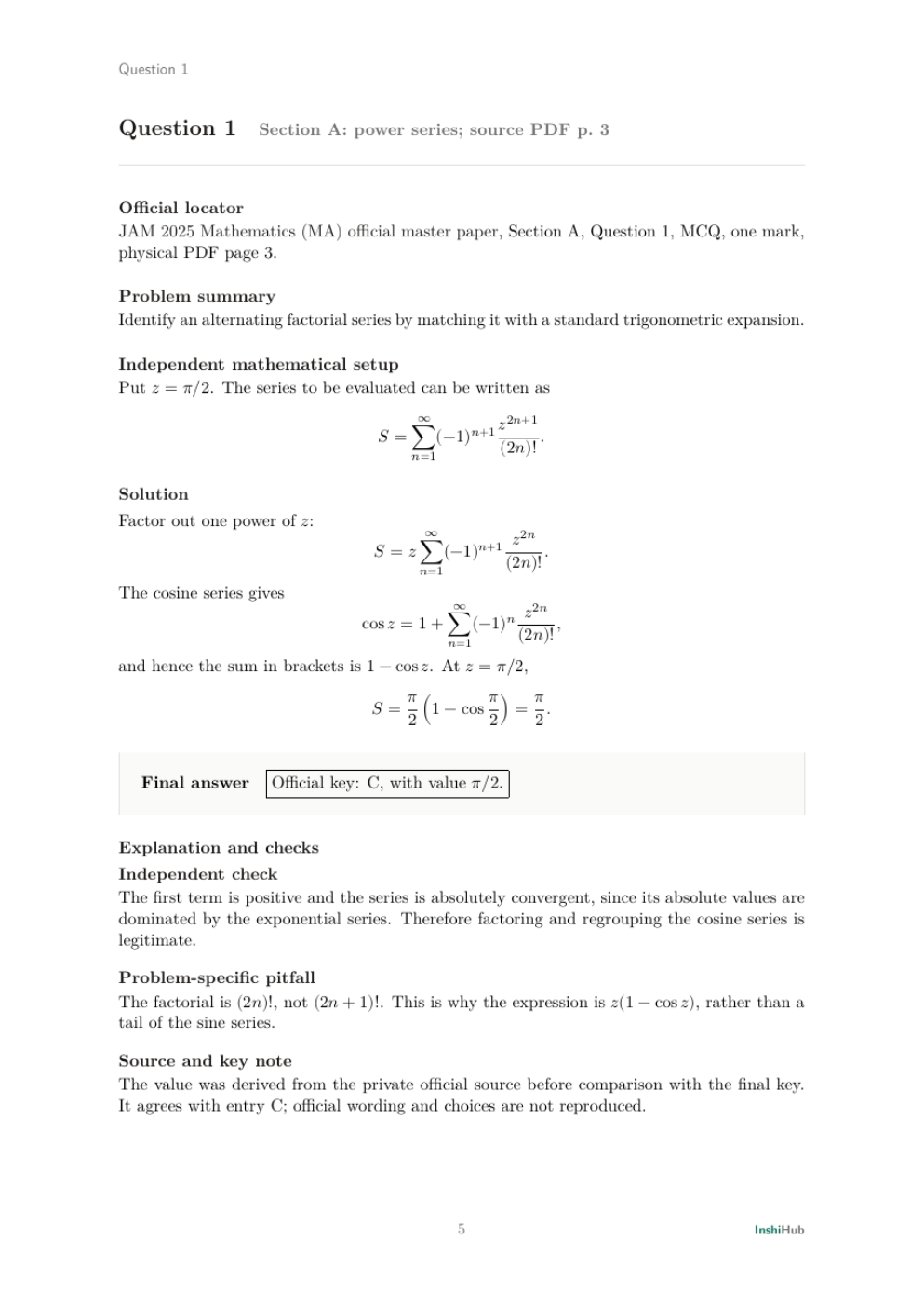
Section A · Q1 · MCQ · 1 mark

Sample 1 — One-mark MCQ: Power series and trigonometric expansions

Identify an alternating factorial series by rewriting it as a transformed cosine series.

Core idea

Factor one power of the parameter, then recognise the remaining even-factorial tail as 1−cos z.

  1. 1Set z=π/2 and factor z from the series.
  2. 2Match the remaining sum with the cosine expansion.
  3. 3Evaluate z(1−cos z) at π/2.
Final response
C, with value π/2.
Independent check
Absolute convergence justifies the regrouping, and the first term’s positive sign agrees with the positive result.

Common pitfall: The factorial is (2n)!, so the series is not a direct tail of the sine expansion.

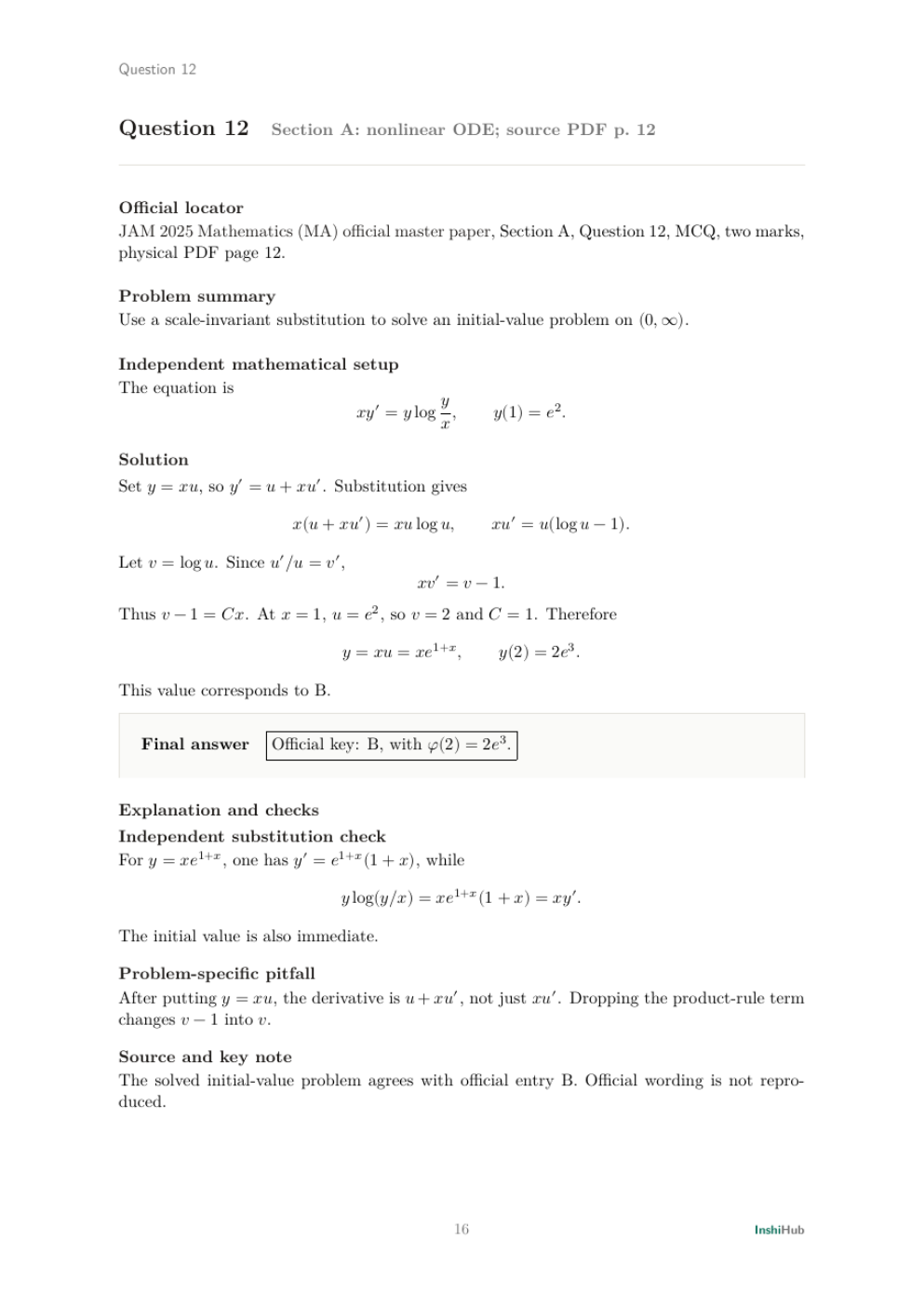
Section A · Q12 · MCQ · 2 marks

Sample 2 — Two-mark MCQ: Scale-invariant nonlinear differential equations

Solve an initial-value problem on the positive half-line by separating the scale ratio y/x.

Core idea

Set y=xu and then v=log u to reduce the nonlinear equation to a first-order linear equation for v.

  1. 1Apply the product rule to y=xu.
  2. 2Use v=log u to obtain xv′=v−1.
  3. 3Determine the constant from the initial value and evaluate the requested point.
Final response
B, with value 2e³.
Independent check
Direct substitution of y=xe^(1+x) satisfies both the differential equation and the initial condition.

Common pitfall: Dropping the u term from y′=u+xu′ changes the entire transformed equation.

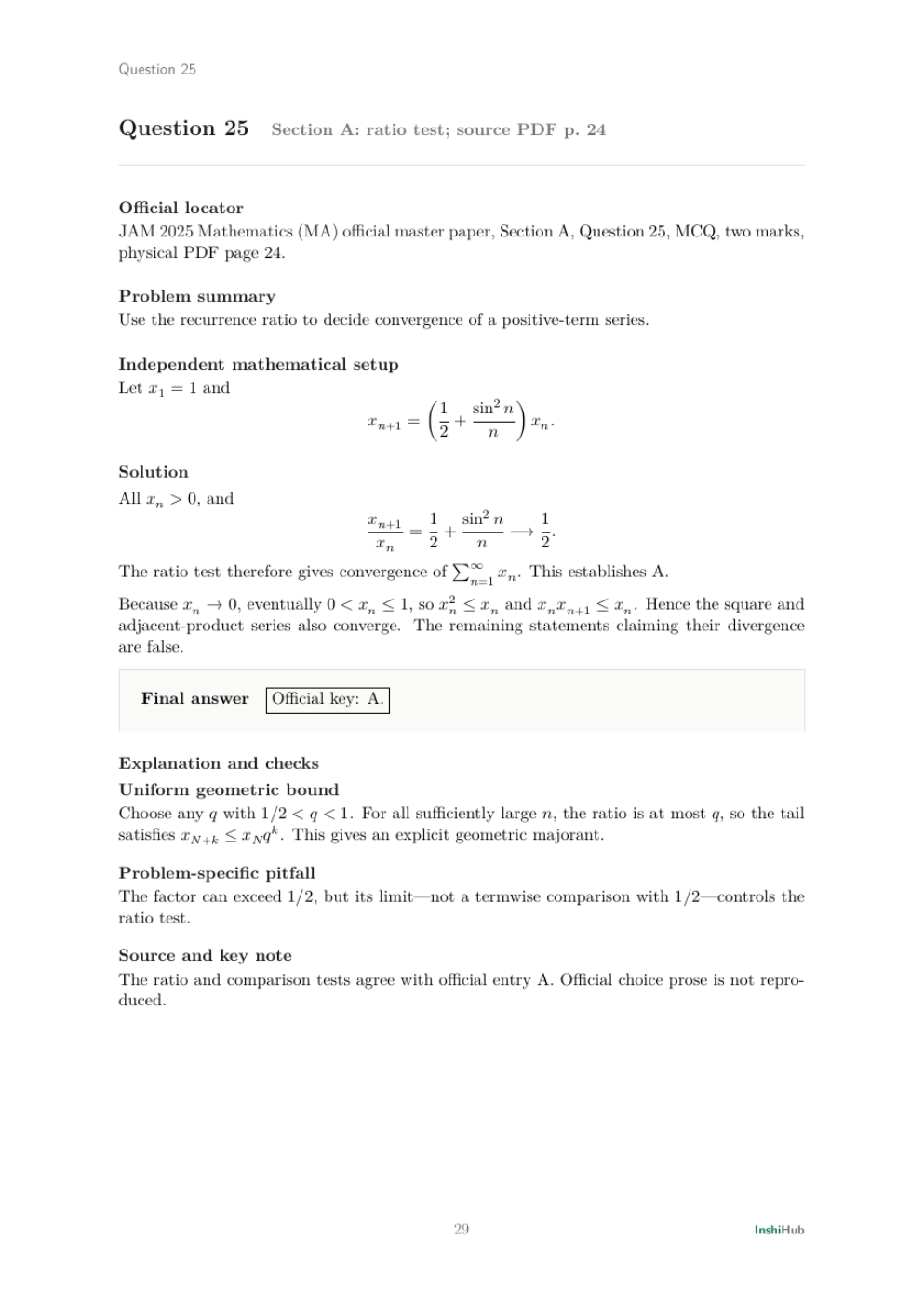
Section A · Q25 · MCQ · 2 marks

Sample 3 — Two-mark MCQ: Ratio test for a recursively defined sequence

Decide convergence of a positive-term series and related square and adjacent-product series from its recurrence ratio.

Core idea

The ratio tends to 1/2, so the original series has a geometric tail; eventual bounds then control the derived series.

  1. 1Read x_(n+1)/x_n directly from the recurrence.
  2. 2Take the limit and apply the ratio test.
  3. 3Use eventual x_n≤1 to compare squares and adjacent products with x_n.
Final response
A.
Independent check
For any q between 1/2 and 1, the sequence tail is bounded by an explicit geometric progression.

Common pitfall: The varying factor need not equal 1/2 term by term; its limit controls the ratio test.

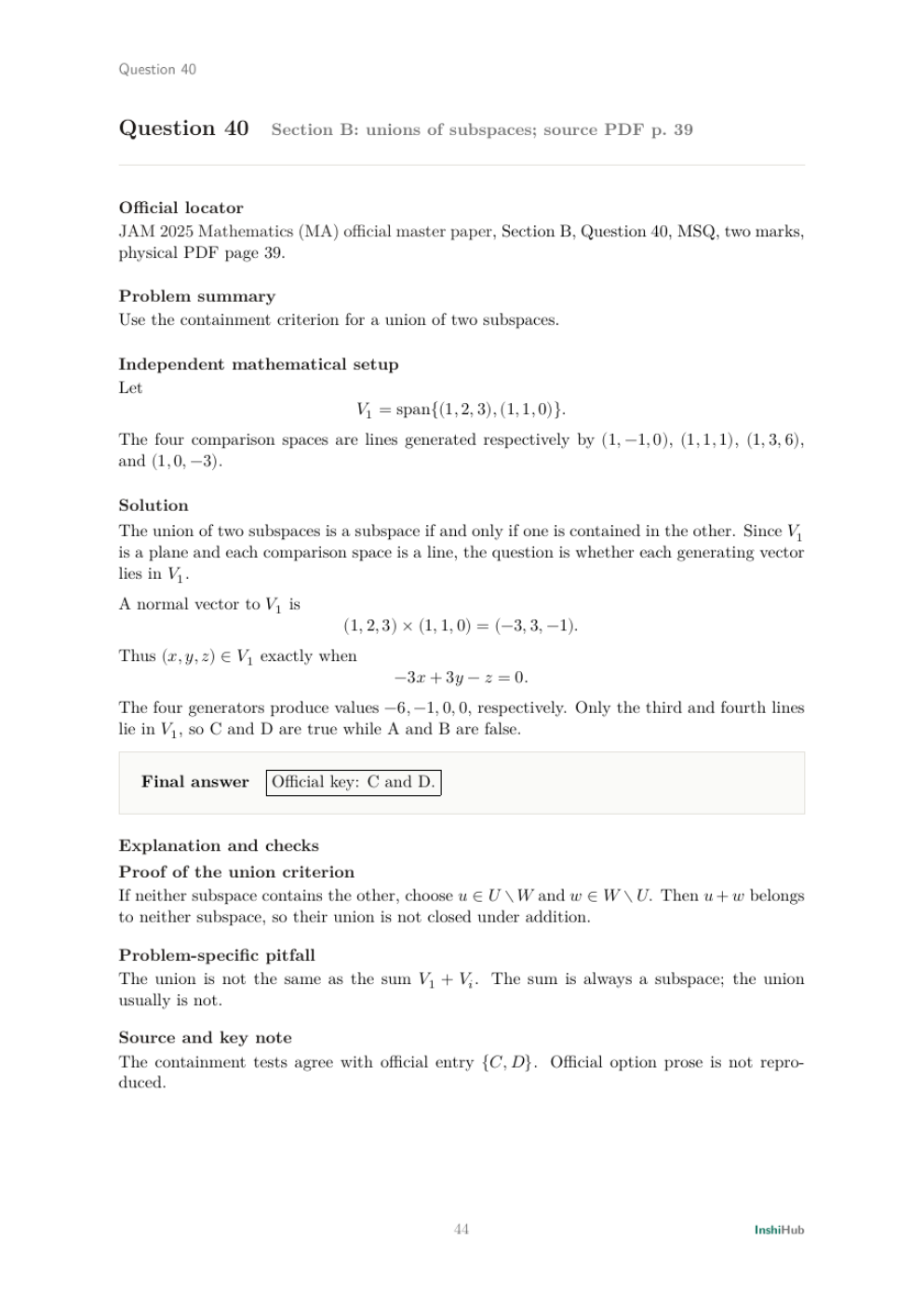
Section B · Q40 · MSQ · 2 marks

Sample 4 — Two-mark MSQ: Unions of vector subspaces

Apply the containment criterion for a plane union a line to four candidate generating vectors.

Core idea

The union of two subspaces is a subspace exactly when one is contained in the other.

  1. 1Compute a normal vector to the fixed plane.
  2. 2Test each line generator in the plane equation.
  3. 3Select exactly the lines contained in the plane.
Final response
C and D.
Independent check
If neither subspace contains the other, adding one vector from each produces a vector in neither, proving the union criterion.

Common pitfall: The union V₁∪V₂ is not the vector-space sum V₁+V₂.

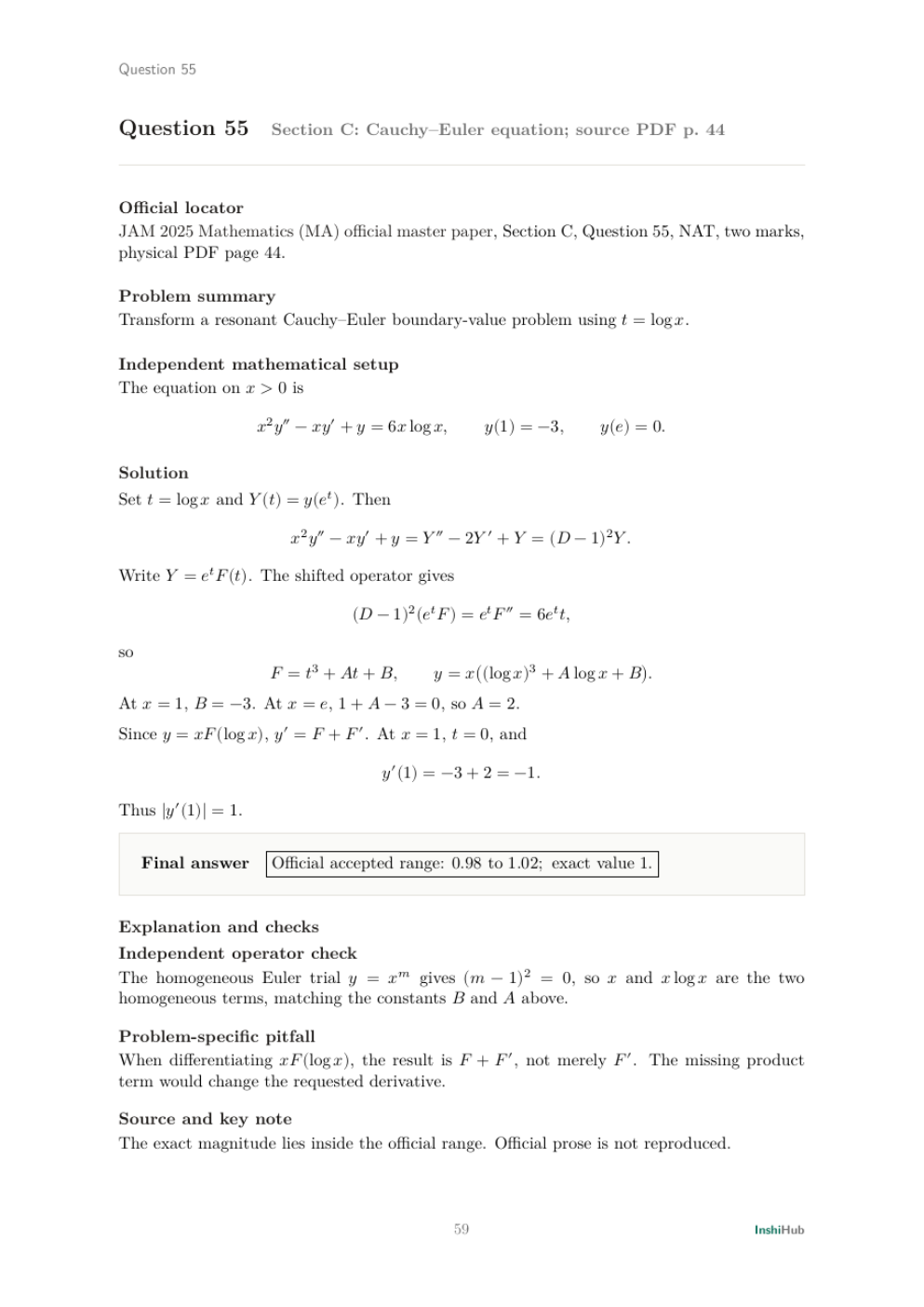
Section C · Q55 · NAT · 2 marks

Sample 5 — Two-mark NAT: Cauchy–Euler boundary-value equations

Transform a resonant Cauchy–Euler equation with t=log x and use two boundary values to recover the requested derivative magnitude.

Core idea

The substitution converts the Euler operator to (D−1)², and writing Y=eᵗF reduces the forced equation to F″=6t.

  1. 1Set t=log x and express the differential operator in t.
  2. 2Integrate the reduced equation and determine two constants from the boundary data.
  3. 3Differentiate xF(log x) correctly and evaluate at x=1.
Final response
Exact value 1; official accepted range 0.98–1.02.
Independent check
The homogeneous trial y=xᵐ gives a repeated root m=1, matching the x and x log x terms in the transformed solution.

Common pitfall: The derivative of xF(log x) is F+F′, not only F′.

Six-page exact-master preview

Cover plus one audited page for each HTML sample. The complete paid master is not stored in the public application.
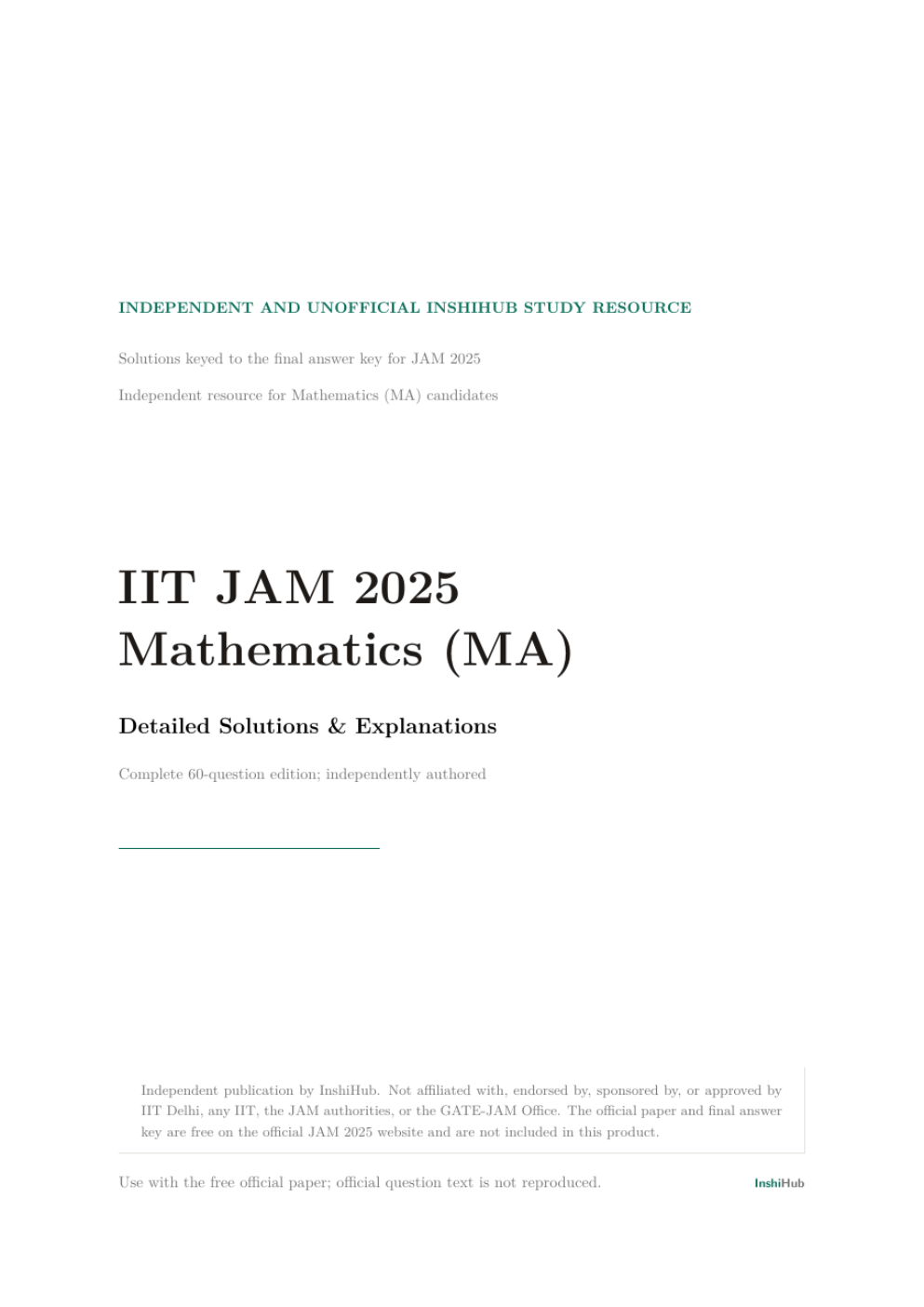
Preview page 1 of 6Sample · not the official paper
IIT JAM Mathematics 2025 — Detailed Solutions, preview page 1 of 6: Cover of the complete IIT JAM Mathematics 2025 guide.
Preview page 2 of 6Sample · not the official paper
IIT JAM Mathematics 2025 — Detailed Solutions, preview page 2 of 6: A detailed Section A MCQ solution with a separate mathematical check.
Preview page 3 of 6Sample · not the official paper
IIT JAM Mathematics 2025 — Detailed Solutions, preview page 3 of 6: A second Section A derivation showing a reusable method and pitfall.
Preview page 4 of 6Sample · not the official paper
IIT JAM Mathematics 2025 — Detailed Solutions, preview page 4 of 6: A detailed Section B MSQ solution with option-by-option reasoning.
Preview page 5 of 6Sample · not the official paper
IIT JAM Mathematics 2025 — Detailed Solutions, preview page 5 of 6: A detailed Section C NAT solution with exact value or accepted range.
Preview page 6 of 6Sample · not the official paper
IIT JAM Mathematics 2025 — Detailed Solutions, preview page 6 of 6: A later-paper solution showing independent verification and source-key mapping.

Product boundary

Included

  • All 60 questions and 100 marks in the official Mathematics paper.
  • Section A Q1–Q30 MCQ, Section B Q31–Q40 MSQ and Section C Q41–Q60 NAT.
  • Official response type, mark value and final-key result or accepted range for every locator.
  • Independently written mathematical setups, complete derivations and final responses.
  • A separate check and a question-specific pitfall on every solution page.
  • The official MTA status of Q57, with a separate bounded-region interpretation clearly labelled as non-authoritative.

Not included

  • Official question statements, option prose, figures, scans, logos and paper layout.
  • The official PDFs or any substitute for consulting the free official paper.
  • A claim of official affiliation, endorsement, sponsorship or approval.
  • A score, rank, admission, scholarship or examination-result guarantee.

Study loop

  1. 1Open the free official paper and attempt one question under a fixed time limit.
  2. 2Compare the first step where your reasoning diverged, not only the final response.
  3. 3Reproduce the independent derivation from a blank page without copying the guide.
  4. 4Run the separate check and record the named problem-specific pitfall.
  5. 5Retry the question after 48 hours, then assemble mixed timed sets from the full paper.

Questions about this guide

What does the IIT JAM Mathematics 2025 guide cover?

It covers all 60 questions and 100 marks: 30 MCQ, 10 MSQ and 20 NAT questions from the official Mathematics paper.

Does the guide reproduce the official JAM 2025 paper?

No. It uses official locators and independently written summaries, setups, derivations, checks and final-key mappings. The free official paper and final key are linked but not bundled.

How is Q57 handled?

The guide preserves the official final-key status MTA. Any separate calculation under an additional bounded-region interpretation is labelled as an independent interpretation, not as the official answer.

How should I use the guide?

Open the linked official paper, attempt one question under time, compare the first divergent step, reproduce the solution from a blank page and run the independent check before retrying.

Is purchase available now?

Yes. The complete guide is available as a one-time, tax-inclusive purchase for ₹1,499 with Dodo-hosted checkout and automatic PDF delivery after confirmed payment.

One-time purchase · tax inclusive

Buy the complete 65-page guide for ₹1,499

Sold and billed by Dodo Payments as the transaction seller and merchant of record. Fermion fulfils delivery through Dodo-hosted PDF access after confirmed payment.

Confirm all five statements before checkout

InshiHub records these five choices before redirecting. Review any separate terms, notices, and fields that Dodo displays before payment; they may differ from this InshiHub consent step.

Licence terms · Delivery · Refunds · Privacy · Dodo Buyer Terms · Dodo privacy · Dodo charge guidance