
InshiHubIndia

InshiHub independent mathematics guide

IIT JAM 2026 Mathematics — Independent Detailed Solutions

Work through the free official IIT JAM 2026 Mathematics paper with independently written derivations for every question. Review five complete samples covering MCQ, MSQ and NAT methods before deciding whether the guide fits your study plan.

  • 60 solution units
  • 30 MCQ · 10 MSQ · 20 NAT
  • English
  • Five reviewed samples

The five samples are available on this page. Paid access and checkout remain held until every commercial release gate passes.

Independent publication by InshiHub. Not affiliated with, endorsed by, sponsored by, or approved by IIT Bombay, the GATE-JAM Office, any IIT, or JAM. The official paper and final answer key are free on the official JAM 2026 website and are not included in this product.

Use the official paper with an independent solution guide

Use the free official IIT JAM 2026 Mathematics paper beside InshiHub's independent English guide. The complete guide covers all 60 items with original derivations, result checks, option-letter or NAT analysis, common traps, and reusable concept notes.

IIT JAM 2026 Mathematics exam format

The official pattern has 60 compulsory questions: 30 MCQ in Section A, 10 MSQ in Section B and 20 NAT in Section C, for a total of 100 marks.

Source-backed IIT JAM 2026 Mathematics exam-format facts
FactOfficial format
ExaminationJoint Admission Test for Masters 2026 — Mathematics (MA)
Test date and session15 February 2026 · Forenoon session
Delivery and languageComputer Based Test · English
Duration and marks180 minutes · 100 marks
Total items60 compulsory questions
Section AQ1-Q30: MCQ; Q1-Q10 carry 1 mark and Q11-Q30 carry 2 marks
MCQ markingOne correct choice; −1/3 for an incorrect 1-mark response and −2/3 for an incorrect 2-mark response; zero for no response
Section BQ31-Q40: ten 2-mark MSQ items with one or more correct choices
MSQ markingNo partial marking and no negative marking; zero for no response
Section CQ41-Q60: NAT; Q41-Q50 carry 1 mark and Q51-Q60 carry 2 marks
NAT markingA signed real number is entered with the virtual numeric keypad; no negative marking; zero for no response
CalculatorAn online virtual calculator was provided; physical calculators were not permitted
Key-order noteThe final key follows master-paper order; candidate-console question and option order may differ

Exam-format facts above are verified against the official JAM 2026 Information Brochure and the official Mathematics master-paper/final-key page. Always check the current official website for official records and later notices.

What the complete guide is designed to include

The complete guide contains 60 independently written solution units, one for each official Mathematics item.

  • An exact section and question-number locator for each of Q1-Q60.
  • A concise topic summary that does not replace the official question.
  • An independently written mathematical setup and complete derivation.
  • The derived answer letter, selected letter set, or NAT value/range.
  • Letter-by-letter reasoning for MCQ and MSQ without reproducing official option text.
  • NAT precision or accepted-range explanation where it matters.
  • A separate verification by substitution, limit, rank, counterexample, structural argument, or another appropriate method.
  • A problem-specific pitfall and a reusable concept note.
  • A source/key note and private correction trail.
  • English digital delivery after, and only after, every commercial release gate passes.

Five reviewed solution samples

Each HTML sample below is a complete solution, free to read. The image preview shows one page from the PDF for each of those questions, not the whole multi-page solution.

Cover and five exact-master preview pages

Preview pages 1-6 are taken from PDF pages 1 (cover), 6 (Q1), 54 (Q25), 68 (Q32), 86 (Q41), and 118 (Q57).

Preview page 1 of 6Sample · not the official paper
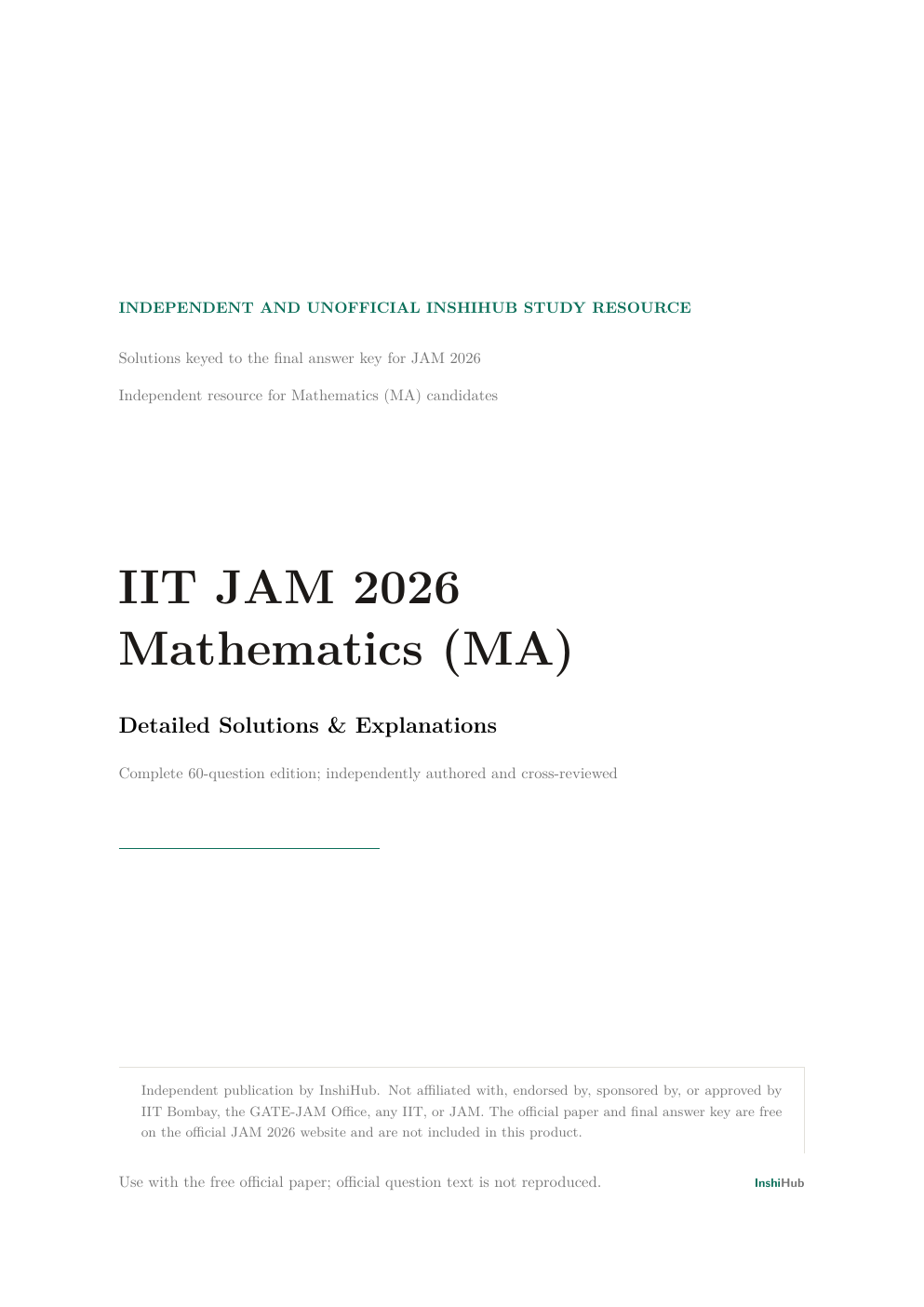
IIT JAM 2026 Mathematics — Independent Detailed Solutions, preview page 1 of 6: Cover of the 125-page IIT JAM 2026 Mathematics independent detailed-solutions guide.
Preview page 2 of 6Sample · not the official paper
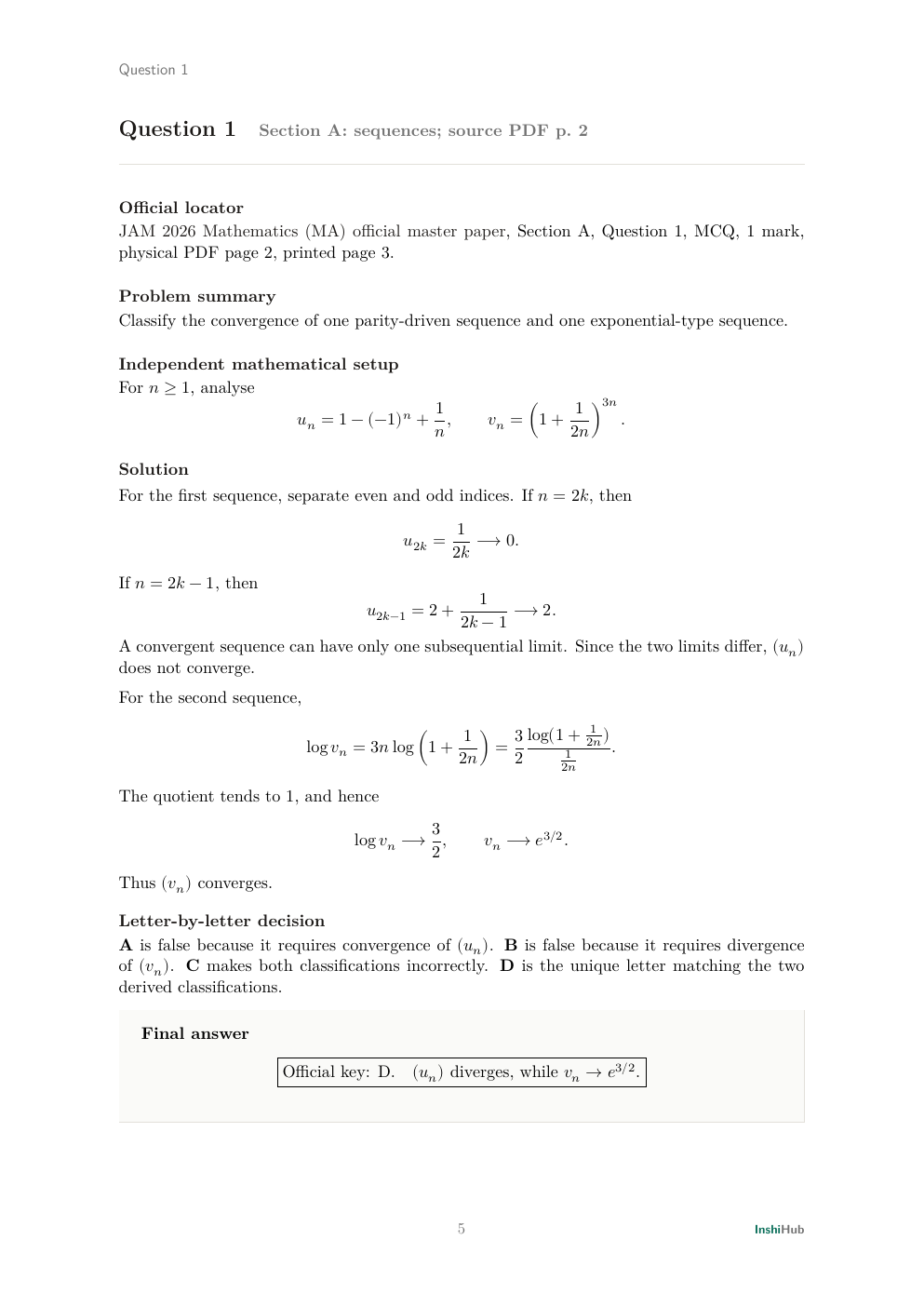
IIT JAM 2026 Mathematics — Independent Detailed Solutions, preview page 2 of 6: Question 1 solution using parity subsequences and an exponential limit.
Preview page 3 of 6Sample · not the official paper
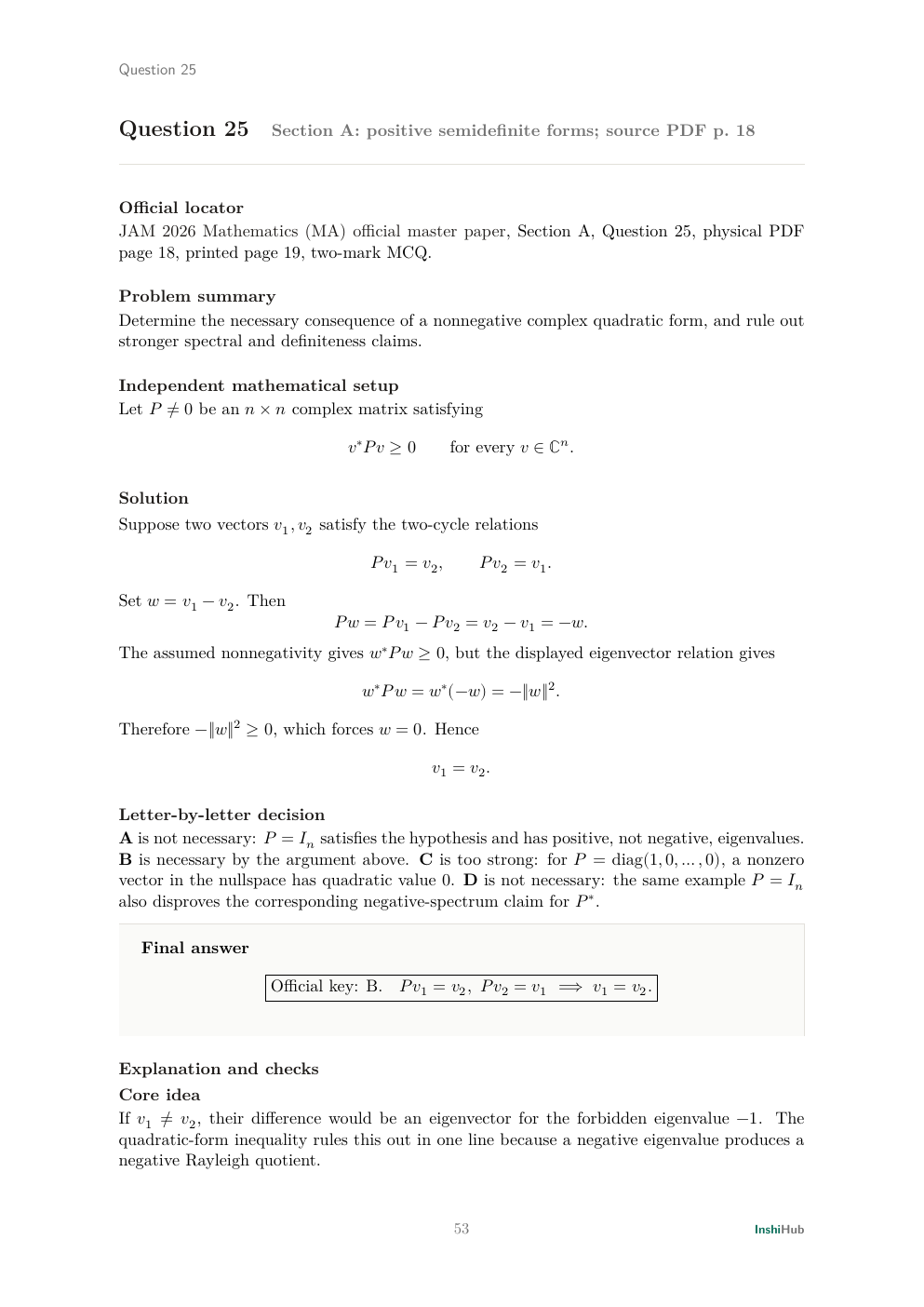
IIT JAM 2026 Mathematics — Independent Detailed Solutions, preview page 3 of 6: Question 25 solution using a positive semidefinite quadratic form to exclude a negative eigenvalue.
Preview page 4 of 6Sample · not the official paper
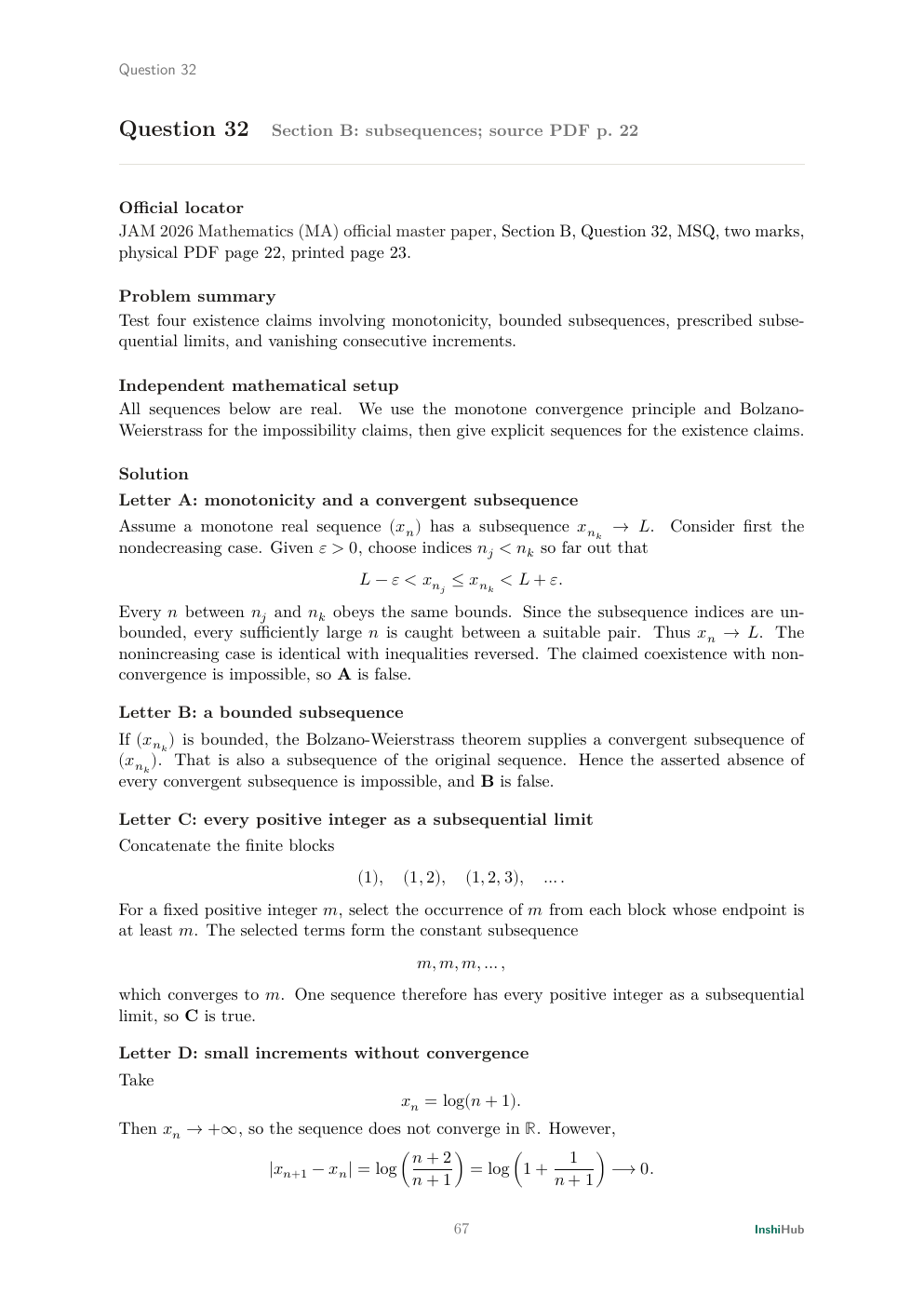
IIT JAM 2026 Mathematics — Independent Detailed Solutions, preview page 4 of 6: Question 32 solution testing subsequence claims with theorems and explicit examples.
Preview page 5 of 6Sample · not the official paper
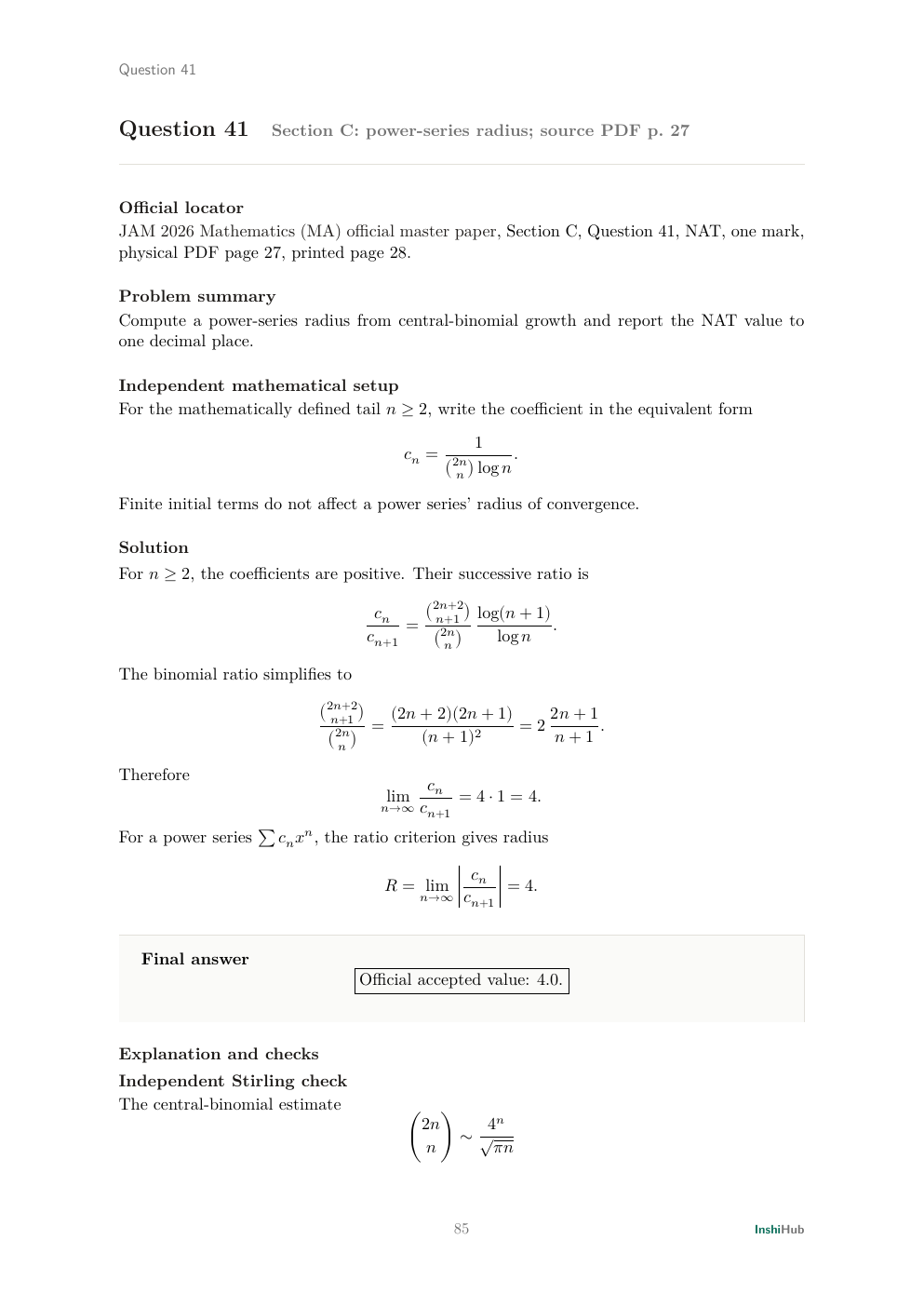
IIT JAM 2026 Mathematics — Independent Detailed Solutions, preview page 5 of 6: Question 41 solution computing a power-series radius while preserving the source-index caveat.
Preview page 6 of 6Sample · not the official paper
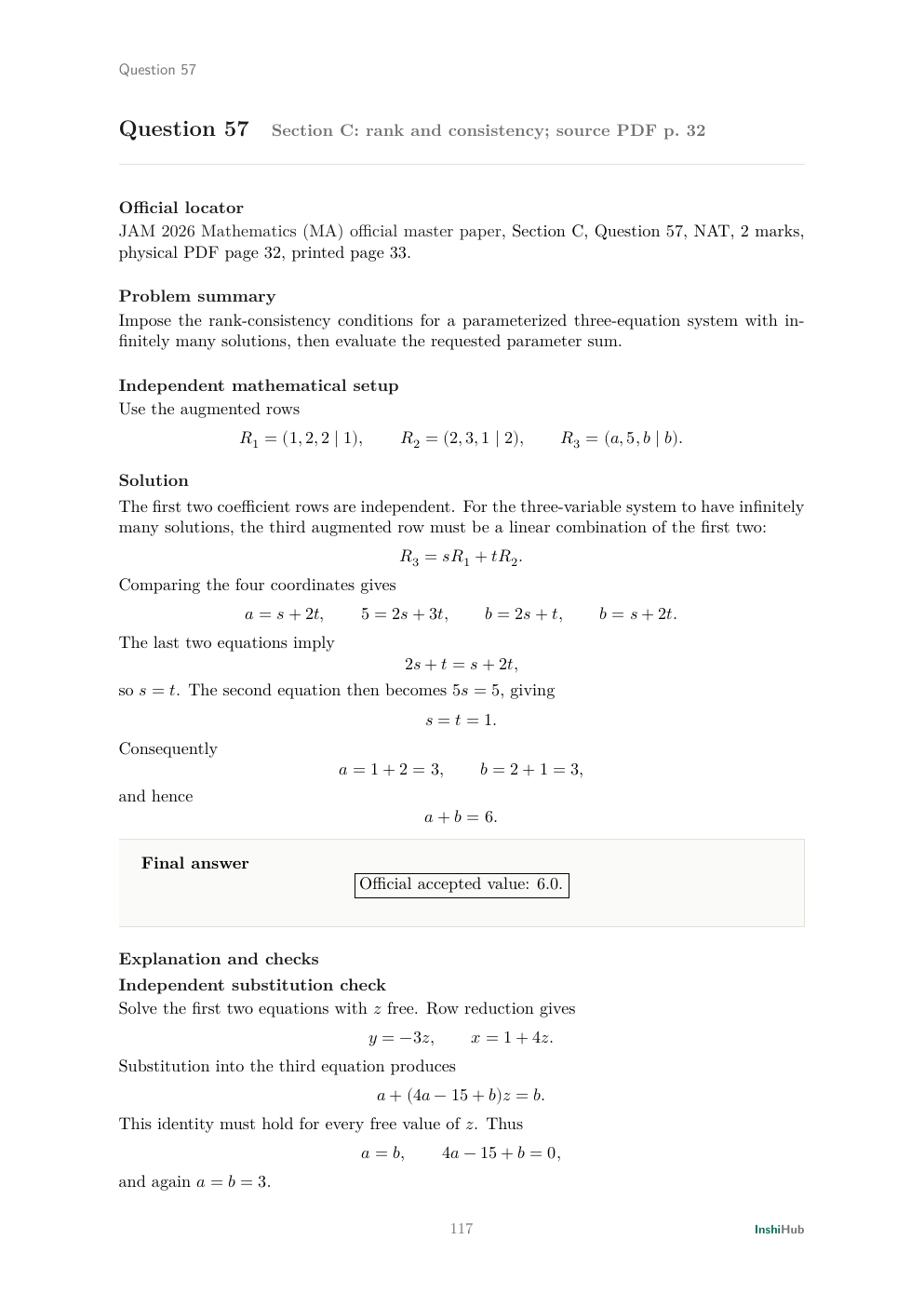
IIT JAM 2026 Mathematics — Independent Detailed Solutions, preview page 6 of 6: Question 57 solution checking rank and consistency for infinitely many solutions.

Independent publication by InshiHub. Not affiliated with, endorsed by, sponsored by, or approved by IIT Bombay, the GATE-JAM Office, any IIT, or JAM. The official paper and final answer key are free on the official JAM 2026 website and are not included in this product.

Sample 1 — One-mark MCQ

Question 1 · Sequences, subsequences and exponential limits

Review record
Independent mathematical and source-expression review passed on 29 July 2026. Use with official Q1; no official prompt or option text is included. Reviewed at .

Summary

Classify a parity-driven sequence and an exponential-type sequence using two different convergence tests. Keep the official Q1 open; this summary does not restate its prompt or answer choices.

Core idea

Split the oscillatory sequence into even and odd subsequences, then use a logarithmic or standard exponential limit for the second sequence.

Derivation

  1. 1Separate the first sequence into its even-indexed and odd-indexed subsequences.
  2. 2Their limits are 0 and 2, so the full first sequence cannot converge.
  3. 3Take logarithms of the second sequence to convert its power into a product.
  4. 4Apply the limit log(1+x)/x → 1 to obtain the exponent 3/2.
  5. 5Exponentiation gives the second limit e^(3/2), and the two derived classifications select letter D.

Final result

D — the first sequence diverges, while the second converges to e^(3/2).

Verification

Rewrite the second expression as a 3/2 power of a standard sequence tending to e; this independently returns e^(3/2).

Common pitfall

A vanishing correction does not remove a fixed parity oscillation. Check subsequences before applying a single-limit rule.

Sample 2 — Two-mark MCQ

Question 25 · Positive semidefinite quadratic forms

Review record
Independent mathematical and source-expression review passed after a locator-only correction on 29 July 2026; the mathematics and key were unchanged. Reviewed at .

Summary

Identify the necessary consequence of a nonnegative complex quadratic form and reject stronger spectral or definiteness claims. Keep the official Q25 open for the complete prompt and choices.

Core idea

Subtract the vectors in the stated two-cycle. Their difference would be an eigenvector with eigenvalue −1, which contradicts nonnegativity unless the difference is zero.

Derivation

  1. 1Let w be the difference of the two vectors appearing in the official relation.
  2. 2Linearity turns the two-cycle relation into Pw = −w.
  3. 3The hypothesis requires w*Pw ≥ 0.
  4. 4But Pw = −w gives w*Pw = −||w||², so w must be zero.
  5. 5The vectors therefore coincide; identity and singular positive semidefinite matrices dispose of the stronger lettered claims.

Final result

B — the two vectors in the stated cycle must be equal.

Verification

Polarization makes the matrix Hermitian positive semidefinite, whose eigenvalues are nonnegative; this independently rules out a nonzero −1 eigenvector.

Common pitfall

Do not assume the matrix is invertible or replace positive semidefinite with positive definite.

Sample 3 — Two-mark MSQ

Question 32 · Subsequences, monotonicity and Cauchy distinctions

Review record
Independent mathematical and source-expression review passed after locator/setup completeness corrections on 29 July 2026; the selected letters were unchanged. Reviewed at .

Summary

Test four existence claims about monotone sequences, bounded subsequences, prescribed subsequential limits, and vanishing consecutive increments. Read the four official claims on the owner-hosted paper.

Core idea

Use monotone convergence and Bolzano-Weierstrass for the impossible letters, then settle the remaining letters with explicit sequences.

Derivation

  1. 1A monotone real sequence with a finite convergent subsequence converges to the same limit, so letter A cannot occur.
  2. 2A bounded subsequence has a convergent subsubsequence by Bolzano-Weierstrass, so letter B cannot occur.
  3. 3Concatenate the finite blocks (1), (1,2), (1,2,3), …; every positive integer then appears along a constant subsequence, proving C.
  4. 4Use a divergent logarithmic sequence whose consecutive increments tend to zero to prove D.
  5. 5The proven letter set is therefore C and D.

Final result

C and D.

Verification

Monotone convergence gives a second proof for A, and harmonic partial sums provide an independent example for D.

Common pitfall

Consecutive increments tending to zero is much weaker than the Cauchy condition, which controls every sufficiently late pair.

Sample 4 — One-mark NAT

Question 41 · Power-series radius and central-binomial growth

Review record
Independent mathematical and source-expression review passed with the source-index caveat retained on 29 July 2026. InshiHub does not infer an official correction or explanation. Reviewed at .

Summary

Compute the radius determined by a central-binomial coefficient and a logarithmic factor. The official display has an undefined first term; the reviewed calculation works explicitly with the well-defined tail.

Core idea

Finite defined initial changes do not affect a radius of convergence. On the n ≥ 2 tail, a coefficient ratio tends to 4; a Cauchy-Hadamard/Stirling check gives the same value.

Derivation

  1. 1Separate the well-defined n ≥ 2 tail and do not silently assign a value to the undefined displayed first coefficient.
  2. 2Form the ratio of consecutive tail coefficients.
  3. 3The central-binomial ratio tends to 4, while the logarithmic ratio tends to 1.
  4. 4The power-series ratio criterion therefore gives radius R = 4.
  5. 5Report the one-decimal NAT entry 4.0, matching the final accepted range.

Final result

4.0.

Verification

The estimate C(2n,n) ~ 4^n/sqrt(πn) makes the coefficient nth-root tend to 1/4, so Cauchy-Hadamard independently gives R = 4.

Common pitfall

The logarithmic factor is subexponential and does not change the radius. The undefined first displayed term must be disclosed, not silently treated as an ordinary coefficient.

Sample 5 — Two-mark NAT

Question 57 · Rank, consistency and infinitely many solutions

Review record
Independent mathematical and source-expression review passed after locator/concept completeness corrections on 29 July 2026; the value and derivation were unchanged. Reviewed at .

Summary

Determine parameter values that make a three-equation linear system consistent with a free variable, then report the requested sum. Keep the official Q57 open for the system itself.

Core idea

Because the first two augmented rows are independent, the third augmented row must lie in their span. Matching every augmented coordinate enforces both rank loss and consistency.

Derivation

  1. 1Write the third augmented row as s times the first plus t times the second.
  2. 2Comparing the two coordinates tied to the repeated parameter forces s = t.
  3. 3The fixed-coordinate equation then gives s = t = 1.
  4. 4The two parameters are both 3, so their requested sum is 6.
  5. 5At those values the coefficient and augmented ranks are both 2 < 3, confirming infinitely many solutions.

Final result

6.0.

Verification

Solve the first two equations with one free variable and require the third equation to hold identically; this again gives both parameters equal to 3.

Common pitfall

A zero coefficient determinant is not enough. Infinite solutions require equal coefficient and augmented ranks below the number of unknowns.

Topic coverage across all 60 questions

This is an editorial topic map derived from the reviewed solution headings; it is not a reproduction of the official syllabus or paper.

Topic groupReviewed unitsWhat the guide teaches
Sequences, series and real analysisQ1, Q2, Q6, Q7, Q11-Q13, Q19, Q21, Q29, Q31-Q34, Q41-Q44, Q48Subsequence tests, convergence, continuity, derivative tests, power-series growth, limits, and integral arguments
Multivariable calculus and geometryQ5, Q10, Q15, Q17, Q20, Q22, Q36, Q46, Q52-Q55Changing integration order, polar or solid regions, critical points, partial derivatives, chain rules, and geometric integration
Differential equationsQ3, Q4, Q16, Q18, Q23, Q35, Q45, Q51Substitutions, orthogonal trajectories, integrating factors, exactness, factorised operators, and resonance
Linear algebraQ8, Q14, Q24, Q25, Q28, Q37, Q39, Q49, Q50, Q56, Q57, Q59Row operations, affine solution sets, nullspaces, positive semidefinite forms, isometries, eigenstructure, determinants, rank, and consistency
Abstract algebraQ9, Q26, Q27, Q30, Q40, Q47Groups, quotients, split extensions, representations, symmetric difference, quadratic fields, and cyclic-group maps
CombinatoricsQ38, Q58, Q60Alternating binomial sums, positive compositions, and binomial identities

Who this guide is for

This guide is designed for candidates who have the free official IIT JAM 2026 Mathematics paper and want to audit their own work against full, independently checked reasoning. It is most useful after a timed attempt: compare the first move, the derivation, the verification, and the recorded pitfall rather than reading only the final key.

It is not a substitute for learning the syllabus from the beginning, and it does not predict a future JAM paper. Candidates preparing for another year should use the current official syllabus and announcements as the controlling sources.

What is not included

The official source materials and services outside the independent written guide are not included.

  • The official question paper or final answer key.
  • Official question or answer-choice wording.
  • Official figures, scans, screenshots, logos, watermarks, typography, or paper layout.
  • The official syllabus or information brochure.
  • Video lessons, live classes, marking, tutoring, or admission counselling.
  • A promise of any score, rank, admission, scholarship, or result.
  • Future-year updates or coverage of another JAM paper unless separately stated and reviewed.

How each solution was checked

Every claim on this page describes the same finished 125-page PDF that the previews are taken from: 60 reviewed solutions, checked against the official paper and the final answer key.

  1. 1

    Official-source verification

    Question number, section, response type, marks, and final-key status were checked against the private official sources.

  2. 2

    Independent derivation

    A reviewer solved each item independently before relying on the authored explanation.

  3. 3

    Letter or range audit

    MCQ and MSQ letters were justified without reproducing official option text; NAT values and accepted ranges were checked separately.

  4. 4

    Second-method check

    Each unit includes an appropriate substitution, limit, counterexample, rank, structural, or numerical verification.

  5. 5

    Expression and rights review

    The guide was screened to exclude official prose, figures, scans, logos, watermark, typography and paper layout.

  6. 6

    Document QA

    The reviewed tranches were compiled and checked for mathematical completeness, English presentation, source dependencies, PDF integrity and rendered-page defects. The frozen paid master also passes PDF/UA-2 and WTPDF 1.0 Accessibility validation, with MathML attached to all 1,576 formula elements.

Price and paid-access status

Catalogue price: ₹1,499, inclusive of applicable tax. This is not an active offer. Checkout, payment and delivery remain held until the final consumer, tax, merchant, payment, delivery, refund and rights gates pass.

The complete guide has 125 A4 pages. No purchase, reservation or release-alert collection is currently enabled.

How to use the guide

Use the official paper as the controlling question source, then use the matching InshiHub unit to review your reasoning.

  1. 1Open the free official JAM 2026 Mathematics master paper from the official JAM website.
  2. 2Attempt a question under timed conditions before opening the matching InshiHub unit.
  3. 3Compare your first move and derivation, not only the final letter or number.
  4. 4Run the verification method and record the problem-specific pitfall.
  5. 5Return to the relevant topic group and retry the item without looking at the guide.

Frequently asked questions

These 13 answers define the guide's scope, source boundary, review status, catalogue price and paid-access status.

What is included in the IIT JAM 2026 Mathematics guide?

The complete guide contains 60 written solutions, one for each official Mathematics item. Each one gives a page reference to the official paper, a topic summary, the derivation, the final result, a second check, the common pitfall and a reusable concept note; MCQ and MSQ solutions also explain why each wrong choice fails, without reproducing official option text.

Does the guide include the official question paper or final answer key?

No. The official paper and final answer key remain free on the official JAM 2026 website and are not bundled, mirrored, embedded or delivered by InshiHub. Use the official paper beside the guide.

Is this an official IIT Bombay or JAM publication?

Independent publication by InshiHub. Not affiliated with, endorsed by, sponsored by, or approved by IIT Bombay, the GATE-JAM Office, any IIT, or JAM. The official paper and final answer key are free on the official JAM 2026 website and are not included in this product.

How many questions and response types were in IIT JAM 2026 Mathematics?

The official pattern has 60 compulsory questions: 30 MCQ in Section A, 10 MSQ in Section B and 20 NAT in Section C, for a total of 100 marks.

What were the negative-marking rules?

For MCQ, an incorrect 1-mark response incurred −1/3 and an incorrect 2-mark response incurred −2/3. MSQ and NAT had no negative marking. MSQ also had no partial marking. A question left unanswered carried zero marks.

Are all 60 results independently checked?

Yes. The 60-unit solution set was reviewed in four 15-question tranches. Reviewers independently derived each result before comparing it with the authored unit and final key, and documented corrections where needed. Paid access remains held until the artifact and commercial release gates pass.

Which five samples are available?

The available samples are Q1, Q25, Q32, Q41 and Q57. Together they demonstrate one-mark MCQ, two-mark MCQ, MSQ, one-mark NAT and two-mark NAT reasoning across sequences, positive semidefinite forms, subsequences, power-series growth and linear-system consistency.

Why does the Q41 sample include a source caveat?

The official display begins at an index where its logarithmic denominator is zero, so the first displayed coefficient is undefined. The InshiHub solution states this explicitly and computes the radius from the well-defined tail, which gives 4.0 and agrees with the final accepted value. InshiHub does not infer an official correction or explanation.

What language and format does the guide use?

The guide is a 125-page English digital document for the en-IN locale. Six lossless preview images are hash-bound to its audited master; the complete paid PDF is not placed in the public application.

What is the catalogue price?

The catalogue price is ₹1,499, inclusive of applicable tax. It is not an active offer while checkout, payment and delivery remain held behind the commercial release gates.

Can I buy or reserve the guide now?

No. Paid access is currently held, and no purchase, reservation, payment or release-alert collection is enabled. A later commercial release requires a separately verified checkout total, receipt, payment flow, delivery, refund process and rights review.

How will corrections be handled?

Every material correction must be linked to the affected unit, independently reviewed, and propagated to the frozen guide, HTML sample and PDF sample where applicable. The final customer-facing correction policy and redownload process must pass the commercial release gate before checkout opens.

How should I use the official final key with this guide?

Use the official key to confirm the final letter set or accepted NAT range, then use the InshiHub derivation and verification to understand why the result holds. The official page notes that the final key follows master-paper order, which can differ from candidate-console order.

Official JAM 2026 sources

Use owner-hosted links only. InshiHub does not mirror, proxy, cache, embed or package the official files.

Official Mathematics syllabus

Check the official JAM 2026 syllabus page for the Mathematics syllabus used by the organising institute. The topic map on this product page is InshiHub's editorial map of the reviewed 2026 solution units, not a copy of the official syllabus.

Open the official JAM 2026 syllabus page (opens in a new tab)

Independent-publication notice

Independent publication by InshiHub. Not affiliated with, endorsed by, sponsored by, or approved by IIT Bombay, the GATE-JAM Office, any IIT, or JAM. The official paper and final answer key are free on the official JAM 2026 website and are not included in this product.