InshiHubIndia

Complete IIT JAM Mathematics guide

IIT JAM Mathematics 2024 — Detailed Solutions

Work through the complete IIT JAM Mathematics 2024 paper with independently authored derivations, verification checks and practical revision cues.

  • 65 pages
  • 60 questions · 100 marks · 30 MCQ · 10 MSQ · 20 NAT
  • English
  • ₹1,499 held catalogue price

Official sources and editorial boundary

Independent and unofficial InshiHub study guide. Not affiliated with, endorsed by, sponsored by or approved by IIT Madras, any IIT or JAM. The official master paper and final answer key remain free at the linked official source; they are not included in this product.

Format facts

Organising institute
IIT Madras
Delivery and duration
English · Computer Based Test · 180 minutes
Questions and marks
60 questions carrying 100 marks
Section A
Q1–Q30 · MCQ · 50 marks
Section B
Q31–Q40 · MSQ · 20 marks
Section C
Q41–Q60 · NAT · 30 marks
Editorial method
Original summaries, setups, derivations and checks; no official problem or option prose reproduced

Coverage map

Across Q1–Q60

Sequences and real analysis

Limits, continuity, differentiability, series, integration and convergence tests

Across Q1–Q60

Multivariable calculus

Partial derivatives, extrema, multiple integrals and vector-calculus arguments

Across Q1–Q60

Differential equations

First-order methods, linear equations, Cauchy–Euler equations and boundary data

Across Q1–Q60

Linear algebra

Vector spaces, linear maps, matrices, eigenvalues, inner products and quadratic forms

Across Q1–Q60

Groups and algebra

Groups, subgroups, homomorphisms, cyclic structure and polynomial reasoning

Five complete HTML samples

Section A · Q1 · MCQ · 1 mark

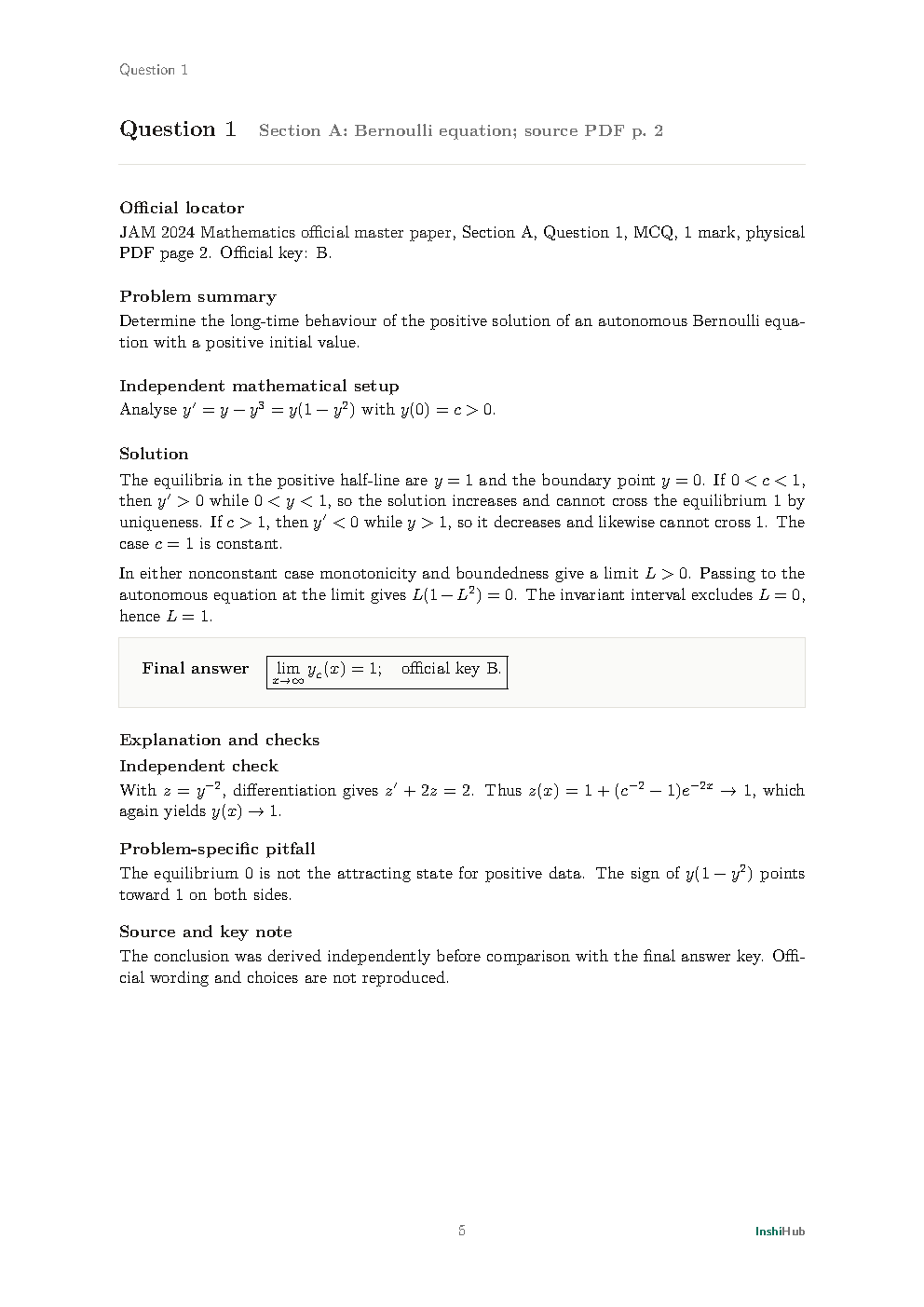
Sample 1 — One-mark MCQ: Long-time behaviour of a Bernoulli equation

Determine the attracting equilibrium for a positive solution of an autonomous cubic differential equation.

Core idea

The vector field points toward 1 on both sides, while uniqueness prevents a positive solution from crossing that equilibrium.

  1. 1Separate the cases below, at and above the positive equilibrium.
  2. 2Use monotonicity and invariant intervals to obtain a positive limit.
  3. 3Insert the limit into the autonomous equation to identify it.
Final response
B, with limiting value 1.
Independent check
The substitution z=y^(−2) gives z′+2z=2 and an explicit solution tending to 1.

Common pitfall: For positive initial data, the sign of y(1−y²) points toward 1, not toward 0.

Section A · Q12 · MCQ · 2 marks

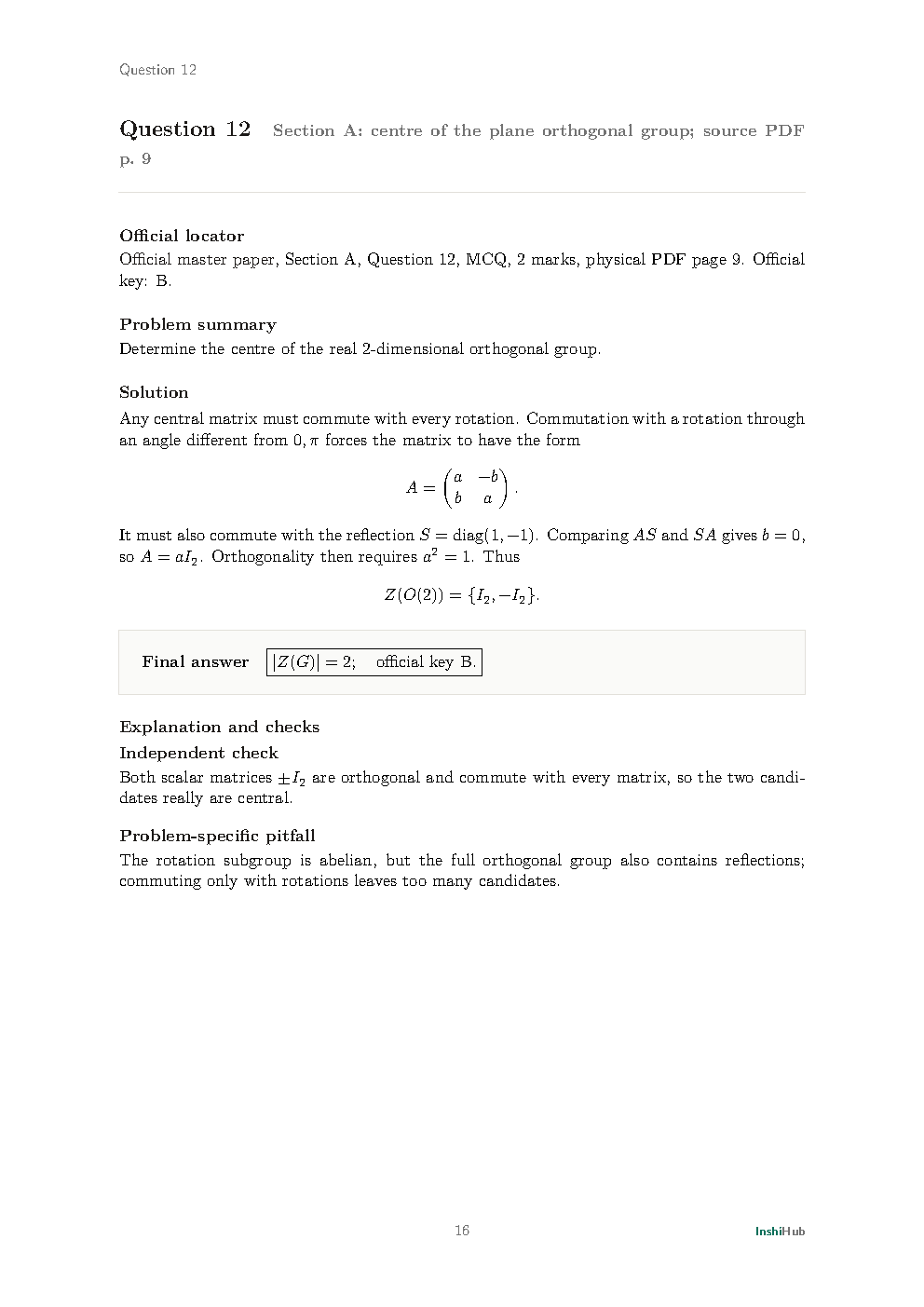
Sample 2 — Two-mark MCQ: Centre of the plane orthogonal group

Determine the matrices that commute with every rotation and reflection in O(2).

Core idea

Commuting with rotations gives a complex-scalar form, and commuting with one reflection eliminates its skew component.

  1. 1Use a nontrivial rotation to constrain the central matrix form.
  2. 2Commute that form with a coordinate reflection.
  3. 3Impose orthogonality on the remaining scalar matrix.
Final response
B — the centre has two elements, ±I.
Independent check
Both scalar matrices ±I are orthogonal and visibly commute with every 2×2 matrix.

Common pitfall: The rotation subgroup is abelian, but the full orthogonal group also contains reflections.

Section A · Q25 · MCQ · 2 marks

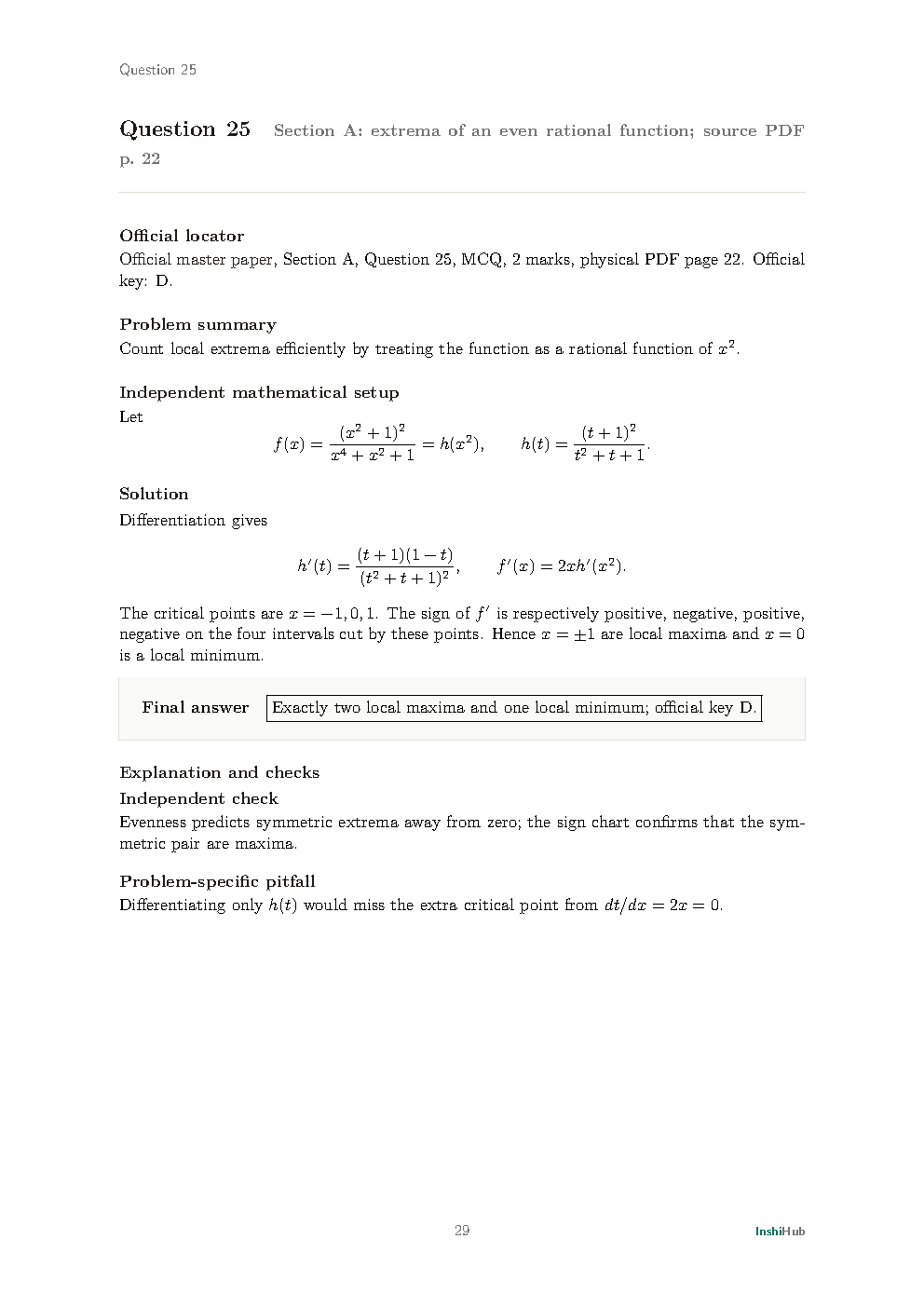
Sample 3 — Two-mark MCQ: Extrema of an even rational function

Count local maxima and minima efficiently by viewing an even rational function as h(x²).

Core idea

Differentiate h with respect to t=x², then include the extra critical point created by dt/dx=2x.

  1. 1Rewrite the rational function as h(x²).
  2. 2Factor h′(t) and combine it with the factor 2x.
  3. 3Build a sign chart at x=−1, 0 and 1.
Final response
D — two local maxima and one local minimum.
Independent check
Evenness predicts a symmetric pair of off-origin extrema, and the sign chart identifies them as maxima.

Common pitfall: Differentiating only h(t) misses the critical point x=0.

Section B · Q40 · MSQ · 2 marks

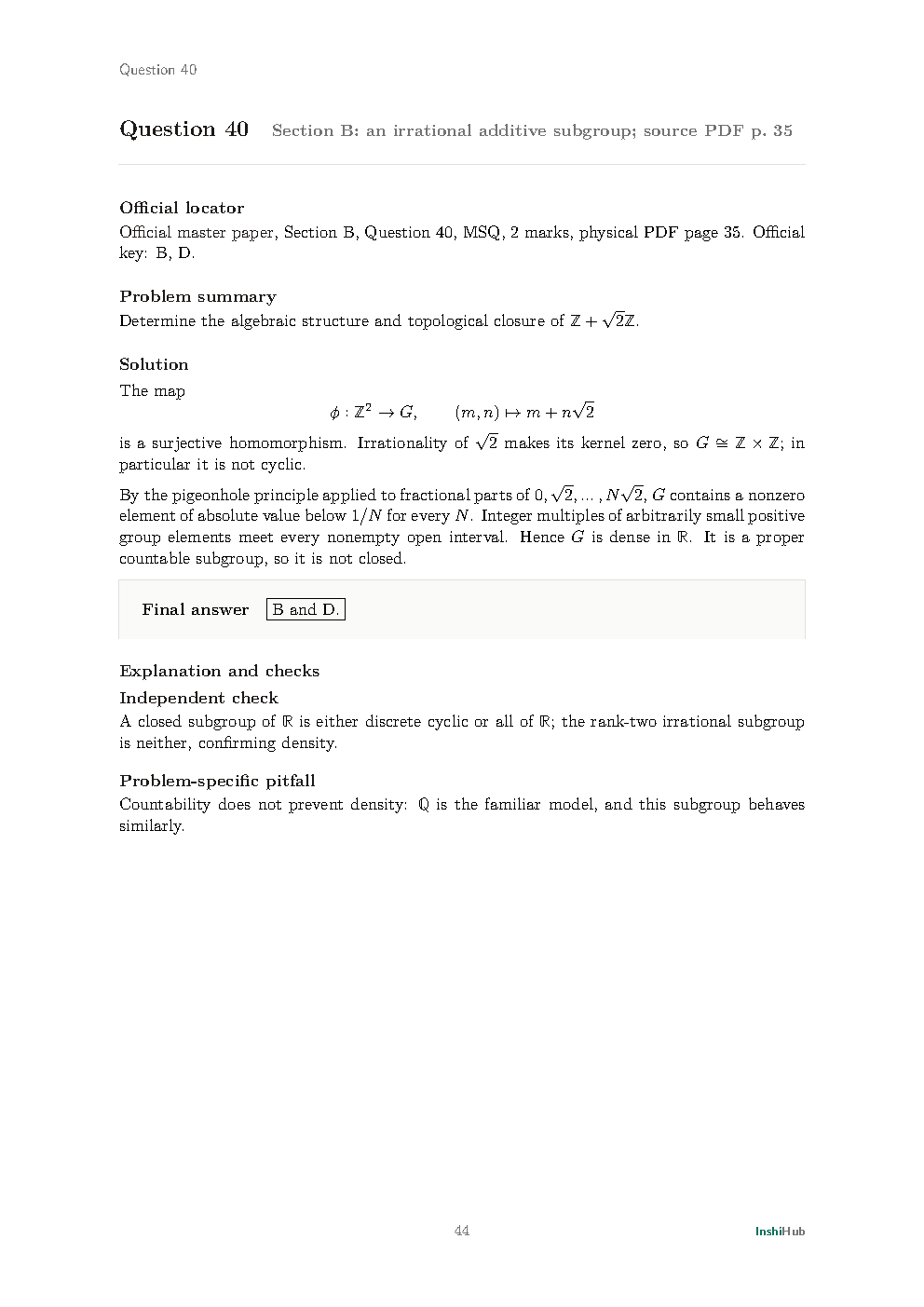
Sample 4 — Two-mark MSQ: An irrational additive subgroup of the real line

Determine the abstract group structure and topological closure of Z+√2Z.

Core idea

Irrationality makes the group free of rank two, while arbitrarily small nonzero elements make it dense in the real line.

  1. 1Prove the natural map from Z² has zero kernel.
  2. 2Use pigeonhole approximation to find nonzero elements arbitrarily close to zero.
  3. 3Use their integer multiples to meet every open interval.
Final response
B and D.
Independent check
A closed subgroup of R is discrete cyclic or all of R; this proper rank-two subgroup is neither.

Common pitfall: Countability does not prevent density; the rational numbers are the familiar counterexample.

Section C · Q55 · NAT · 2 marks

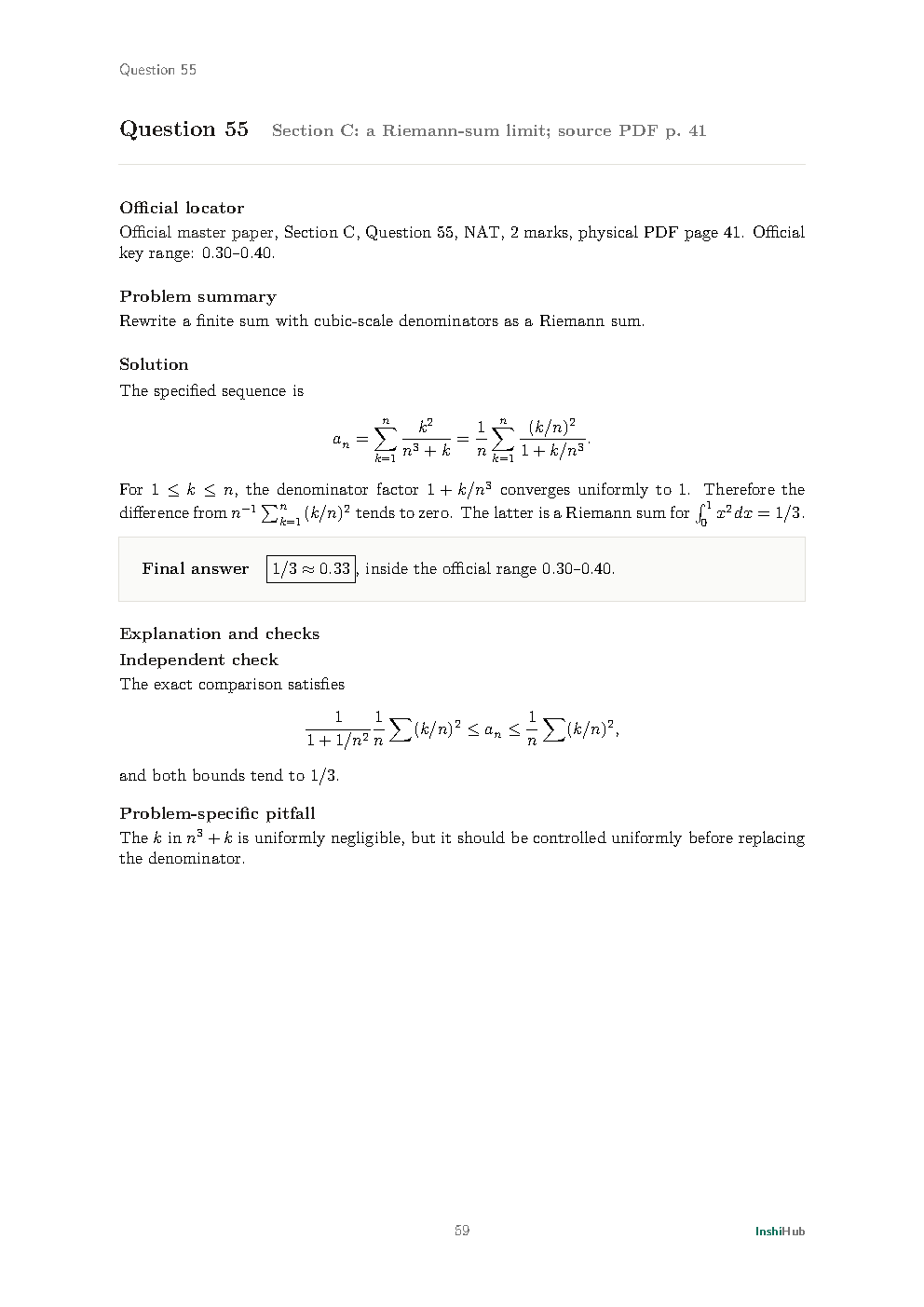
Sample 5 — Two-mark NAT: A Riemann-sum limit

Rewrite a finite sum with cubic-scale denominators as a Riemann sum and control the denominator replacement uniformly.

Core idea

After extracting 1/n, the denominator factor tends uniformly to 1 and the numerator samples x² on [0,1].

  1. 1Scale k by n and rewrite the sum with a 1/n factor.
  2. 2Bound the denominator correction uniformly over 1≤k≤n.
  3. 3Take the limit as the integral of x² from 0 to 1.
Final response
1/3≈0.33, inside the official range 0.30–0.40.
Independent check
Two explicit comparison sums squeeze the expression to the same Riemann-sum limit.

Common pitfall: The denominator perturbation is small only after proving a uniform bound in k.

Six-page exact-master preview

Cover plus one audited page for each HTML sample. The complete paid master is not stored in the public application.
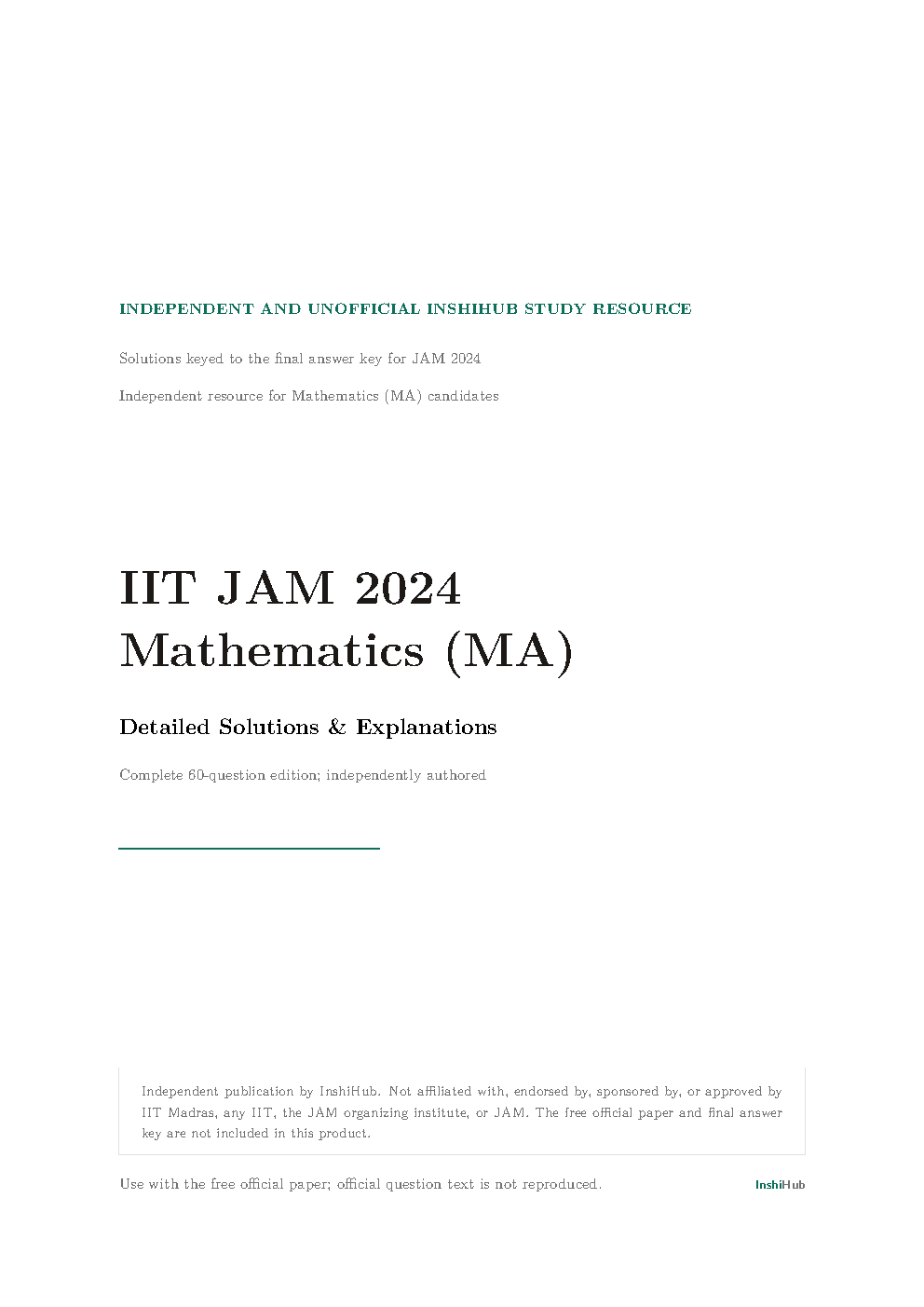
Preview page 1 of 6Sample · not the official paper
IIT JAM Mathematics 2024 — Detailed Solutions, preview page 1 of 6: Cover of the complete IIT JAM Mathematics 2024 guide.
Preview page 2 of 6Sample · not the official paper
IIT JAM Mathematics 2024 — Detailed Solutions, preview page 2 of 6: A detailed Section A MCQ solution with a separate mathematical check.
Preview page 3 of 6Sample · not the official paper
IIT JAM Mathematics 2024 — Detailed Solutions, preview page 3 of 6: A second Section A derivation showing a reusable method and pitfall.
Preview page 4 of 6Sample · not the official paper
IIT JAM Mathematics 2024 — Detailed Solutions, preview page 4 of 6: A detailed Section B MSQ solution with option-by-option reasoning.
Preview page 5 of 6Sample · not the official paper
IIT JAM Mathematics 2024 — Detailed Solutions, preview page 5 of 6: A detailed Section C NAT solution with exact value or accepted range.
Preview page 6 of 6Sample · not the official paper
IIT JAM Mathematics 2024 — Detailed Solutions, preview page 6 of 6: A later-paper solution showing independent verification and source-key mapping.

Product boundary

Included

  • All 60 questions and 100 marks in the official Mathematics paper.
  • Section A Q1–Q30 MCQ, Section B Q31–Q40 MSQ and Section C Q41–Q60 NAT.
  • Official response type, mark value and final-key result or accepted range for every locator.
  • Independently written mathematical setups, complete derivations and final responses.
  • A separate check and a question-specific pitfall on every solution page.
  • A tagged PDF 2.0 master that passes PDF/UA-2 and WTPDF accessibility validation.

Not included

  • Official question statements, option prose, figures, scans, logos and paper layout.
  • The official PDFs or any substitute for consulting the free official paper.
  • A claim of official affiliation, endorsement, sponsorship or approval.
  • A score, rank, admission, scholarship or examination-result guarantee.

Study loop

  1. 1Open the free official paper and attempt one question under a fixed time limit.
  2. 2Compare the first step where your reasoning diverged, not only the final response.
  3. 3Reproduce the independent derivation from a blank page without copying the guide.
  4. 4Run the separate check and record the named problem-specific pitfall.
  5. 5Retry the question after 48 hours, then assemble mixed timed sets from the full paper.

Questions about this guide

What does the IIT JAM Mathematics 2024 guide cover?

It covers all 60 questions and 100 marks: 30 MCQ, 10 MSQ and 20 NAT questions from the official Mathematics paper.

Does the guide reproduce the official JAM 2024 paper?

No. It uses official locators and independently written summaries, setups, derivations, checks and final-key mappings. The free official paper and final key are linked but not bundled.

Is the PDF accessible?

The frozen 65-page PDF 2.0 master is tagged and passes PDF/UA-2 and WTPDF accessibility validation. Its mathematical formulae have associated MathML.

How should I use the guide?

Open the linked official paper, attempt one question under time, compare the first divergent step, reproduce the solution from a blank page and run the independent check before retrying.

Is purchase available now?

Yes. The complete guide is available as a one-time, tax-inclusive purchase for ₹1,499 with Dodo-hosted checkout and automatic PDF delivery after confirmed payment.

One-time purchase · tax inclusive

Buy the complete 65-page guide for ₹1,499

Sold and billed by Dodo Payments as the transaction seller and merchant of record. Fermion fulfils delivery through Dodo-hosted PDF access after confirmed payment.

Confirm all five statements before checkout

InshiHub records these five choices before redirecting. Review any separate terms, notices, and fields that Dodo displays before payment; they may differ from this InshiHub consent step.

Licence terms · Delivery · Refunds · Privacy · Dodo Buyer Terms · Dodo privacy · Dodo charge guidance