
Practices 1–4
Multivariable Taylor theory
Mixed coefficients, Hessian data, degenerate critical points and approximation control
Original GATE Mathematics practice
Build working command of the 15 revised-focus areas with a 60-question original paper, complete derivations, verification stress tests and targeted remediation.
Independent and unofficial InshiHub publication. Not affiliated with, endorsed by, sponsored by or approved by IIT Madras, any IIT or GATE. Every practice problem and solution is independently authored. No official question, answer choice, figure, logo or paper is included.
Practices 1–4
Mixed coefficients, Hessian data, degenerate critical points and approximation control
Practices 5–8
Forward and inverse determinants, transformed regions, integrals and singular-map conditions
Practices 9–12
Closed covers, nowhere-dense sets, completeness and a missing-hypothesis counterexample
Practices 13–16
Sequential tests, compact domains, Lipschitz bounds and unbounded-domain failure
Practices 17–20
Endpoint membership, norms, finite-measure inclusions and almost-everywhere equality
Practices 21–24
Definition, shifts, convolution, initial data and an ODE application
Practices 25–28
Primary decomposition, isomorphism classes, element orders and invariant factors
Practices 29–32
Identity counterexample, finite-rank approximation, diagonal errors and norm closure
Practices 33–36
Dense sets, nonseparable examples, functional norms and dual-basis reasoning
Practices 37–40
Boundary extrema, the strong principle, uniqueness and explicit harmonic data
Practices 41–44
Standard paths, continuous images, products, retracts and component counting
Practices 45–48
Subsequences, metric-space equivalence, continuous images and endpoint failures
Practices 49–52
Infinite-subset criteria, accumulation points, metric equivalence and subspace traps
Practices 53–56
Arbitrary compact products, box topology, cylinder neighbourhoods and a metric trap
Practices 57–60
Normality, closed subsets, bounded extensions and failure when a condition is removed
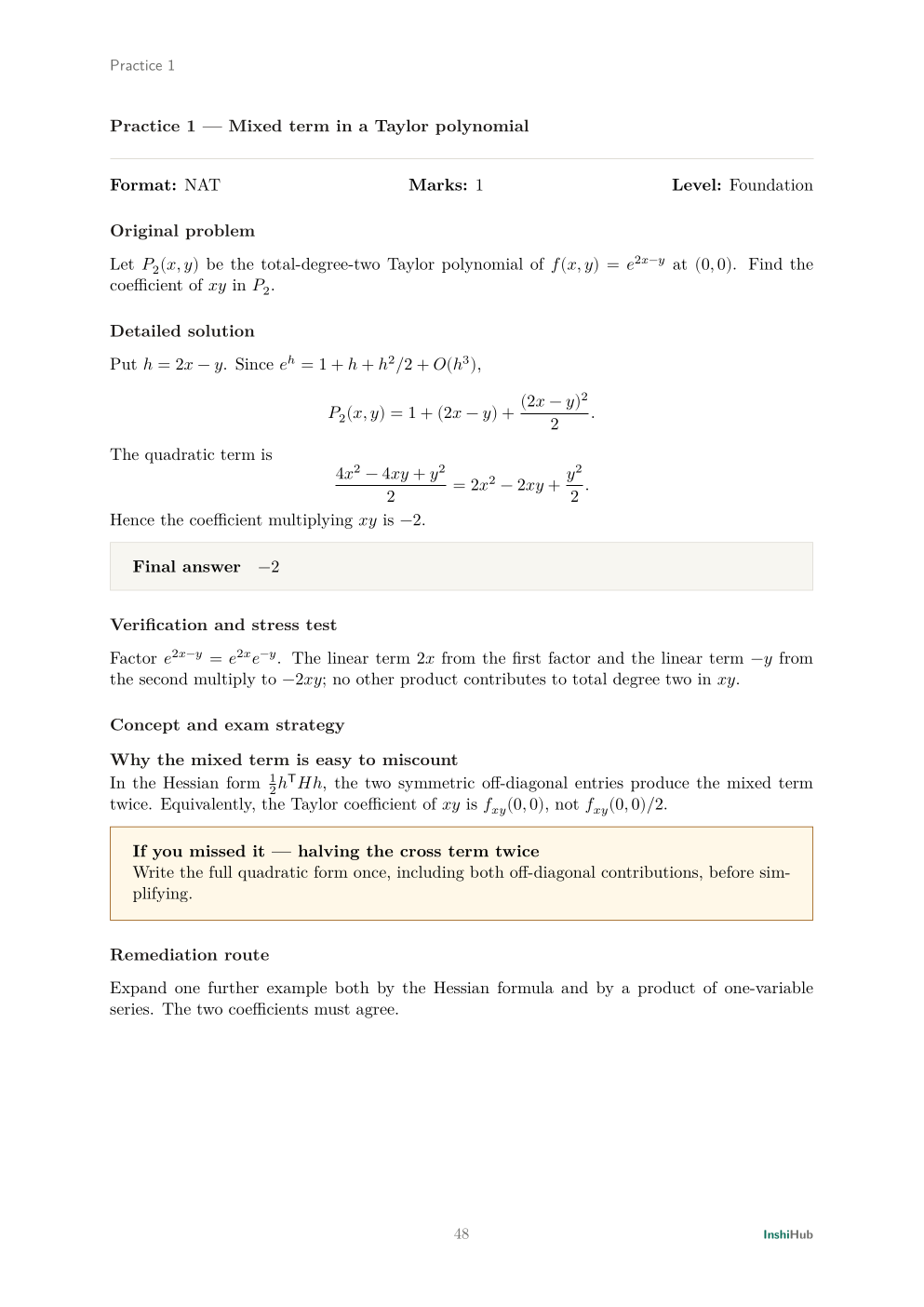
Module 1 · Practice 1 · NAT · 1 mark
Find a mixed second-degree coefficient in the Taylor polynomial of an exponential function of two variables.
Core idea
Expand the one-variable exponential in the linear form 2x−y and track the cross term without halving it twice.
Common pitfall: In the Hessian form, the two symmetric off-diagonal terms already create the factor of two. Do not halve the cross term twice.
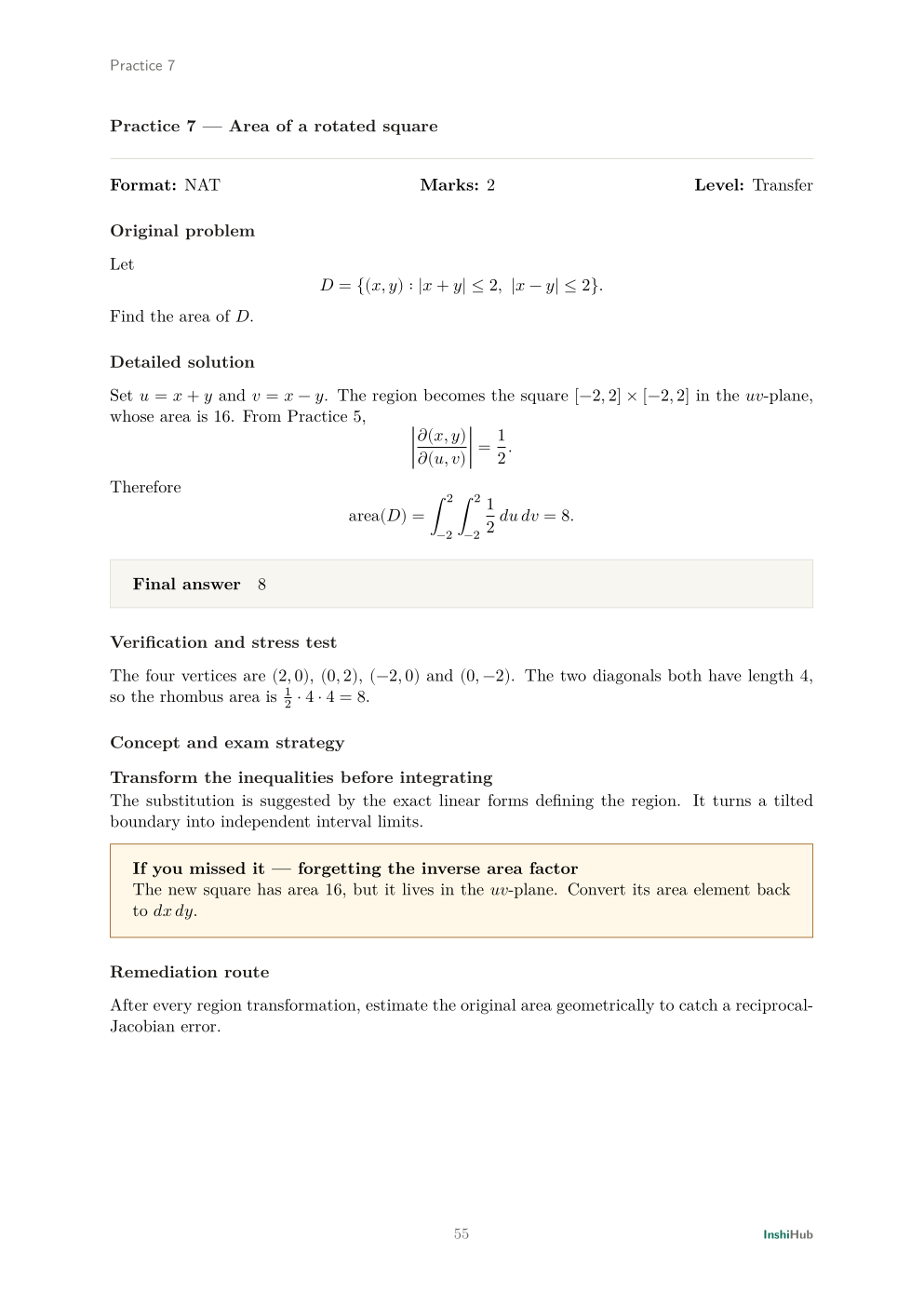
Module 2 · Practice 7 · NAT · 2 marks
Transform a diamond-shaped region defined by x+y and x−y inequalities and compute its area.
Core idea
The substitution u=x+y, v=x−y turns the region into a square; the inverse Jacobian converts its area element back.
Common pitfall: The transformed square lives in the uv-plane. Forgetting the inverse Jacobian gives an answer twice as large.
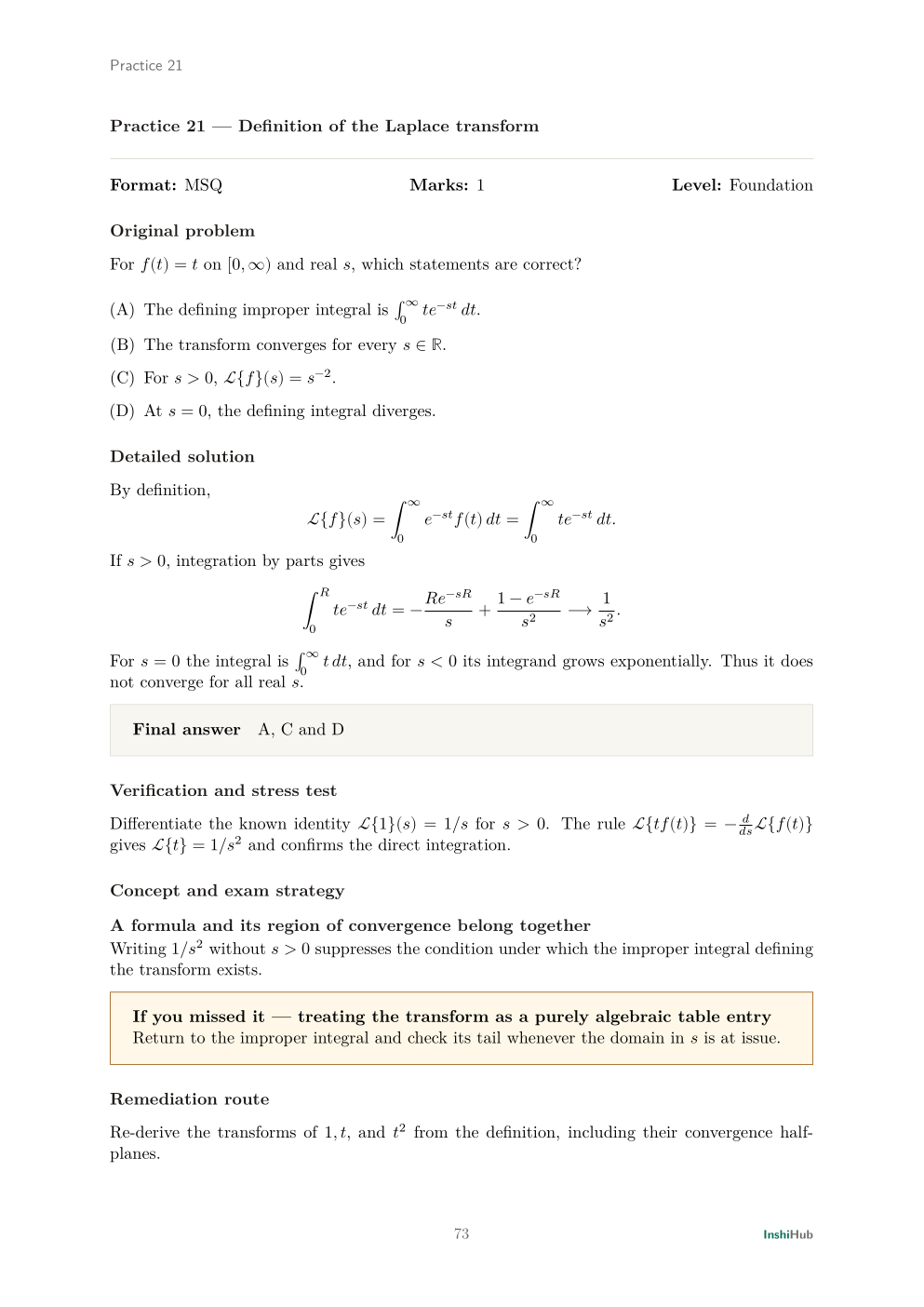
Module 6 · Practice 21 · MSQ · 1 mark
Audit four statements about the defining integral, value and convergence region of the Laplace transform of t.
Core idea
Evaluate the improper integral by parts and keep the condition s>0 attached to the formula 1/s².
Common pitfall: A transform formula is incomplete without its region of convergence.
Module 11 · Practice 41 · MCQ · 1 mark
Identify the only non-path-connected set among four familiar subsets of the plane.
Core idea
The two branches of xy=1 cannot be joined because the continuous first coordinate cannot change sign without passing through zero.
Common pitfall: A set described by one equation need not have one path component.
Module 15 · Practice 57 · MSQ · 1 mark
Select the correct theorem conditions and range conclusion for bounded real-valued Tietze extension.
Core idea
The ambient space is normal, the original domain is closed and a bounded interval range can be preserved; uniqueness is not asserted.
Common pitfall: Metric spaces are normal, but the subset must still be closed before Tietze applies.
Cover plus one audited page for each HTML sample. The complete paid master is not stored in the public application.
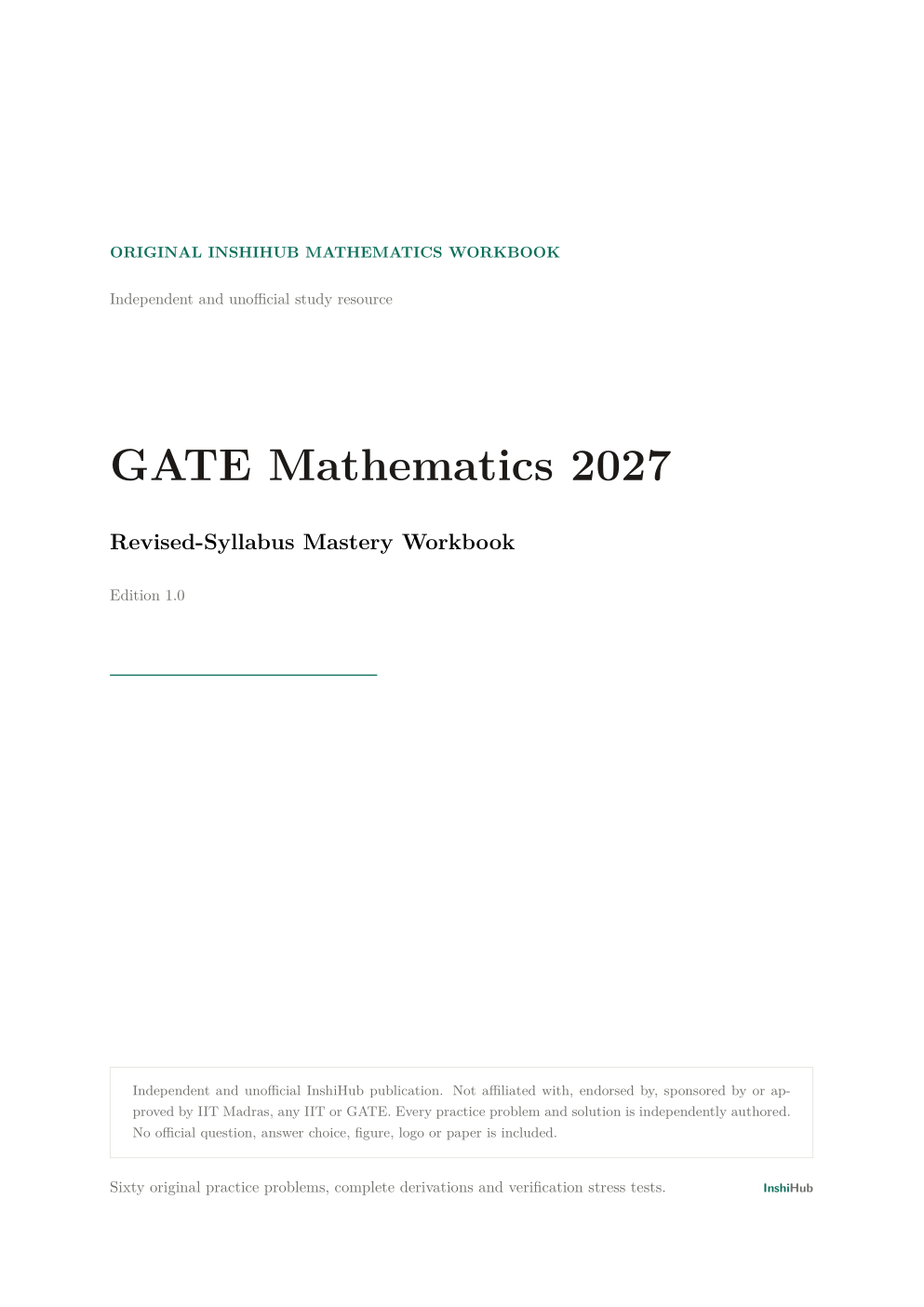
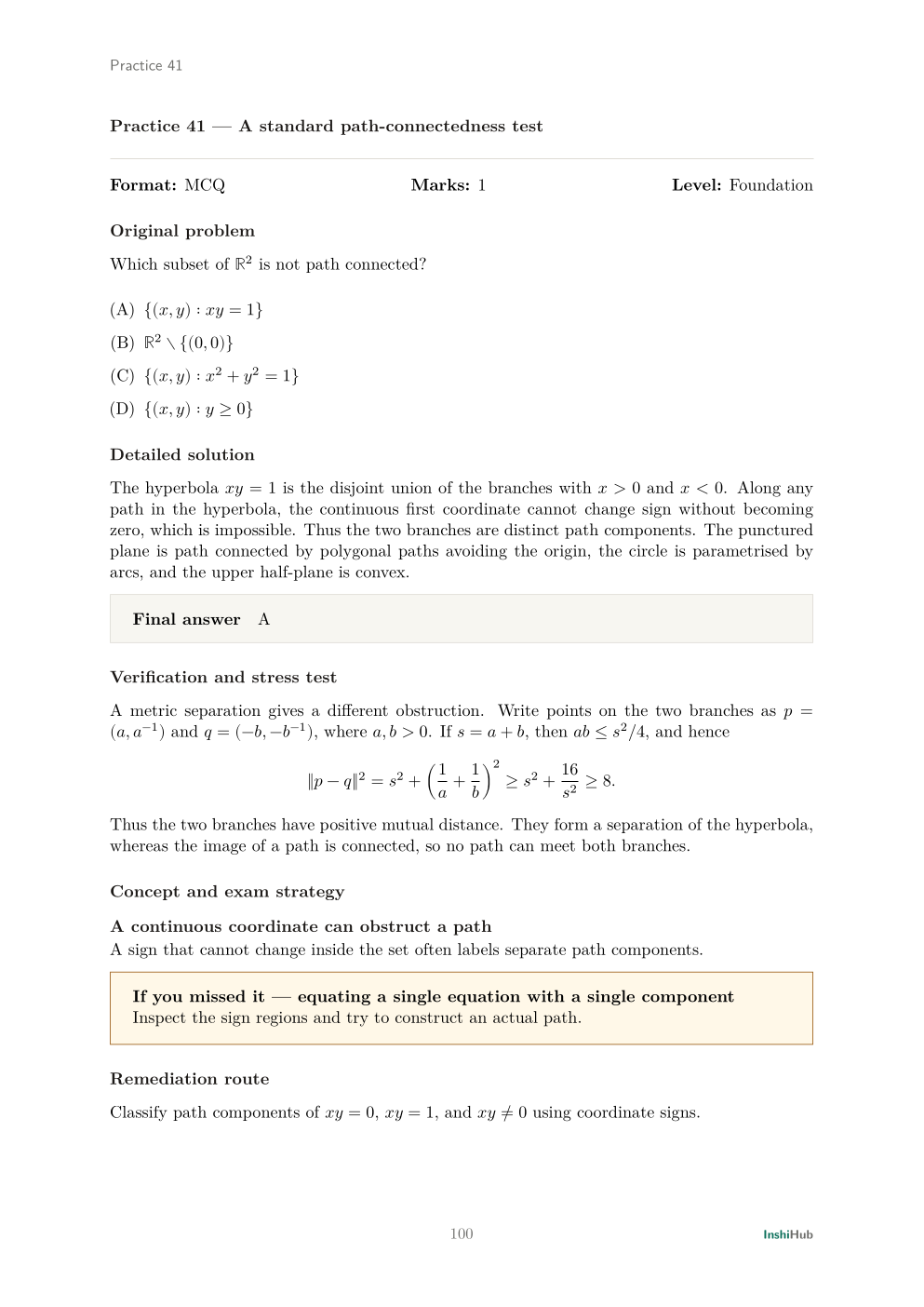
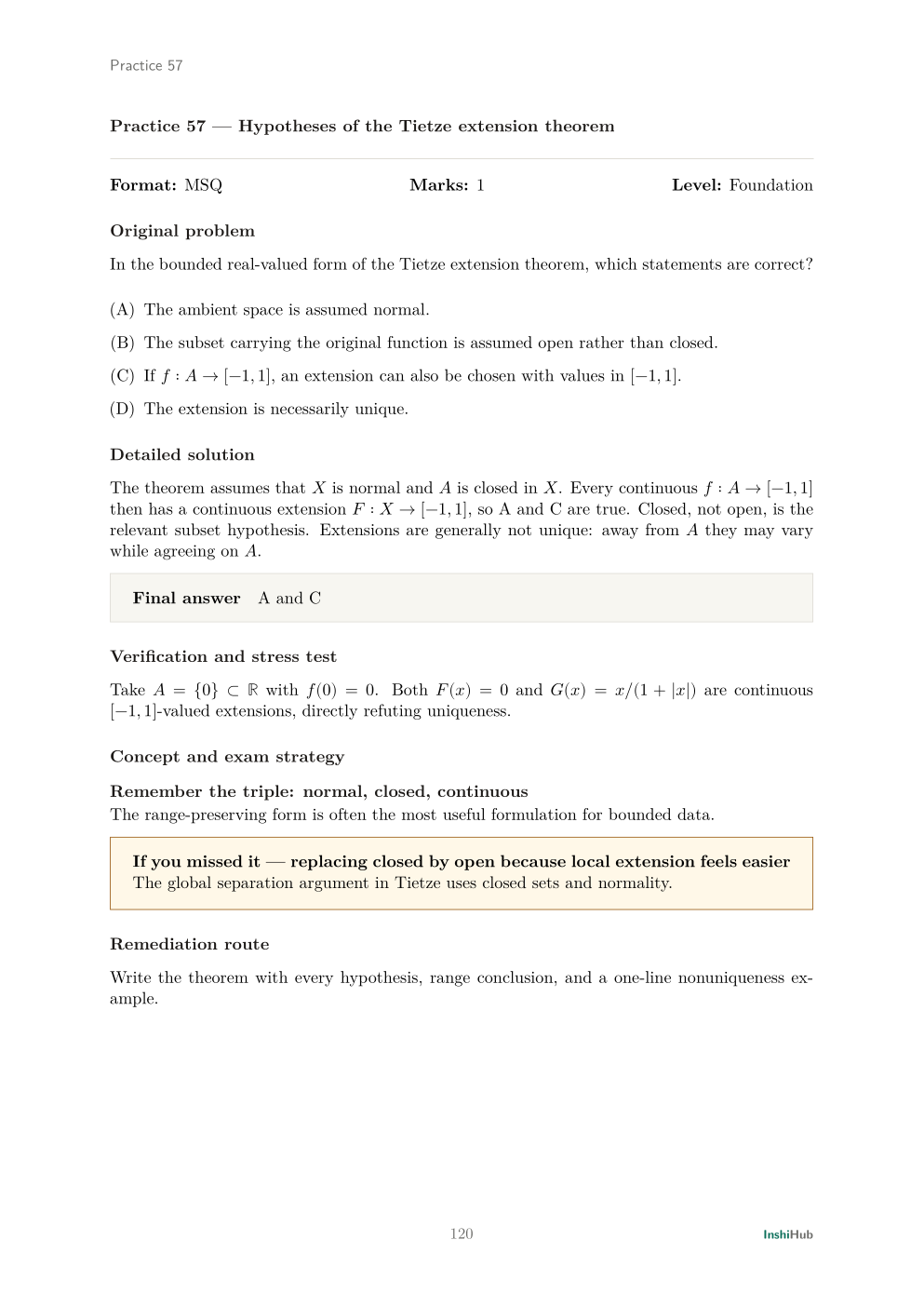
The held 125-page English workbook contains a 60-question original practice paper and 60 detailed solutions. Fifteen revised-focus modules receive four questions each, progressing from foundation to theorem-condition or counterexample audit.
No. Every prompt, answer choice, derivation, check, diagnosis and remediation note is independently authored by InshiHub. The official 2027 and 2026 syllabi are linked only as sources for the wording comparison.
The workbook uses an even mix of 20 MCQ, 20 MSQ and 20 NAT items with one-mark and two-mark labels. These labels follow the official format categories but the questions themselves are original.
No. It concentrates on 15 concepts newly named, broadened or made more explicit in the 2027 syllabus wording. It does not replace full-syllabus study or General Aptitude preparation.
Not necessarily. The workbook makes no first-time-examinability claim. Some concepts were already implicit, named in a narrower form or examinable under earlier syllabus language.
The master passed qpdf syntax checks, PDF/UA-2 and both WTPDF profiles. All fonts are embedded with Unicode mappings, and all 1,282 mathematical fragments have attached MathML.
The held one-time catalogue price is ₹1,499, inclusive of applicable tax. It is not an active offer while seller, tax, payment, delivery, refund and reconciliation gates remain open.
No purchase, reservation, waitlist or release-alert collection is enabled. Checkout will appear only after the exact product and all commercial release gates have been independently verified.
One-time purchase · tax inclusive
Sold and billed by Dodo Payments as the transaction seller and merchant of record. Fermion fulfils delivery through Dodo-hosted PDF access after confirmed payment.
InshiHub records these five choices before redirecting. Review any separate terms, notices, and fields that Dodo displays before payment; they may differ from this InshiHub consent step.
Licence terms · Delivery · Refunds · Privacy · Dodo Buyer Terms · Dodo privacy · Dodo charge guidance