InshiHubIndia

Complete GATE Mathematics subject guide

GATE Mathematics 2026 — Detailed Solutions

Audit the complete 85-mark Mathematics subject section with 55 independently authored solutions, concrete checks and problem-specific error notes.

  • 58 pages
  • 55 questions · 85 marks · 22 MCQ · 14 MSQ · 19 NAT
  • English
  • ₹1,499 held catalogue price

Official sources and editorial boundary

Independent and unofficial InshiHub study guide. Not affiliated with, endorsed by, sponsored by or approved by IIT Guwahati, any IIT or GATE. The official master paper and final answer key remain free at the linked official source; they are not included in this product.

Format facts

Guide scope
Complete Mathematics subject section Q11–Q65; General Aptitude Q1–Q10 excluded
Questions and marks
55 Mathematics questions carrying 85 marks
Response mix
22 MCQ · 14 MSQ · 19 NAT
Source and key
Official master paper and official final answer key, linked free and not bundled
Editorial method
Original summaries, derivations, checks and pitfalls; no official problem or option prose reproduced

Coverage map

Across Mathematics Q11–Q65

Linear algebra

Vector spaces, matrices, eigenvalues, canonical forms and numerical linear algebra

Across Mathematics Q11–Q65

Real and complex analysis

Sequences, series, continuity, integration, power series and analytic-function arguments

Across Mathematics Q11–Q65

Calculus and differential equations

Multivariable derivatives, transforms, ODEs, PDEs and numerical methods

Across Mathematics Q11–Q65

Abstract algebra

Groups, rings, fields, finite structures and polynomial reasoning

Across Mathematics Q11–Q65

Topology and functional analysis

Compactness, connectedness, normed spaces and operator-theoretic criteria

Across Mathematics Q11–Q65

Probability and optimisation

Probability models, statistics, linear programming and operations-research methods

Five complete HTML samples

Mathematics Q11 · MCQ · 1 mark

Sample 1 — One-mark MCQ: Quotient spaces of matrices

Identify a familiar matrix space isomorphic to a quotient of all 3×3 matrices by the upper-triangular subspace.

Core idea

Subtract subspace dimensions, then confirm the match by choosing a unique strictly lower-triangular representative for each coset.

  1. 1Compute the ambient dimension as 9 and the upper-triangular dimension as 6.
  2. 2Obtain quotient dimension 3.
  3. 3Match it with the three free entries of a 3×3 skew-symmetric matrix.
Final response
A — the skew-symmetric 3×3 matrix space.
Independent check
Map the unique strictly lower-triangular coset representative to the corresponding skew-symmetric matrix, giving an explicit linear bijection.

Common pitfall: A quotient is not a set-theoretic complement; diagonal entries belong to the triangular subspace being factored out.

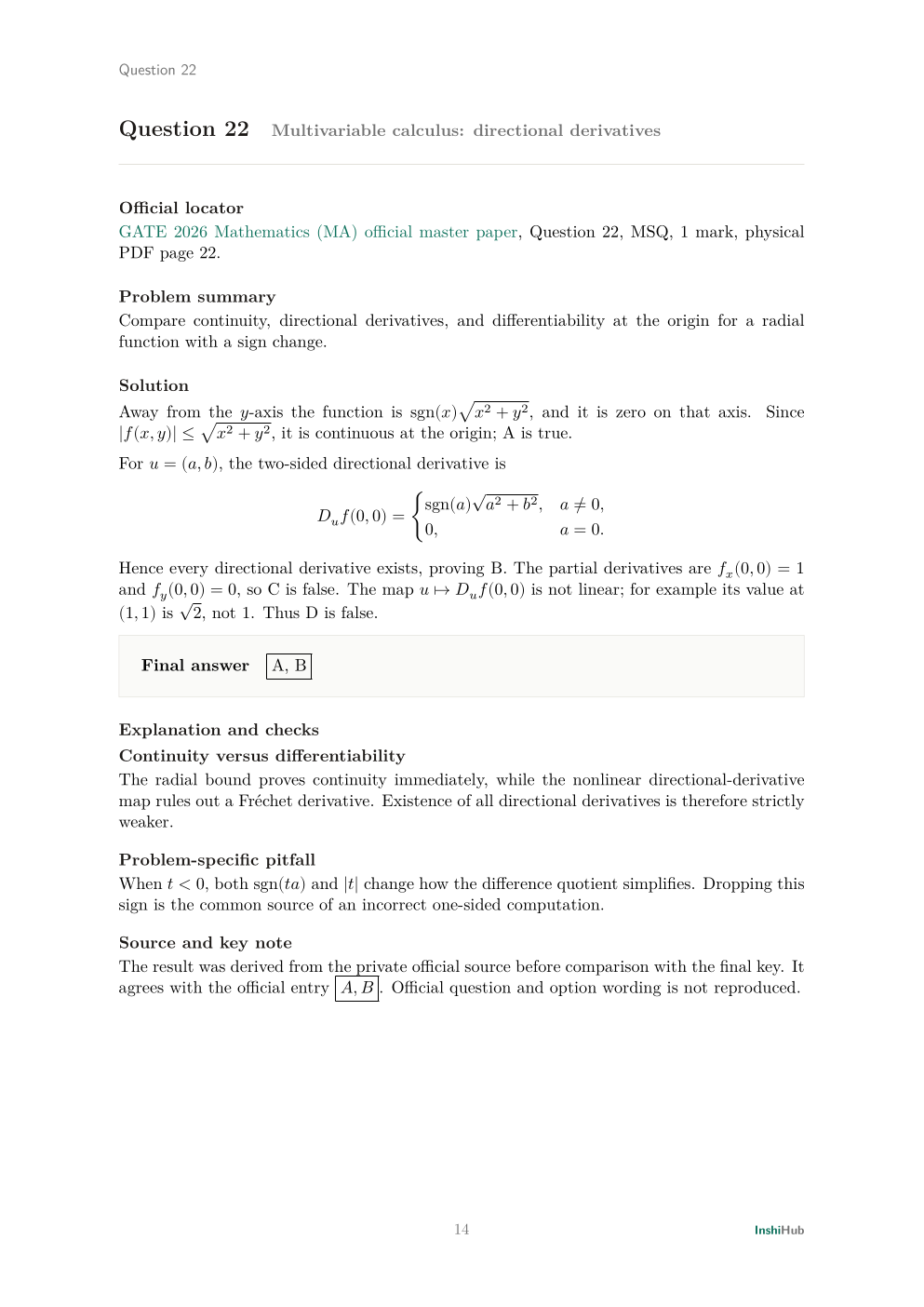
Mathematics Q22 · MSQ · 1 mark

Sample 2 — One-mark MSQ: Continuity, directional derivatives and differentiability

Separate continuity and existence of every directional derivative from genuine Fréchet differentiability at the origin.

Core idea

A radial bound proves continuity, while the directional-derivative map’s failure of linearity rules out differentiability.

  1. 1Bound the absolute function value by the Euclidean radius.
  2. 2Compute the two-sided directional derivative for an arbitrary direction.
  3. 3Compare its nonlinear dependence on direction with the partial-derivative candidate.
Final response
A and B.
Independent check
The derivative value at direction (1,1) disagrees with the linear map implied by the two partial derivatives.

Common pitfall: Existence of all directional derivatives is strictly weaker than differentiability.

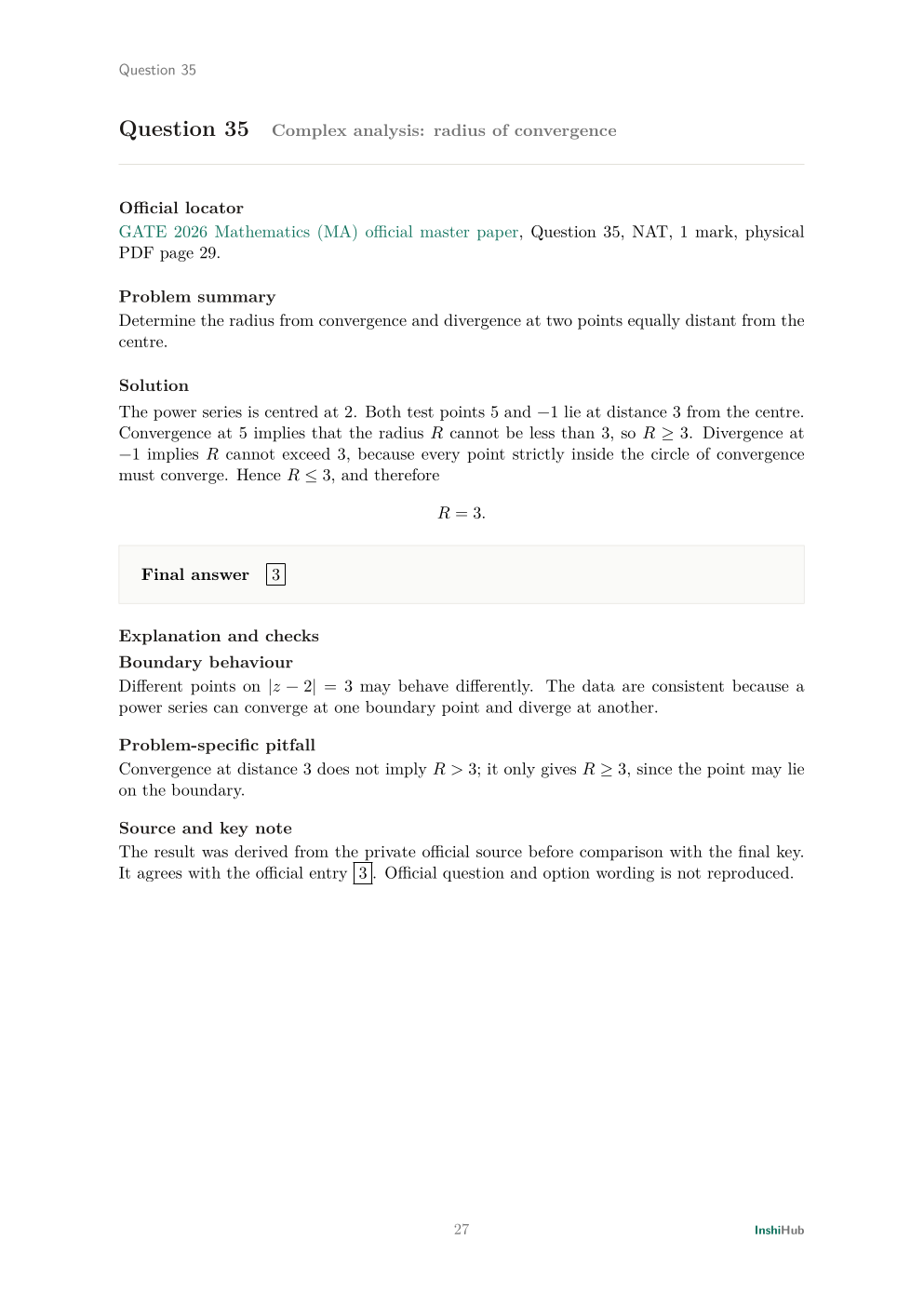
Mathematics Q35 · NAT · 1 mark

Sample 3 — One-mark NAT: Radius of convergence and boundary behaviour

Pin down a power series radius using convergence and divergence at two points equally distant from the centre.

Core idea

Convergence at distance 3 forces R≥3, while divergence at another point of the same distance forces R≤3.

  1. 1Measure both supplied points from the series centre.
  2. 2Translate convergence into a lower bound for the radius.
  3. 3Translate divergence into the matching upper bound.
Final response
3.
Independent check
Different boundary points may have different convergence behaviour, so the two observations are consistent exactly at radius 3.

Common pitfall: Convergence at a point of distance 3 does not imply R>3; the point may lie on the boundary.

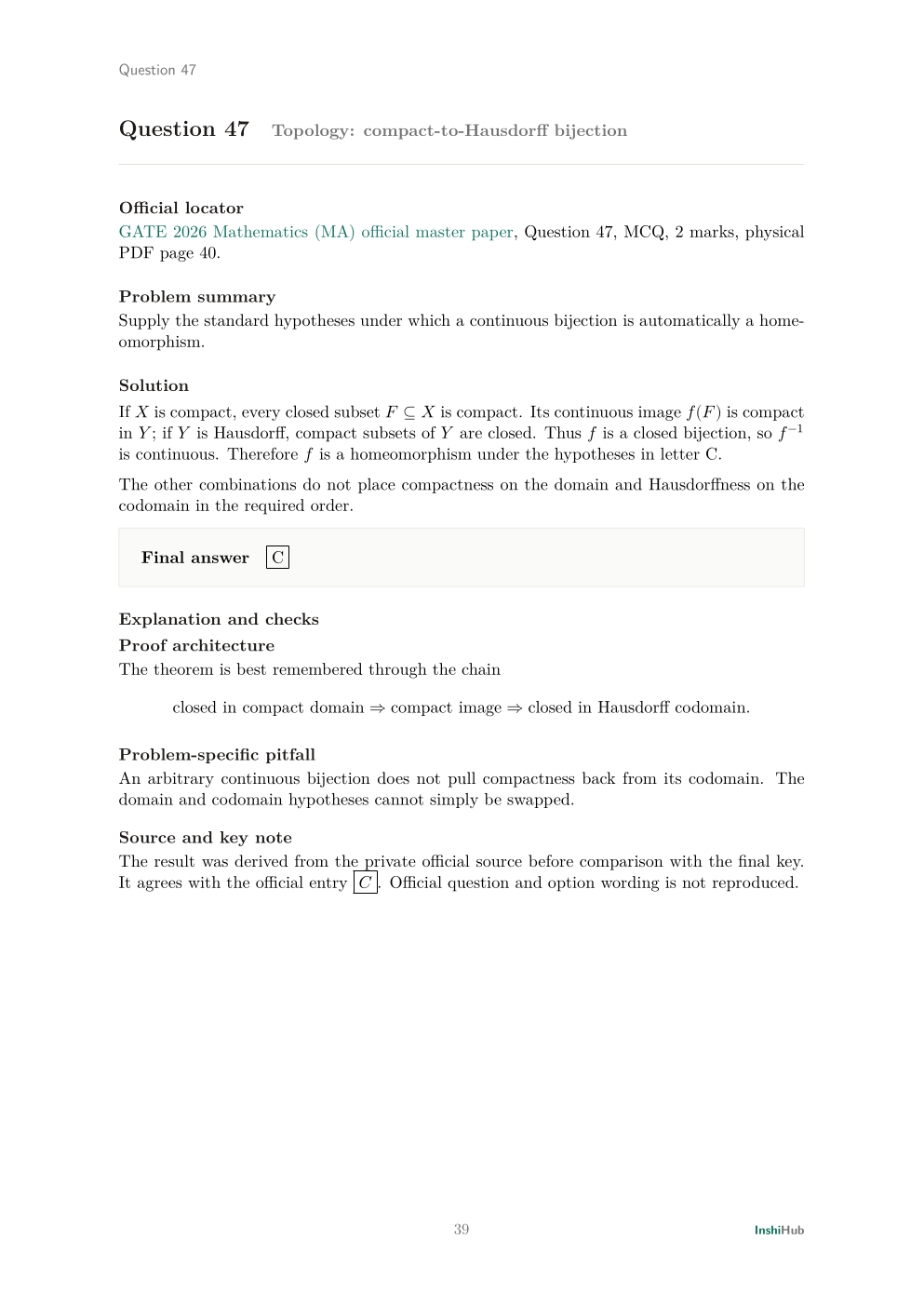
Mathematics Q47 · MCQ · 2 marks

Sample 4 — Two-mark MCQ: Compact-to-Hausdorff continuous bijections

Choose the standard domain and codomain hypotheses that make a continuous bijection automatically a homeomorphism.

Core idea

Closed subsets of a compact domain have compact images, and compact subsets of a Hausdorff codomain are closed.

  1. 1Start with a closed subset of the compact domain.
  2. 2Push it forward to a compact subset of the codomain.
  3. 3Use Hausdorffness to make the image closed and the inverse continuous.
Final response
C — compact domain and Hausdorff codomain.
Independent check
The argument proves the bijection is a closed map, which is equivalent to continuity of its inverse.

Common pitfall: The compact and Hausdorff roles cannot be swapped between domain and codomain.

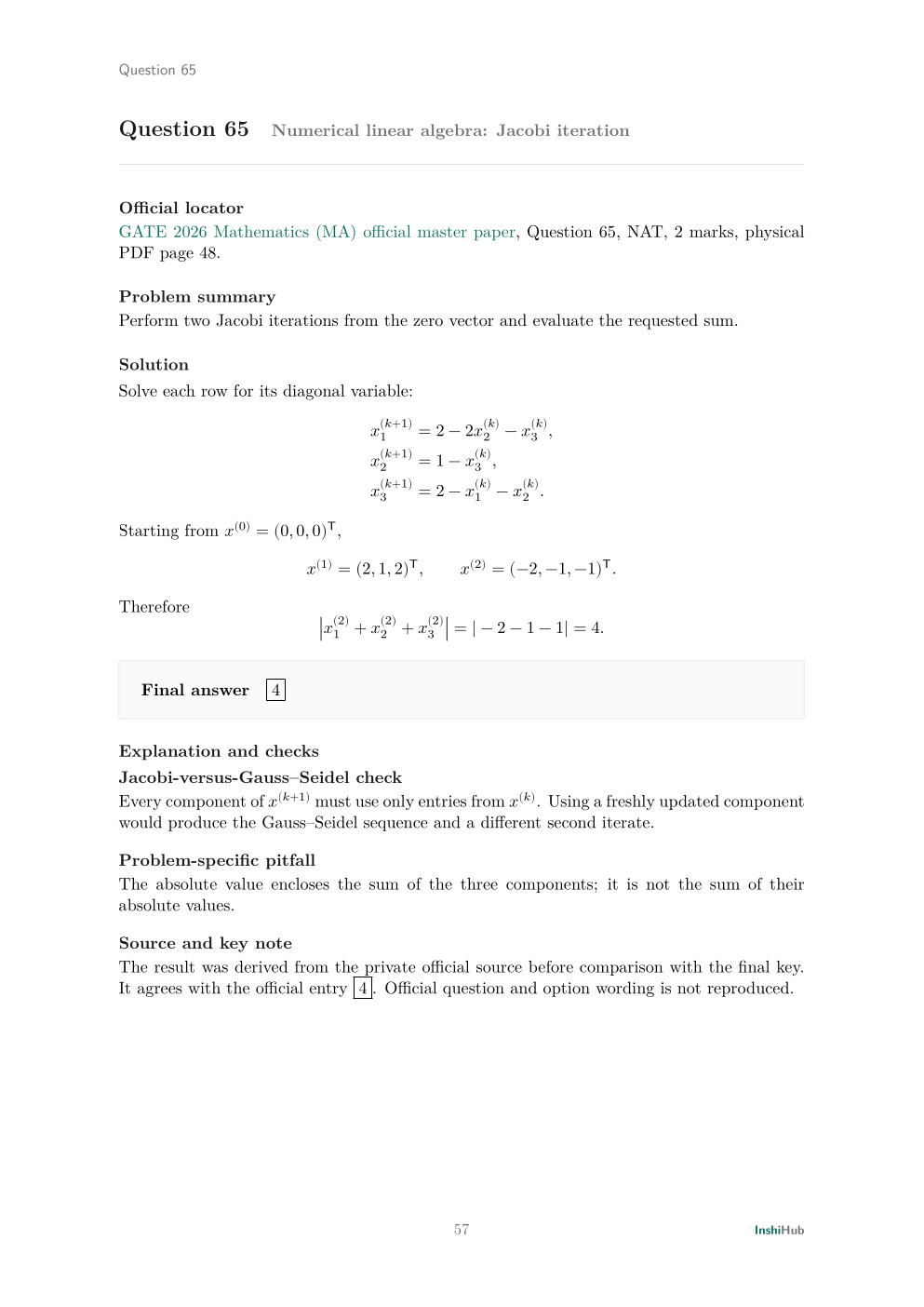
Mathematics Q65 · NAT · 2 marks

Sample 5 — Two-mark NAT: Two Jacobi iterations

Run two simultaneous Jacobi updates from the zero vector and evaluate the absolute value of the requested component sum.

Core idea

Every coordinate of the next iterate must use only values from the previous iterate.

  1. 1Solve each system row for its diagonal variable.
  2. 2Apply all three recurrences to the zero vector to obtain the first iterate.
  3. 3Use only that first iterate to obtain the second and then form the sum.
Final response
4.
Independent check
Recomputing the second iterate component by component gives (−2,−1,−1), whose sum is −4.

Common pitfall: Using a freshly updated coordinate changes the method to Gauss–Seidel and produces a different sequence.

Six-page exact-master preview

Cover plus one audited page for each HTML sample. The complete paid master is not stored in the public application.
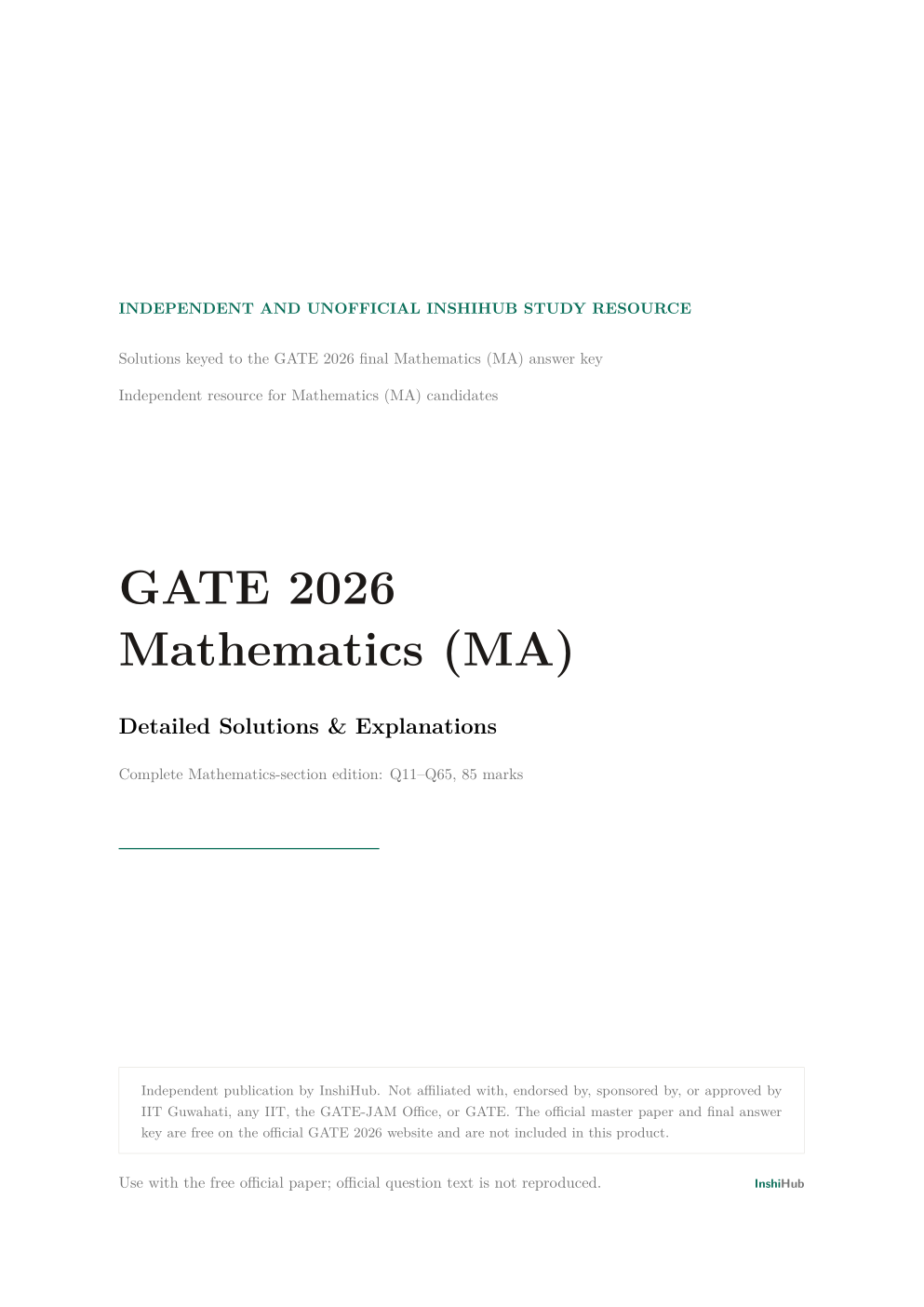
Preview page 1 of 6Sample · not the official paper
GATE Mathematics 2026 — Detailed Solutions, preview page 1 of 6: Cover of the complete GATE Mathematics 2026 subject-section guide.
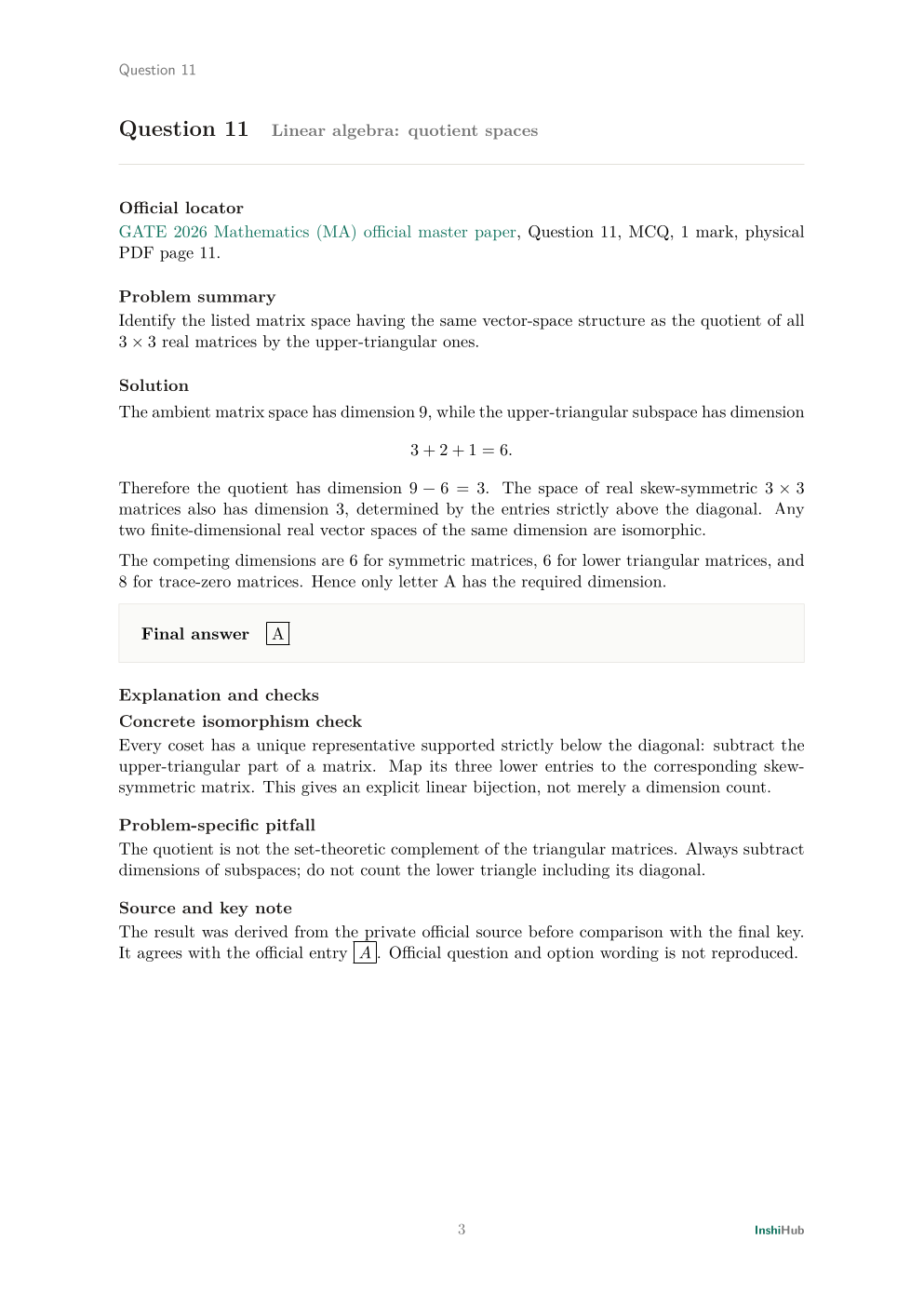
Preview page 2 of 6Sample · not the official paper
GATE Mathematics 2026 — Detailed Solutions, preview page 2 of 6: A detailed linear-algebra solution with an independent structural check.
Preview page 3 of 6Sample · not the official paper
GATE Mathematics 2026 — Detailed Solutions, preview page 3 of 6: A detailed analysis or calculus solution with a reusable theorem criterion.
Preview page 4 of 6Sample · not the official paper
GATE Mathematics 2026 — Detailed Solutions, preview page 4 of 6: A numerical-answer solution with the official key or accepted range.
Preview page 5 of 6Sample · not the official paper
GATE Mathematics 2026 — Detailed Solutions, preview page 5 of 6: A two-mark proof-oriented solution with a problem-specific pitfall.
Preview page 6 of 6Sample · not the official paper
GATE Mathematics 2026 — Detailed Solutions, preview page 6 of 6: A final-section solution showing an independent computational check.

Product boundary

Included

  • All 55 Mathematics-subject questions, official Q11–Q65, carrying 85 marks.
  • Official MCQ, MSQ and NAT response types, marks and final-key results for every locator.
  • Independently written summaries, mathematical setups, full derivations and exact final responses.
  • A concrete verification idea and problem-specific pitfall for every question.
  • One question per solution page for predictable study and citation.

Not included

  • General Aptitude Q1–Q10 and its 15 marks.
  • Official question statements, option prose, figures, scans, logos and paper layout.
  • A claim of official affiliation, endorsement, sponsorship or approval.
  • A score, rank, admission, scholarship or examination-result guarantee.

Study loop

  1. 1Open the free official paper and attempt one question under a fixed time limit.
  2. 2Compare the first step where your reasoning diverged, not only the final response.
  3. 3Reproduce the independent derivation from a blank page without copying the guide.
  4. 4Run the separate check and record the named problem-specific pitfall.
  5. 5Retry the question after 48 hours, then assemble mixed timed sets from the full paper.

Questions about this guide

What does the GATE Mathematics 2026 guide cover?

It covers the complete Mathematics subject section, official Q11–Q65: 55 questions and 85 marks. General Aptitude Q1–Q10 is not part of the guide.

Does the guide reproduce the official GATE 2026 paper?

No. It uses question-number locators, independent summaries, original derivations, checks and final-key mappings. The free official paper and key are linked but not bundled.

Which response formats are covered?

The guide covers the official Mathematics-section MCQ, MSQ and NAT items, including each question’s mark value and final-key response or numerical range.

How can I use the solutions for revision?

Attempt the official question from the linked source, compare the first diverging step, reproduce the independent derivation, run the check and record the named pitfall before retrying.

Is purchase available now?

Yes. The complete guide is available as a one-time, tax-inclusive purchase for ₹1,499 with Dodo-hosted checkout and automatic PDF delivery after confirmed payment.

One-time purchase · tax inclusive

Buy the complete 58-page guide for ₹1,499

Sold and billed by Dodo Payments as the transaction seller and merchant of record. Fermion fulfils delivery through Dodo-hosted PDF access after confirmed payment.

Confirm all five statements before checkout

InshiHub records these five choices before redirecting. Review any separate terms, notices, and fields that Dodo displays before payment; they may differ from this InshiHub consent step.

Licence terms · Delivery · Refunds · Privacy · Dodo Buyer Terms · Dodo privacy · Dodo charge guidance