
Part A
20 single-correct multiple-choice items
+2 correct · −1 incorrect · 0 blank
The official instructions state that the TIFR CAM Integrated PhD route is evaluated on Part A only.
Study all 40 items through independently written proofs, counterexamples, option-level conclusions, and second-route checks. Read five complete solutions in searchable HTML and inspect six pages from the exact full-edition PDF.
The official paper and its embedded final indicators are free from TIFR.The configured price is solely for InshiHub's original explanations, verification, organisation, and controlled digital delivery.
Direct exam-pattern answer
The central GS-2026 schedule placed the Mathematics examination on 14 December 2025 from 2:00 pm to 5:00 pm. The Stage I paper has 20 single-correct items in Part A and 20 true-or-false items in Part B. Both parts use negative marking, with a larger two-mark penalty for an incorrect Part B response.
Admission cycle
GS 2026
Central exam date
14 December 2025
Mathematics session
2:00 pm–5:00 pm
Working time
180 minutes
Paper structure
Part A: 20 · Part B: 20
Maximum score
80 marks
Part A
+2 correct · −1 incorrect · 0 blank
The official instructions state that the TIFR CAM Integrated PhD route is evaluated on Part A only.
Part B
+2 correct · −2 incorrect · 0 blank
The other mathematics routes covered by this Stage I paper answer both parts, subject to the current official programme instructions.
GS-2026 is the admission-cycle label
The central GS advertisement and schedule give 14 December 2025 as the examination date. A School of Mathematics page displays 4 December 2025. This page uses the central schedule and records the discrepancy rather than silently merging the two dates.
Six-page visual preview
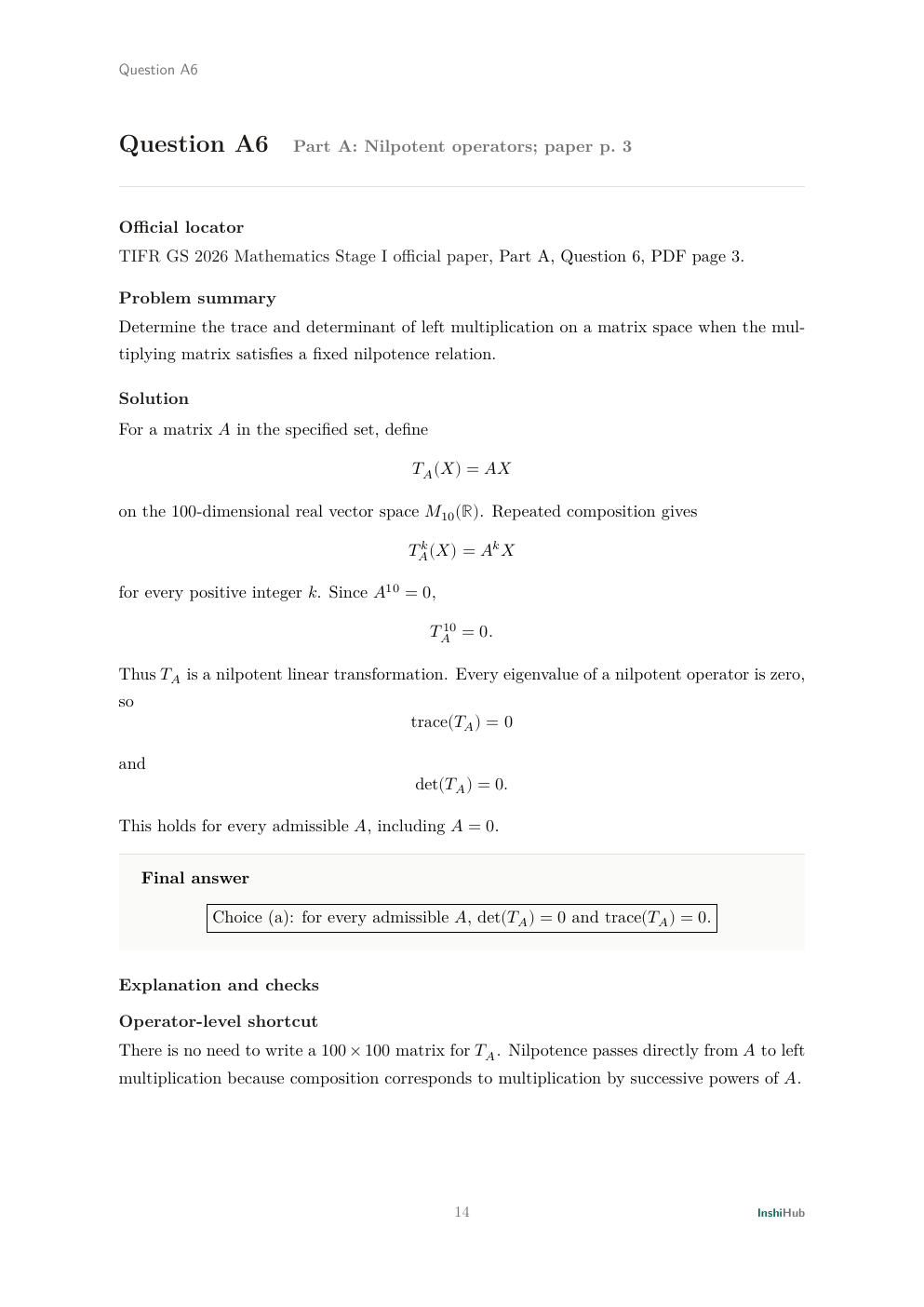
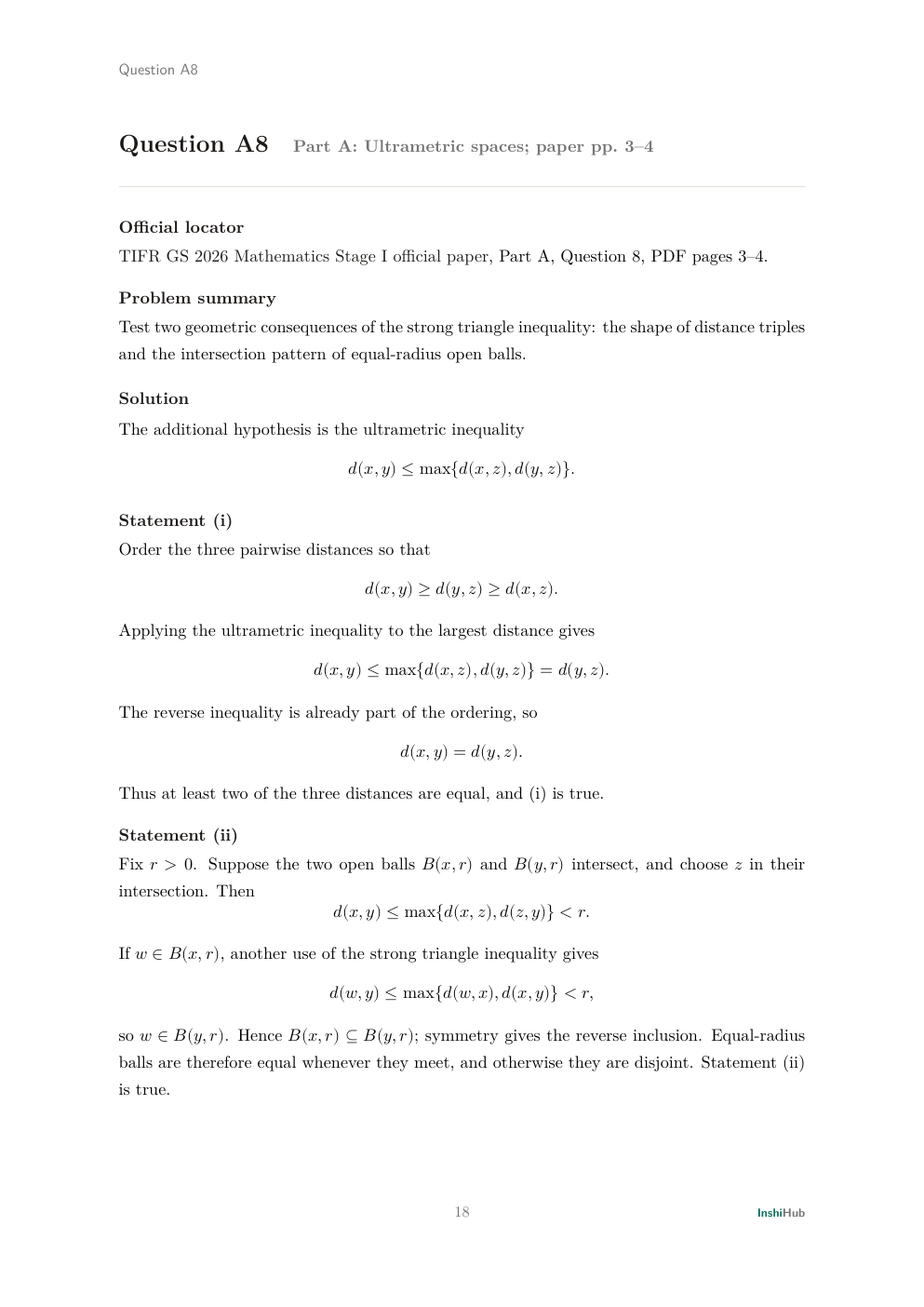
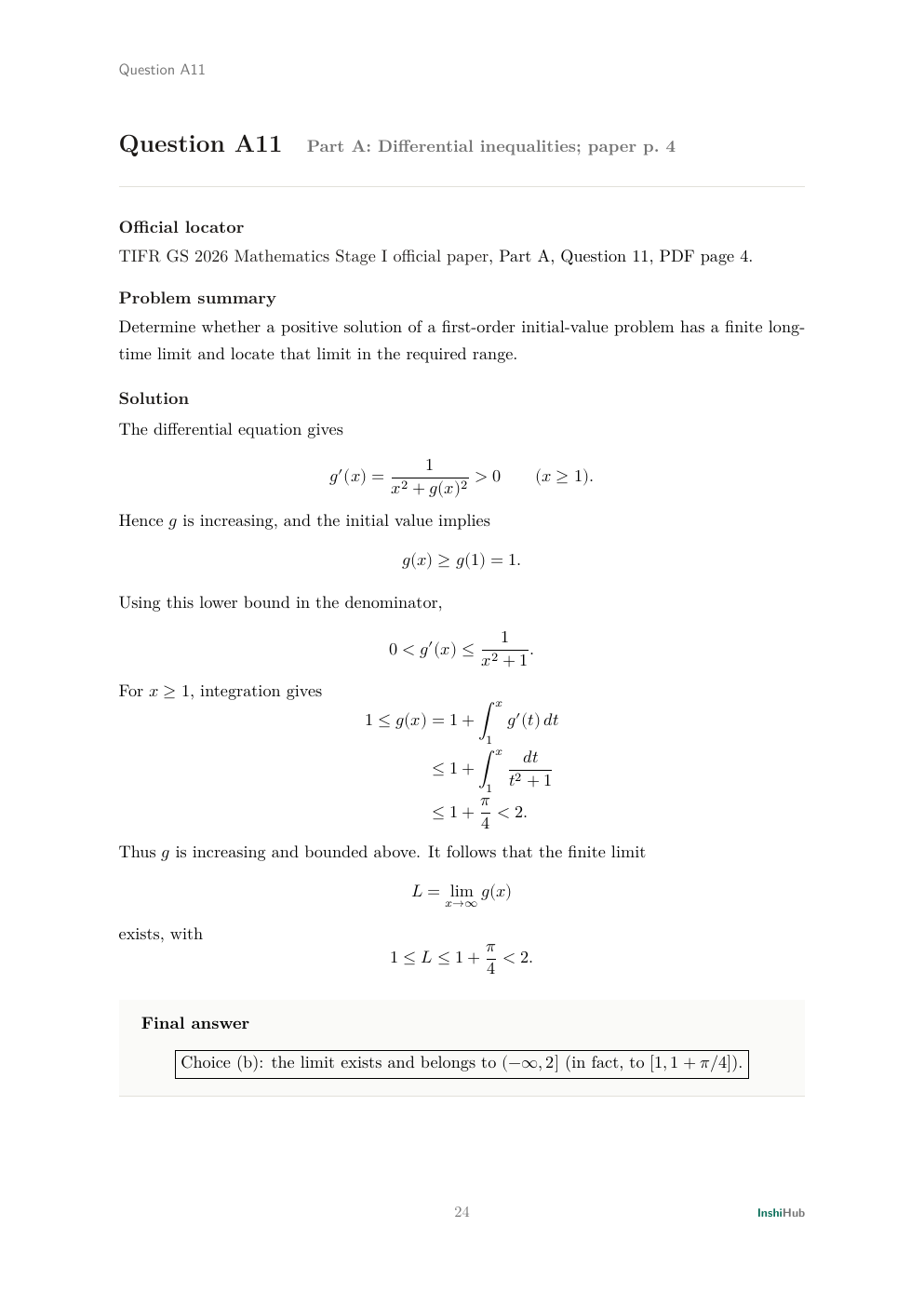
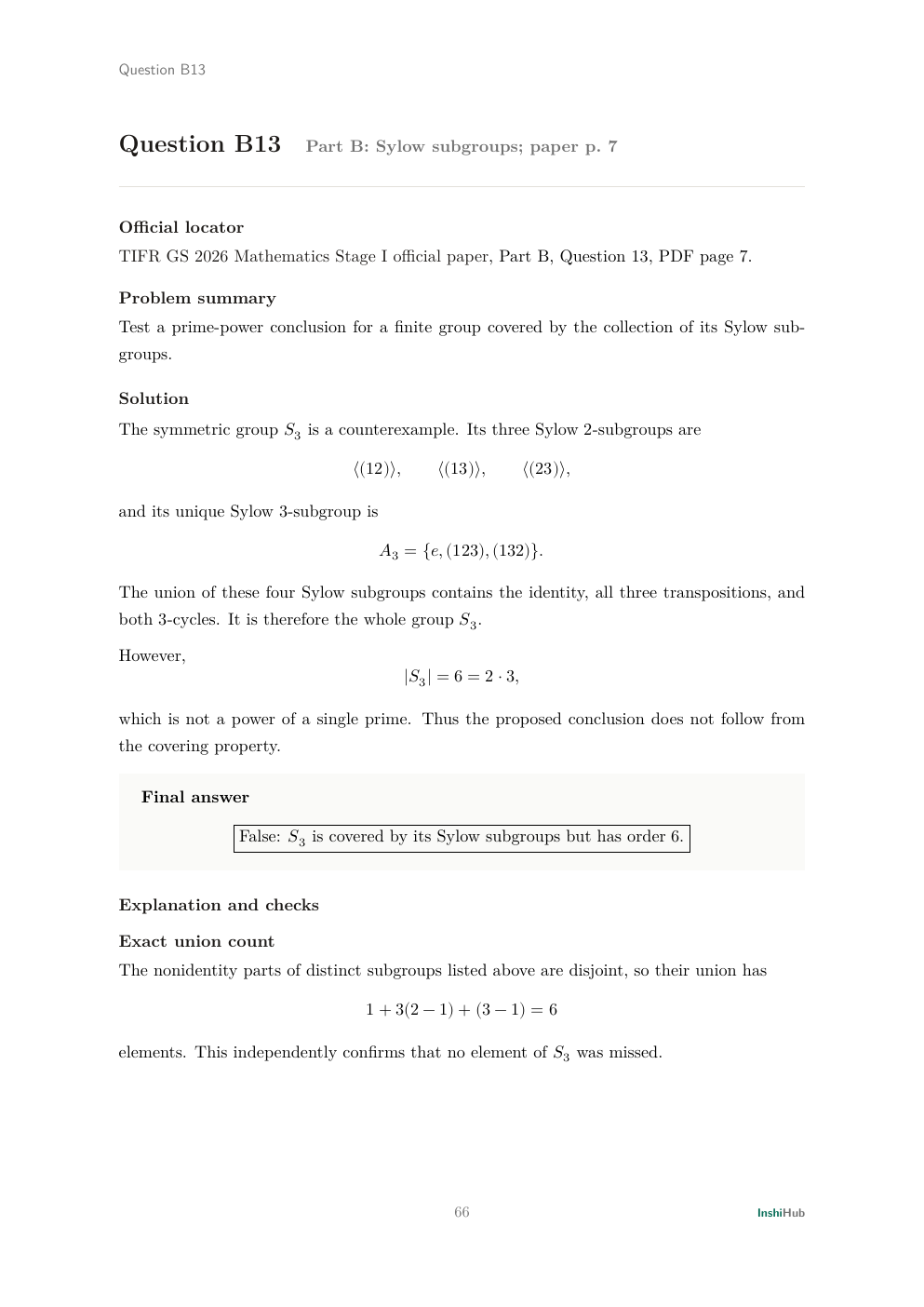
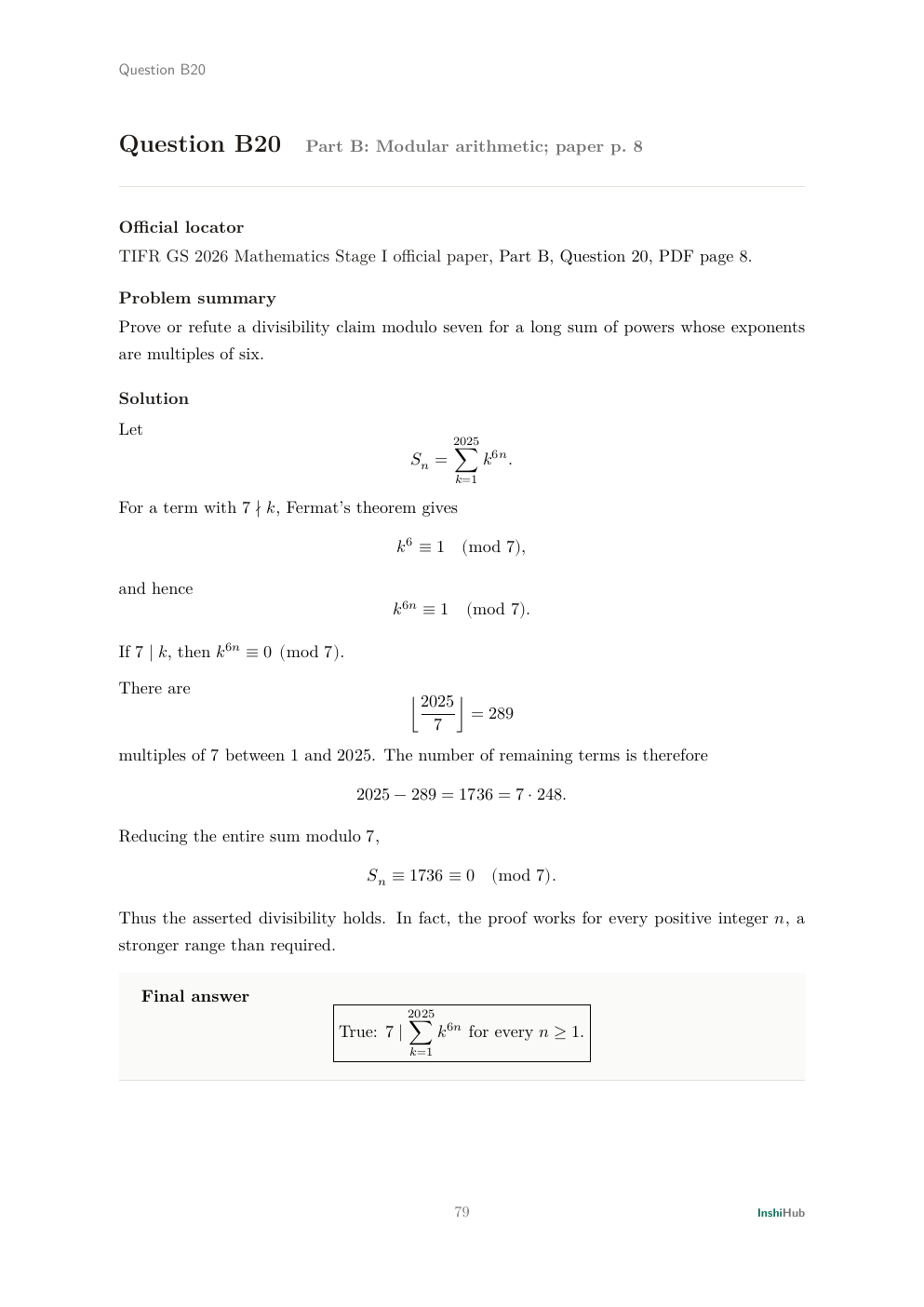
The preview shows the cover plus A6, A8, A11, B13, and B20 from the exact 81-page master. Every page is an InshiHub-authored page, never a scan of TIFR's paper, choices, figures, or layout.
Crawlable HTML samples
Each summary identifies the task without replacing the official question. Open TIFR's paper at the source locator, attempt the item, and then audit your method against the derivation, verification, and common-error note below.
Free sample 1
Determine the trace and determinant of left multiplication on a matrix space when the multiplying matrix satisfies a fixed nilpotence relation.
Composition by left multiplication converts powers of the induced operator directly into powers of the original matrix, so nilpotence passes to the full 100-dimensional operator without writing its matrix.
Choice (a): for every admissible A, both det(T_A) and trace(T_A) are zero.
Free sample 2
Test two consequences of the strong triangle inequality: the shape of a distance triple and the intersection pattern of equal-radius open balls.
Apply the maximum-form triangle inequality first to the largest of three distances, then twice around a shared point of two balls.
Choice (a): both statements are true.
Free sample 3
Determine whether a positive solution of a first-order initial-value problem has a finite long-time limit and locate that limit in the required range.
Use the differential equation twice: positivity proves monotonicity, and the resulting lower bound on the solution produces an integrable upper bound for its derivative.
Choice (b): the limit exists and lies in the required interval ending at 2; in fact it lies in [1, 1+pi/4].
Free sample 4
Test a prime-power conclusion for a finite group covered by the collection of all its Sylow subgroups.
Use the smallest nonabelian symmetric group: its transpositions and 3-cycles separate cleanly into its Sylow subgroups, yet its order contains two different primes.
False: S3 is covered by its Sylow subgroups but has order 6.
Free sample 5
Prove or refute a divisibility claim modulo seven for a long sum of powers whose exponents are multiples of six.
Separate multiples of seven, reduce every other term to one using the six-element multiplicative group modulo seven, and count the surviving terms exactly.
True: 7 divides the sum from k=1 to 2025 of k raised to 6n for every positive integer n.
Complete topic map
The paper moves across undergraduate mathematics rather than isolating one subject. The full guide preserves the official A1–A20 and B1–B20 labels so each topic can be located immediately.
A1–A5, A10–A11, A13, A18, A20; B1, B7, B11, B16
Series, products, power series, uniform convergence, uniform continuity, critical points, differential inequalities, fractional parts, Taylor data, monotone limits, differentiability, periodic functions, and differential operators.
A6, A9, A12, A14–A15; B5–B6, B9, B14
Nilpotent operators, range and kernel, products of endomorphisms, matrix topology, linear operators, diagonalizability, matrix powers, stochastic matrices, and matrix functions.
A7–A8; B2–B4, B10, B12, B19
Dense-set extensions, ultrametrics, topology of the rationals, function-space compactness, continuous bijections, finite metric embeddings, finite topologies, and parameter topology.
A16–A17, A19; B8, B13, B15, B17–B18, B20
Commutative algebra, plane geometry, group theory, polynomial composition, Sylow subgroups, finite abelian groups, symmetric groups, combinatorial expectation, and modular arithmetic.
Editorial quality system
Every solution names its official part, item number, and PDF page while leaving the official question and choices at TIFR.
The mathematical result is established from the stated structure before the embedded final indicator is consulted.
A different reviewer rechecks theorem use, calculations, counterexamples, option conclusions, source locators, and rendered pages.
Where useful, a second calculation, structural argument, limiting case, or explicit counterexample tests the conclusion independently.
Official sources, provenance, and rights
The official PDF is titled “Mathematics: Stage I Questions” and contains the final indicators used for the post-derivation comparison. InshiHub links to TIFR's source files but does not republish question text, answer choices, figures, logos, or paper layout.
Independently produced by InshiHub. InshiHub is not affiliated with, endorsed by, sponsored by, or approved by Tata Institute of Fundamental Research. TIFR and related names identify the examination source only. This guide contains InshiHub's original explanations and does not reproduce the official question text, answer choices, figures, logos, or paper layout.
Transparent release status
Publishing this page does not accept payment or create an order. Paid access may appear only after every mathematical, seller, tax, payment, delivery, refund, and reconciliation gate passes for this exact edition.
Build breadth across examinations
TIFR Stage I has its own format and negative-marking logic. For a second preparation style, compare the independently worked NBHM Combined paper rather than treating unrelated examinations as one interchangeable syllabus.
Open the NBHM Combined 2026 guideFrequently asked questions
The current 81-page edition contains original worked solutions to all 20 Part A and all 20 Part B items, with source locators, full reasoning, independent checks, final results, and problem-specific error notes.
No. The guide contains InshiHub's independently written explanations and short, non-substituting topic summaries. The official paper remains available free from TIFR through the direct links on this page.
No. InshiHub is an independent publisher and is not affiliated with, endorsed by, sponsored by, or approved by Tata Institute of Fundamental Research.
All 40 items are covered: 20 multiple-choice items in Part A and 20 true-or-false items in Part B.
The official instructions assign this Mathematics Stage I paper to the mathematics routes covered by the GS process. They also state that the TIFR CAM Integrated PhD route evaluates Part A only, while the other covered routes answer both parts. Candidates should verify the current programme instructions directly with TIFR.
No. This guide is for the GS 2026 Mathematics Stage I paper. It does not cover the separate CAM Mathematics PhD examination.
GS-2026 names the admission cycle. TIFR's central advertisement scheduled the examination for 14 December 2025, so the cycle label and calendar date refer to different things.
Part A had 20 single-correct multiple-choice items scored +2 for correct, -1 for incorrect, and 0 for blank. Part B had 20 true-or-false items scored +2 for correct, -2 for incorrect, and 0 for blank.
Yes. Each result was independently derived first, then independently cross-reviewed and compared with the final indicators embedded in TIFR's official paper.
It is an English, one-time digital PDF. The frozen edition has 81 A4 pages.
The configured one-time catalogue price is ₹1,499, inclusive of applicable tax. It is not a temporary discount or crossed-out-price promotion, and no payment control is present while validation remains incomplete.
Material corrections receive a dated public note. The delivery system is designed to keep an exact content version attached to each entitlement so that replacement files remain traceable.