
Section 1
Algebra
1.1–1.10
Groups, rings, linear algebra, field structure, and spectral arguments.
Prepare for NBHM Doctoral and PhD-level mathematics with independent derivations for all 50 numbered questions and 50 addressable solution prompts. Read three complete solutions in searchable HTML, inspect six guide pages, and understand the original best-four-of-five scoring rule before practising.
Direct format answer
The 150-minute paper contained five subject sections of ten one-point questions. All 50 questions could be attempted, but only the best four section totals counted, giving a maximum counted score of 40. When one numbered question requested multiple answers, every requested answer was required for that point; no partial credit was provided.
Test date
19 January 2013
Working time
150 minutes
Paper structure
5 sections × 10 questions
Question value
1 point per numbered question
Counted result
Best 4 section scores
Maximum counted score
40 points
Question count is not a physical-answer-field count
The guide has 50 addressable solution prompts. Each of the 50 numbered questions maps to one complete solution chapter. The archived paper refers to a separate answer booklet but does not establish its physical field count, so this page does not invent one.
Each section contributes ten numbered questions. The guide keeps the printed dotted labels so a learner can move directly between an official question and the matching explanation.
Section 1
1.1–1.10
Groups, rings, linear algebra, field structure, and spectral arguments.
Section 2
2.1–2.10
Real and complex analysis, measure, sequences, series, and function spaces.
Section 3
3.1–3.10
Continuity, compactness, connectedness, quotient ideas, and metric spaces.
Section 4
4.1–4.10
Multivariable calculus, integration, ordinary differential equations, and boundary-value problems.
Section 5
5.1–5.10
Probability, combinatorics, geometry, optimisation, and mixed reasoning.
Six-page visual preview
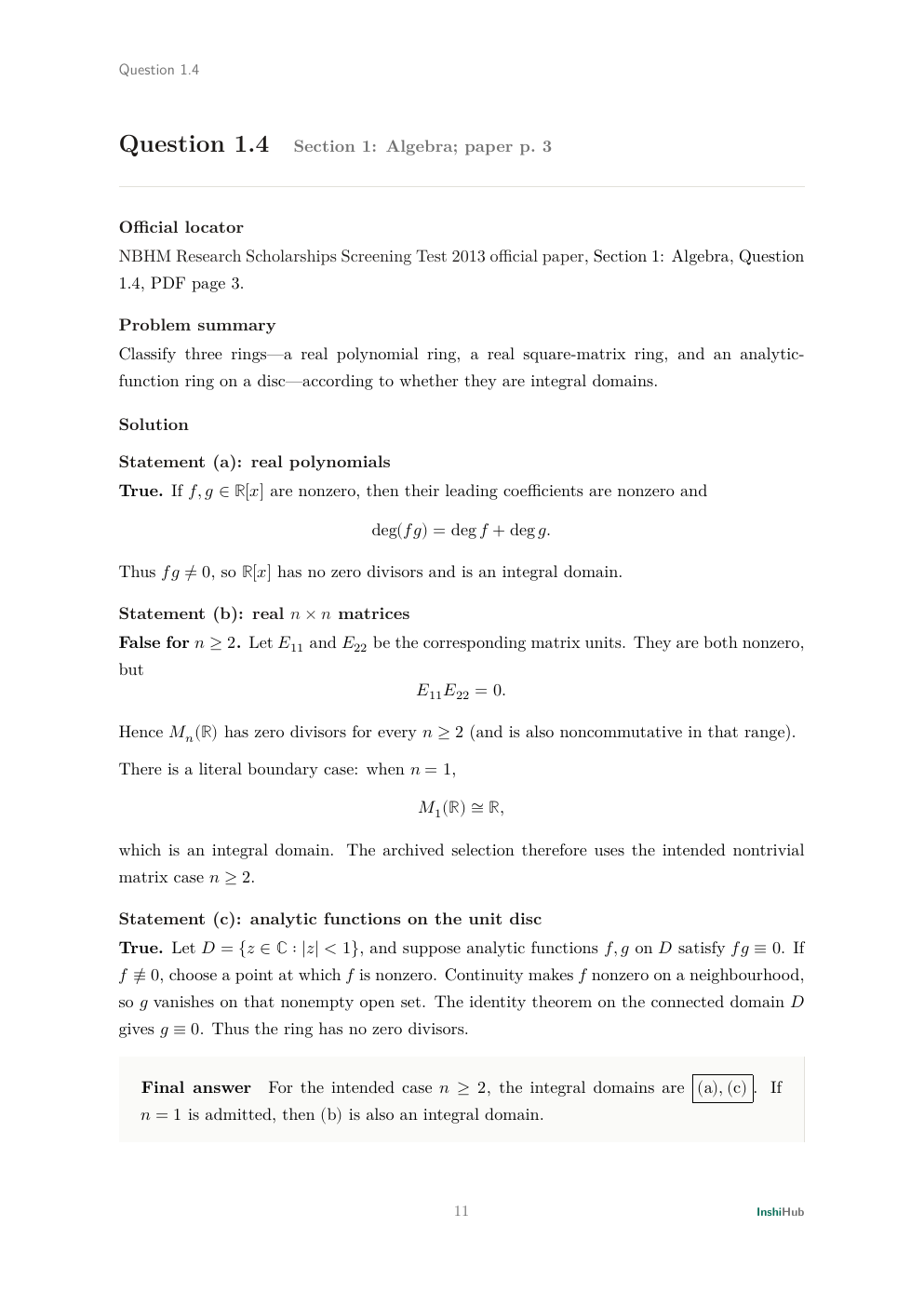
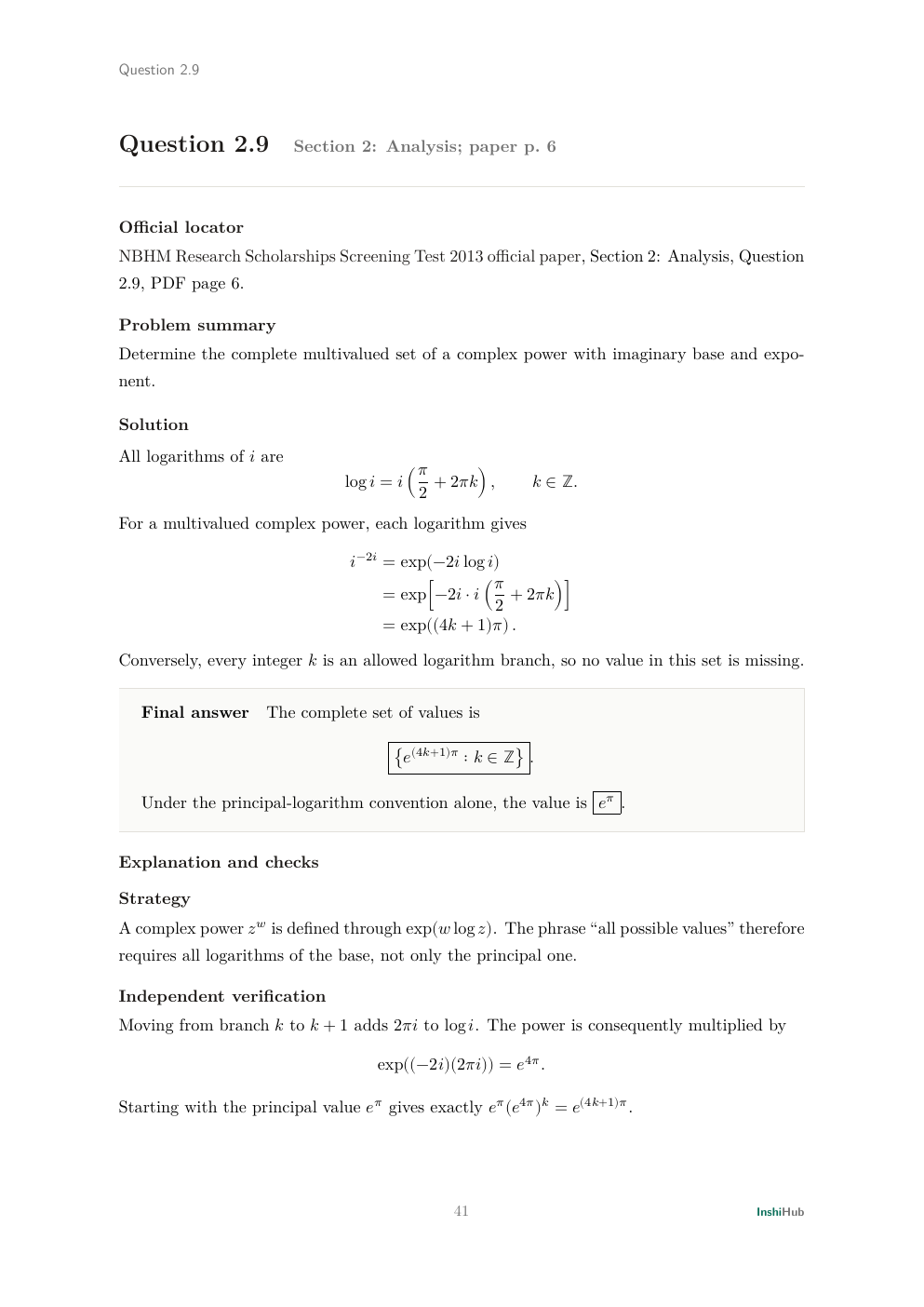
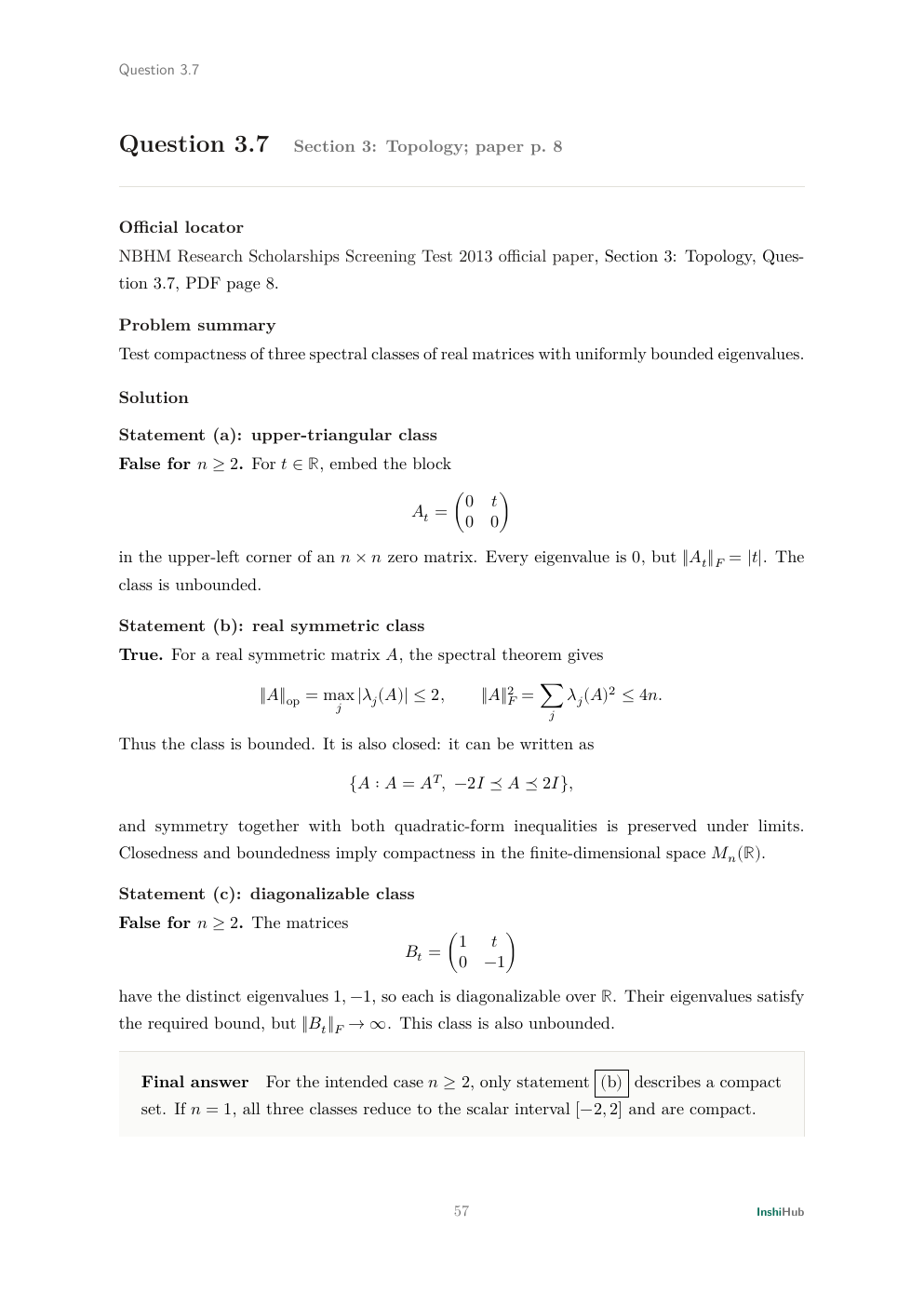
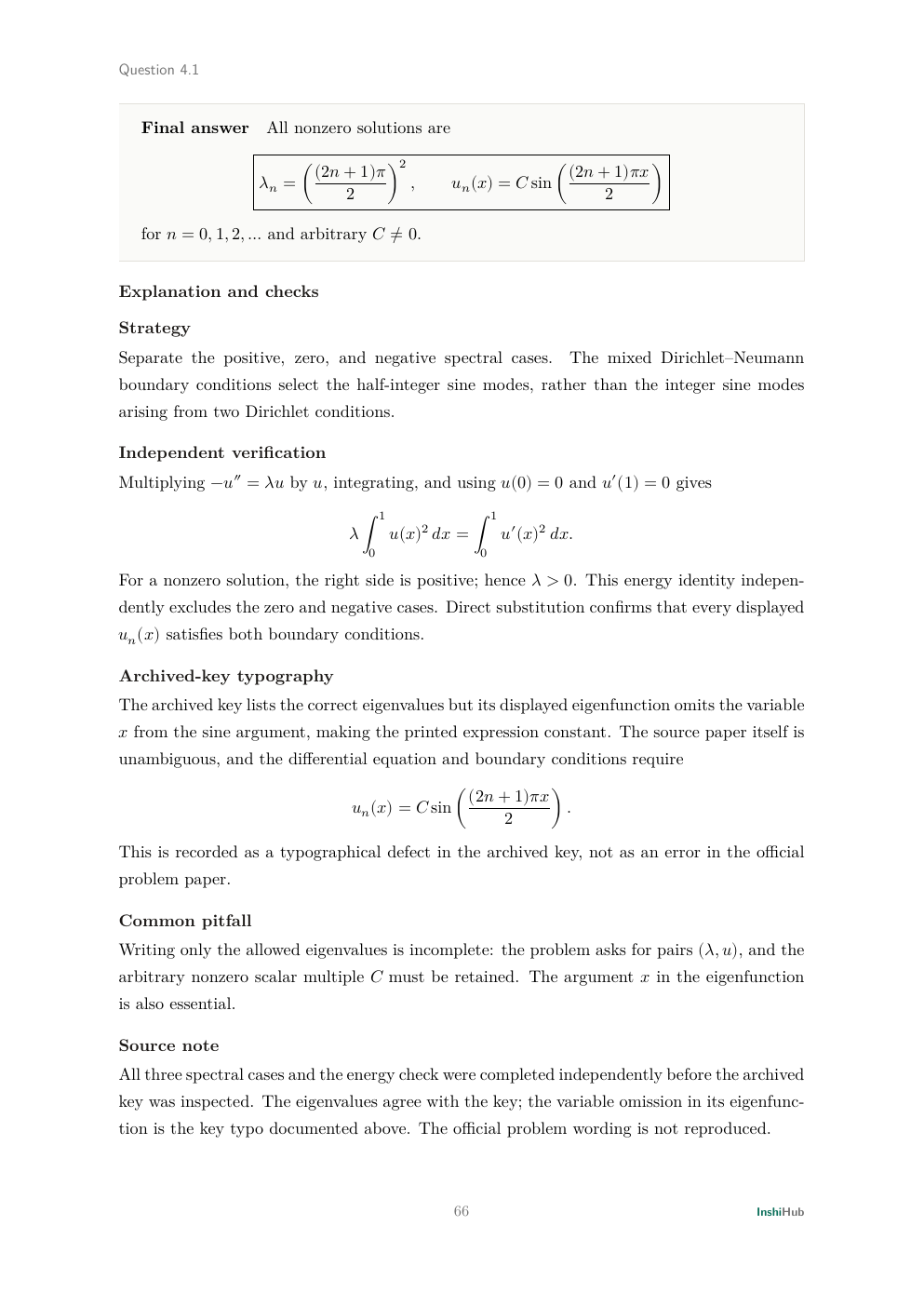
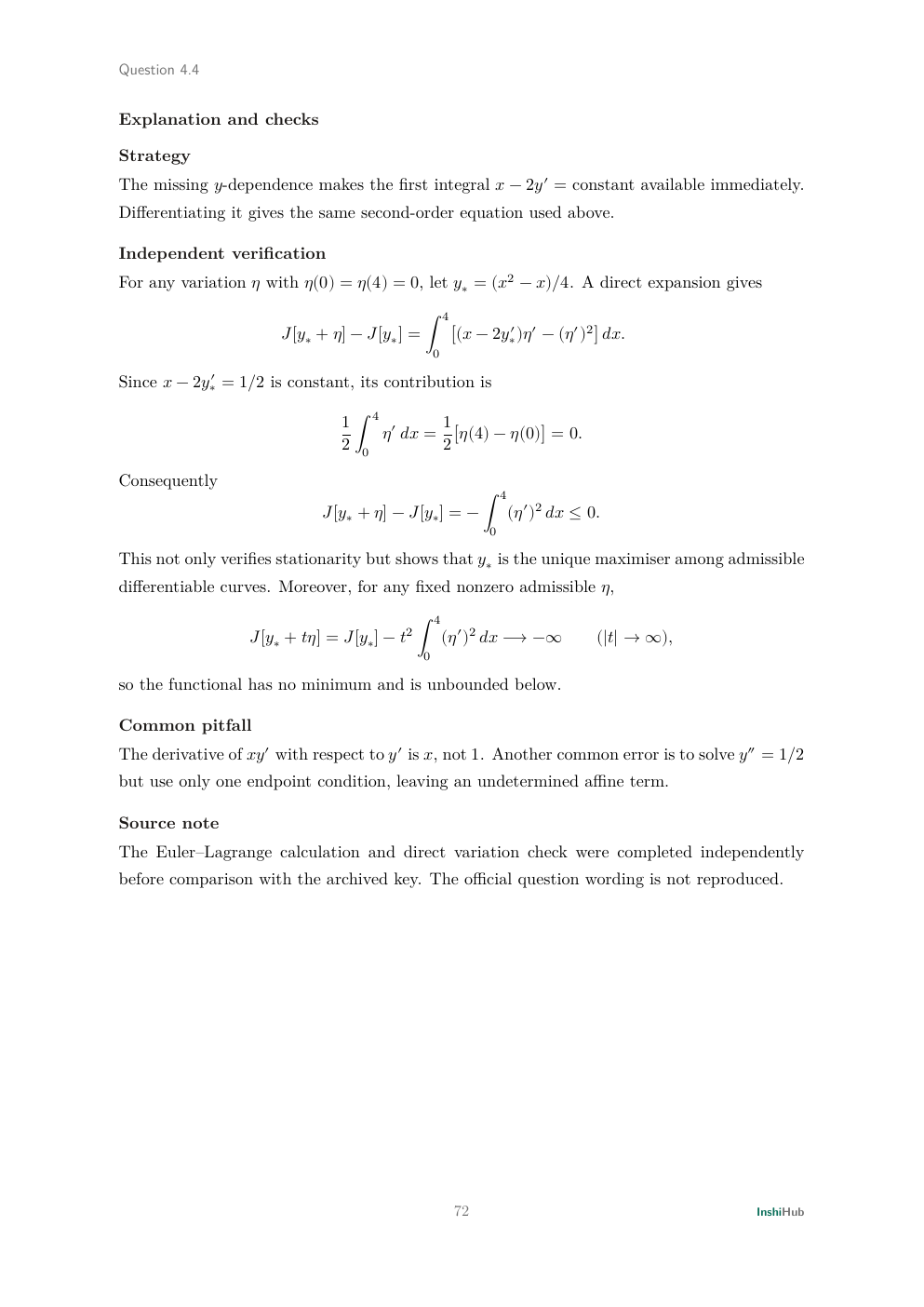
The preview covers Questions 1.4, 2.9, 3.7, 4.1, 4.4, 5.7 from the current 106-page manuscript. Every image is an InshiHub explanation page, never a scan of the official paper or answer key.
Crawlable HTML samples
These summaries identify the mathematical task without substituting for the official question. Open the source paper at the precise locator, attempt the problem, and then audit your work against the derivation, verification, and common-error note.
Free sample 1
Classify a polynomial ring, a full matrix ring, and an analytic-function ring by the absence of zero divisors, while preserving the dimension-one edge case.
Leading terms settle the polynomial ring, matrix units expose zero divisors for n at least 2, and the identity theorem forces one analytic factor to vanish on the connected disc.
For the intended n≥2 case, the integral domains are the polynomial ring and the analytic-function ring. If n=1 is admitted, the matrix ring is also an integral domain.
Free sample 2
Solve a second-order eigenvalue problem with a Dirichlet condition at one endpoint and a Neumann condition at the other, then verify the variable that the archived key omits.
The two boundary conditions select half-integer sine modes. An energy identity independently excludes zero and negative eigenvalues.
λn=((2n+1)π/2)² and un(x)=C sin((2n+1)πx/2), for n=0,1,2,… and C≠0.
Free sample 3
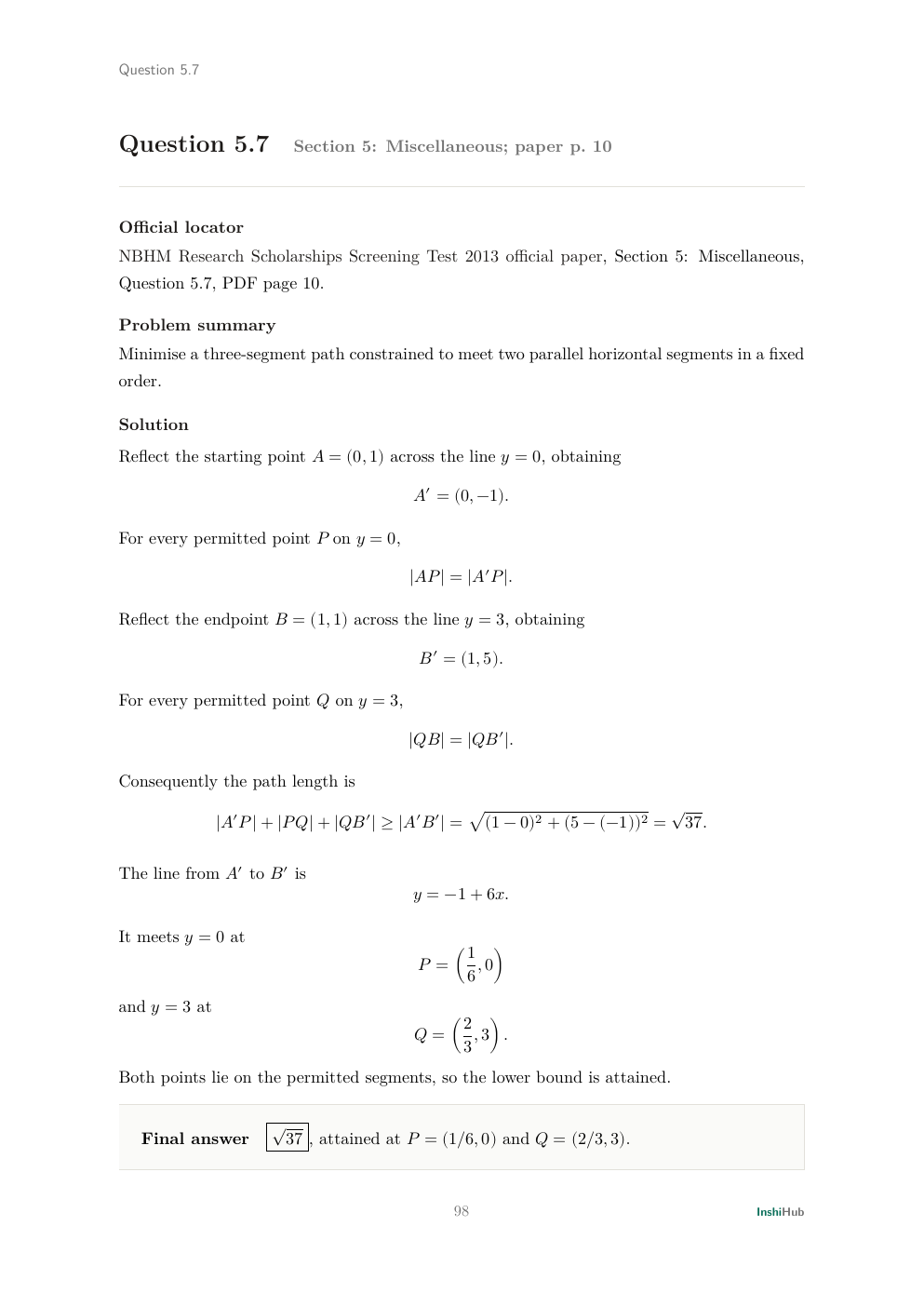
Minimise a three-segment path that must meet two parallel horizontal segments in order, while verifying that the unfolded straight line remains feasible.
Reflect the endpoints across the two constraint lines. The broken path then has the same length as a path from one reflected endpoint to the other, so the triangle inequality supplies a sharp straight-line lower bound.
The minimum is √37, attained at P=(1/6,0) and Q=(2/3,3).
Editorial quality system
Every solution identifies its official section, dotted question label, and paper page without copying the question or answer choices.
Each result is proved or disproved from the printed mathematical hypotheses before the final answer is compared with the archived key.
A different reviewer rechecks theorem use, calculations, counterexamples, boundary cases, source locators, and the rendered explanation.
Where dimension, branch, endpoint, transform domain, extremum class, or key typography changes the conclusion, the guide states the precise boundary and does not invent an official correction.
Review boundary
The guide page and free samples can be public while commercial validation remains incomplete. Seller accountability and end-to-end delivery approval are required before any payment control may be introduced.
Official sources, provenance, and rights
The paper itself is titled “Research Scholarships Screening Test.” The official NBHM past-paper archive classifies the file dated 19 January 2013 under Doctoral. This page uses “NBHM Doctoral 2013” as the searchable edition name while preserving the paper's historical title.
Independent answer-key comparison
Questions 1.4, 3.5, and 3.7 have dimension-one boundaries: the archived selections use the intended n≥2 matrix setting, while the guide also states what changes at n=1. Question 2.9 uses the multivalued logarithm convention for complex exponentiation. In Question 4.1, the archived key gives the correct eigenvalues but omits x from the sine argument; the guide derives the required x-dependent eigenfunction and records this as a local key typo. Question 4.4's stationary path is the unique strict maximiser and the functional is unbounded below. Question 4.5 requires s>0 in the real Laplace convention, or the corresponding right half-plane for complex s. Question 4.7's weighted-orthogonality conclusion uses the standard regular-endpoint, or vanishing Lagrange-bracket, interpretation; the weaker literal open-interval assumptions do not by themselves control the boundary term or weighted-integral convergence. Question 4.9 uses the standard Simpson formula without the key's harmless extra closing parenthesis. These are independent mathematical qualifications and are not presented as official errata.
National Board for Higher Mathematics publishes the source documents, which are hosted by The Institute of Mathematical Sciences. InshiHub links to that archive but does not republish its paper, answer choices, logos, or answer-key text.
InshiHub is independent and is not affiliated with, endorsed by, or sponsored by the National Board for Higher Mathematics, the Department of Atomic Energy, or The Institute of Mathematical Sciences. Official names identify the examination source only.
Transparent release status
The 2013 edition remains in validation. Publishing this page does not accept payment or create an order. Paid access may appear only after every recorded gate below passes for this exact edition.
Frequently asked questions
No. It contains independently written solutions and short, non-substituting topic summaries. Use the direct IMSc archive links on this page for the official question paper and archived key.
The current 106-page edition covers all 50 numbered questions and 50 addressable prompts, with dotted source labels, complete derivations, independent checks, and problem-specific error notes.
The paper had five sections of ten one-point questions. Only the candidate's best four section scores counted, so the maximum counted score was 40. No partial credit was provided for multiple-selection questions.
For n at least 2 the full real matrix ring has zero divisors, matching the archived selection. At n=1 it is just the real field and is an integral domain. The guide states both the intended reading and the literal edge case.
The archived key gives the correct eigenvalues but visibly omits x from the sine argument. The guide derives the boundary-condition-compatible function C sin((2n+1)πx/2) and identifies the omission as a local key typo, not a paper error.
The stationary curve in Question 4.4 is the unique strict maximiser and the functional is unbounded below. The Laplace-transform identity in Question 4.5 requires s>0 in the real convention, or the corresponding right half-plane in the complex convention. The weighted-orthogonality conclusion in Question 4.7 uses the standard regular-endpoint, or vanishing Lagrange-bracket, interpretation.
Not yet. The editorial page and free samples are public, but paid access remains disabled while seller, tax, payment, delivery, refund, and reconciliation validation is incomplete.
The configured one-time catalogue price is ₹999, inclusive of applicable tax. It is not a temporary discount or crossed-out-price promotion, and no payment control is present while validation remains incomplete.
Each solution was independently derived, checked against edge cases and source locators, and cross-reviewed before final comparison with the archived key. InshiHub is an independent publisher and is not affiliated with NBHM, the Department of Atomic Energy, or IMSc.