
Section 1
Algebra
1.1–1.10
Groups, rings, linear algebra, field structure, and spectral arguments.
Prepare for NBHM Doctoral and PhD-level mathematics with independent derivations for all 50 numbered questions and 52 addressable solution prompts. Read three complete solutions in searchable HTML, inspect six guide pages, and understand the original best-four-of-five scoring rule before practising.
Direct format answer
The 150-minute paper contained five subject sections of ten one-point questions. All 50 questions could be attempted, but only the best four section totals counted, giving a maximum counted score of 40. When one numbered question requested multiple answers, every requested answer was required for that point; no partial credit was provided.
Test date
22 January 2011
Working time
150 minutes
Paper structure
5 sections × 10 questions
Question value
1 point per numbered question
Counted result
Best 4 section scores
Maximum counted score
40 points
Question count is not a physical-answer-field count
The guide has 52 addressable solution prompts. This is because Question 5.3 contains separately explained parts inside the numbered, one-point question entries. The archived paper refers to a separate answer booklet but does not establish its physical field count, so this page does not invent one.
Each section contributes ten numbered questions. The guide keeps the printed dotted labels so a learner can move directly between an official question and the matching explanation.
Section 1
1.1–1.10
Groups, rings, linear algebra, field structure, and spectral arguments.
Section 2
2.1–2.10
Real and complex analysis, measure, sequences, series, and function spaces.
Section 3
3.1–3.10
Continuity, compactness, connectedness, quotient ideas, and metric spaces.
Section 4
4.1–4.10
Multivariable calculus, integration, ordinary differential equations, and boundary-value problems.
Section 5
5.1–5.10
Probability, combinatorics, geometry, optimisation, and mixed reasoning.
Six-page visual preview
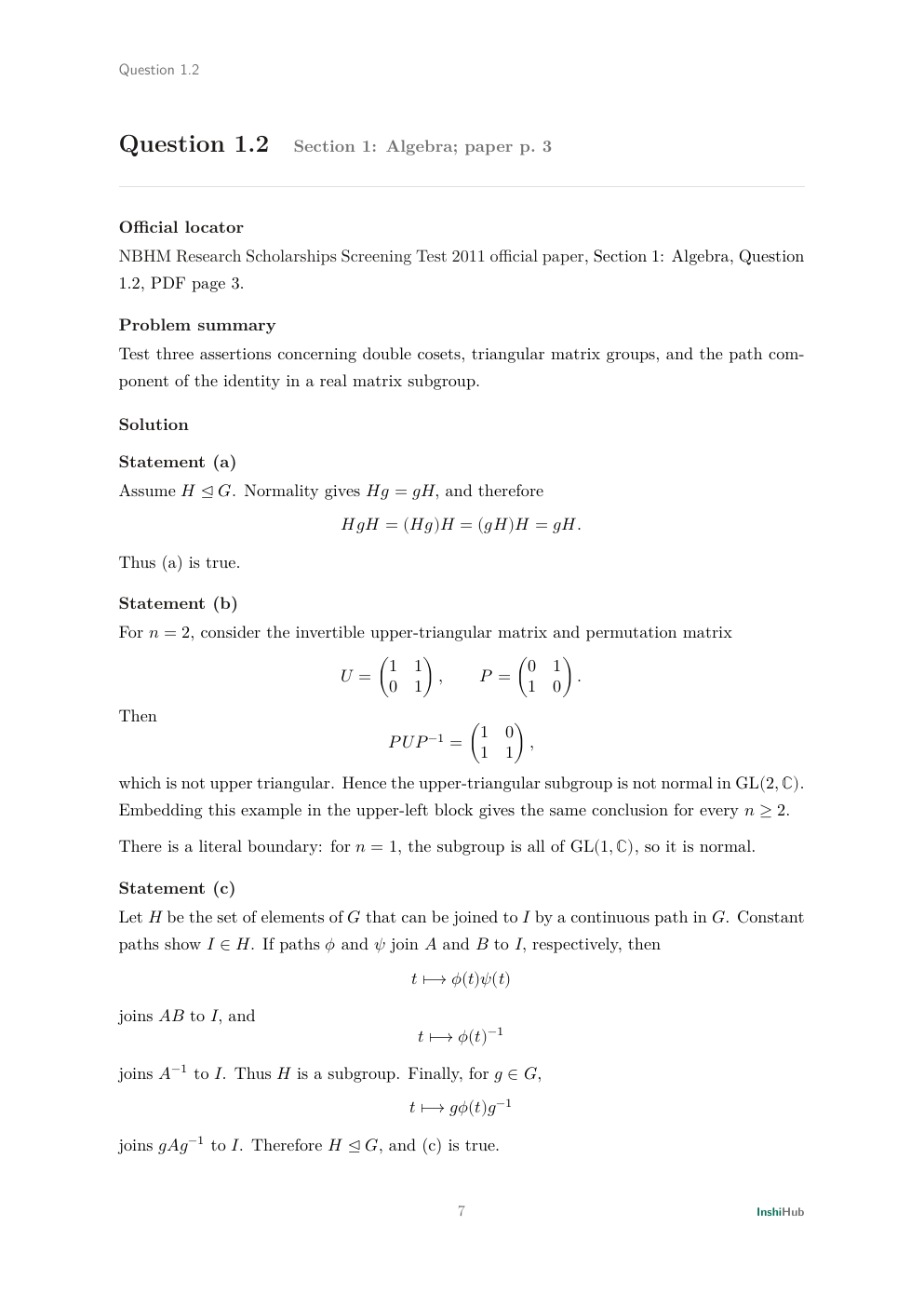
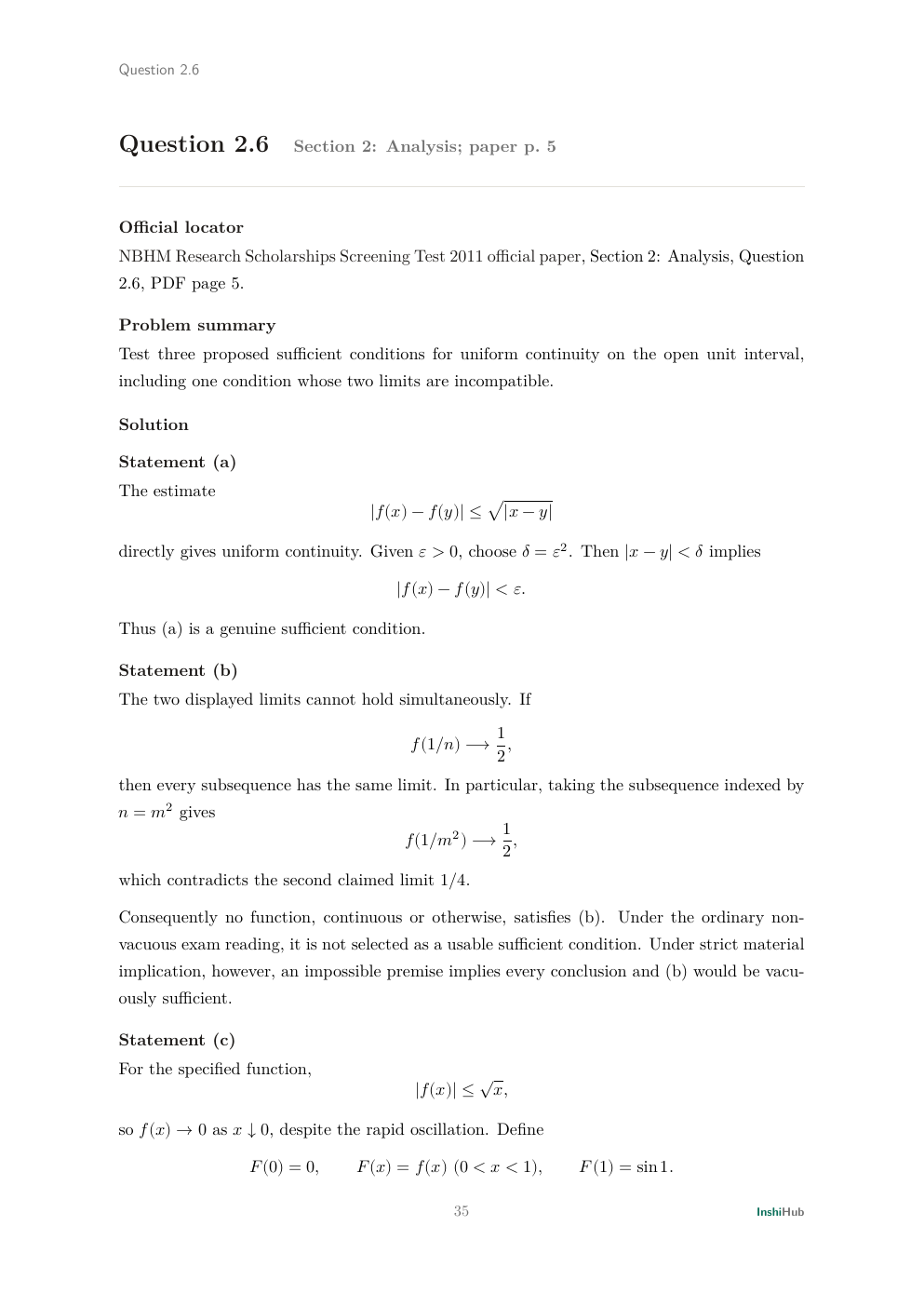
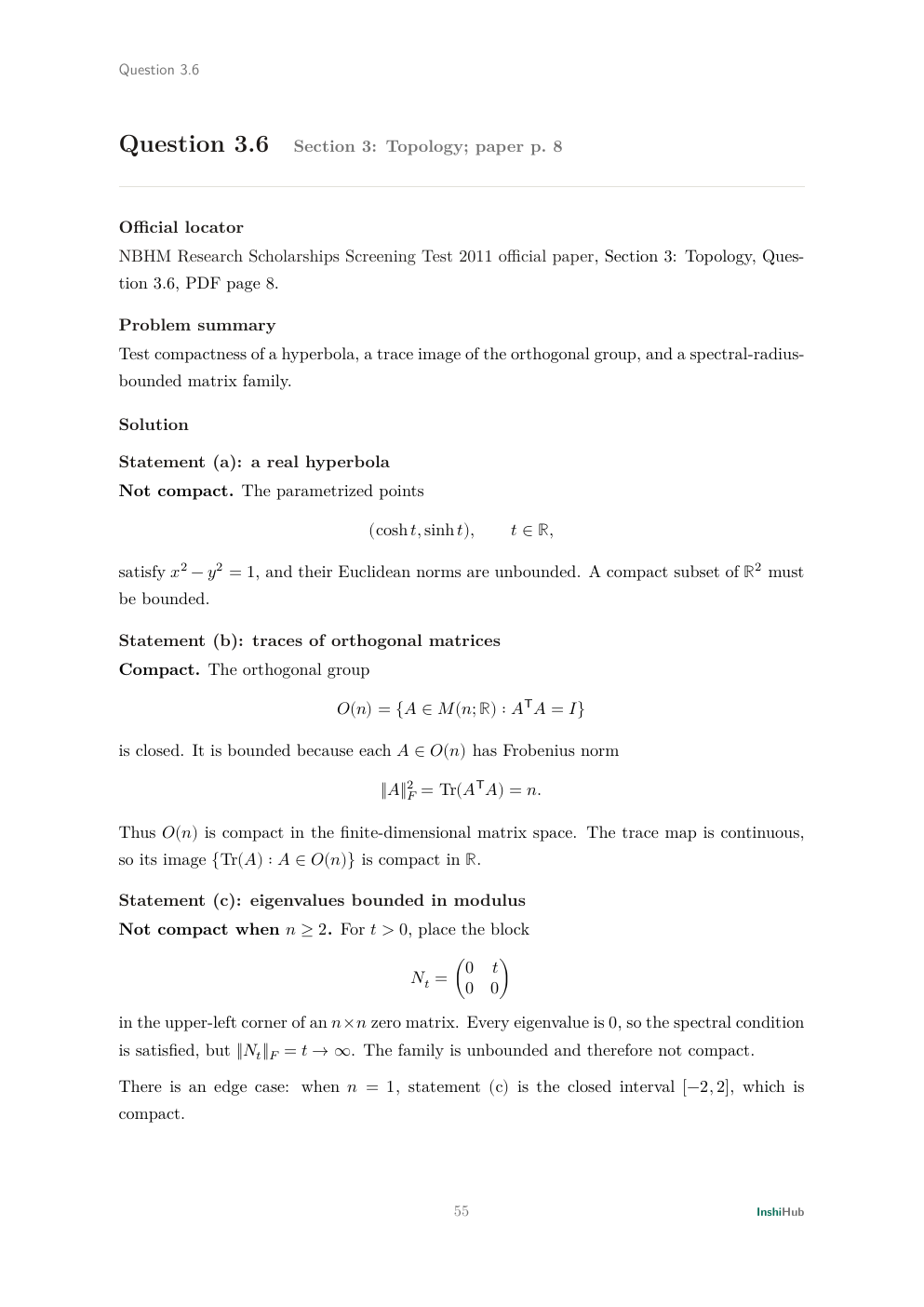
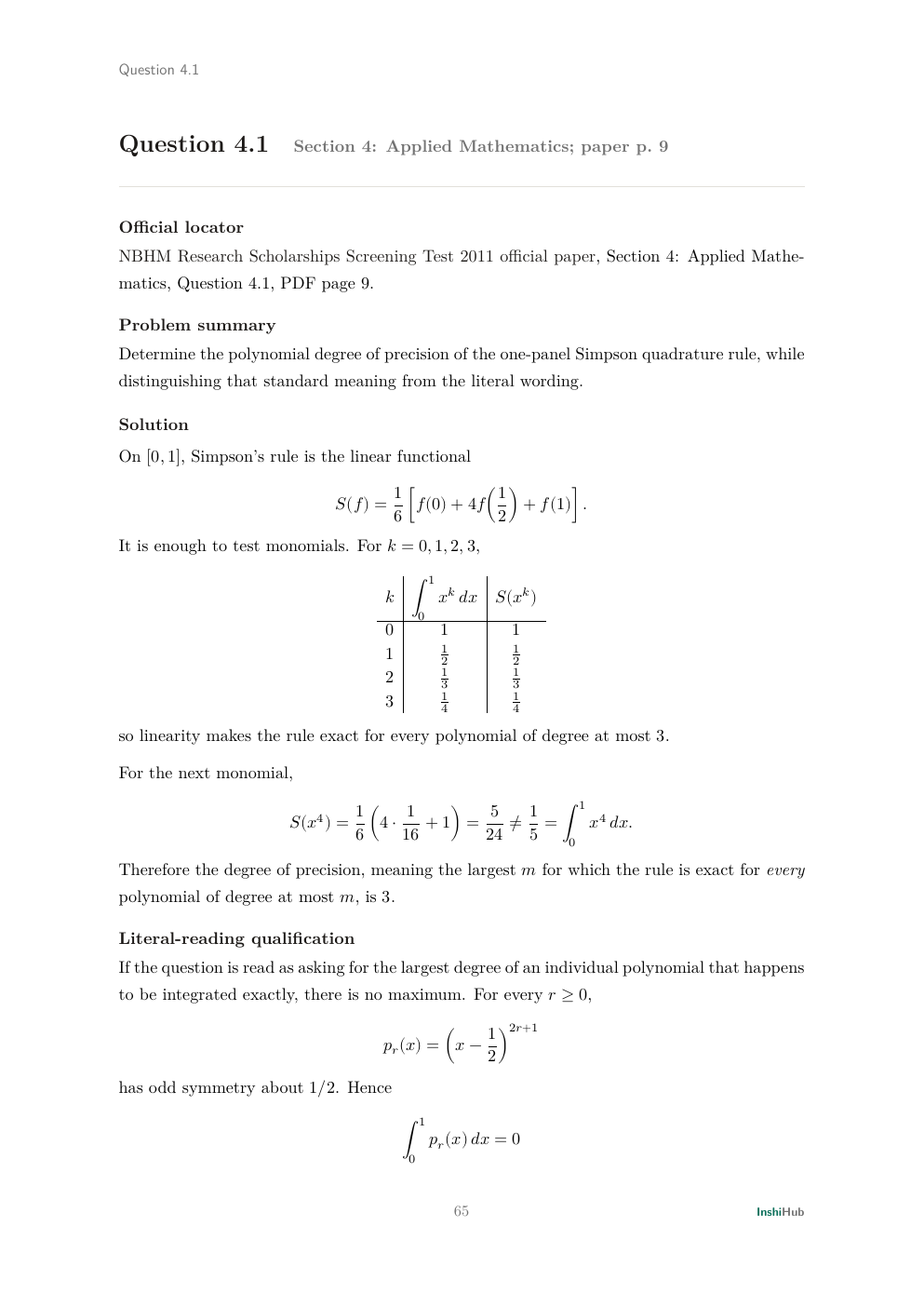
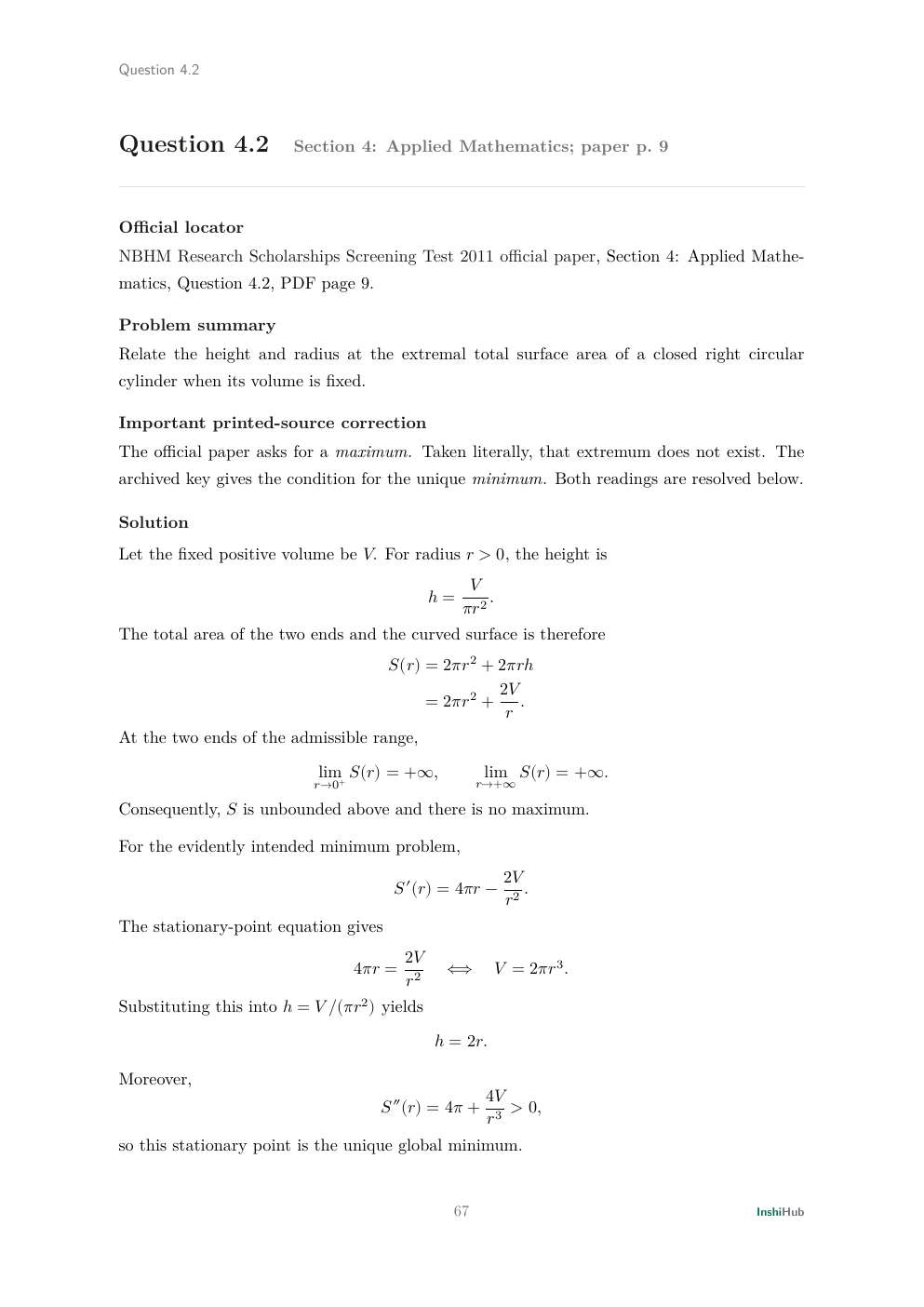
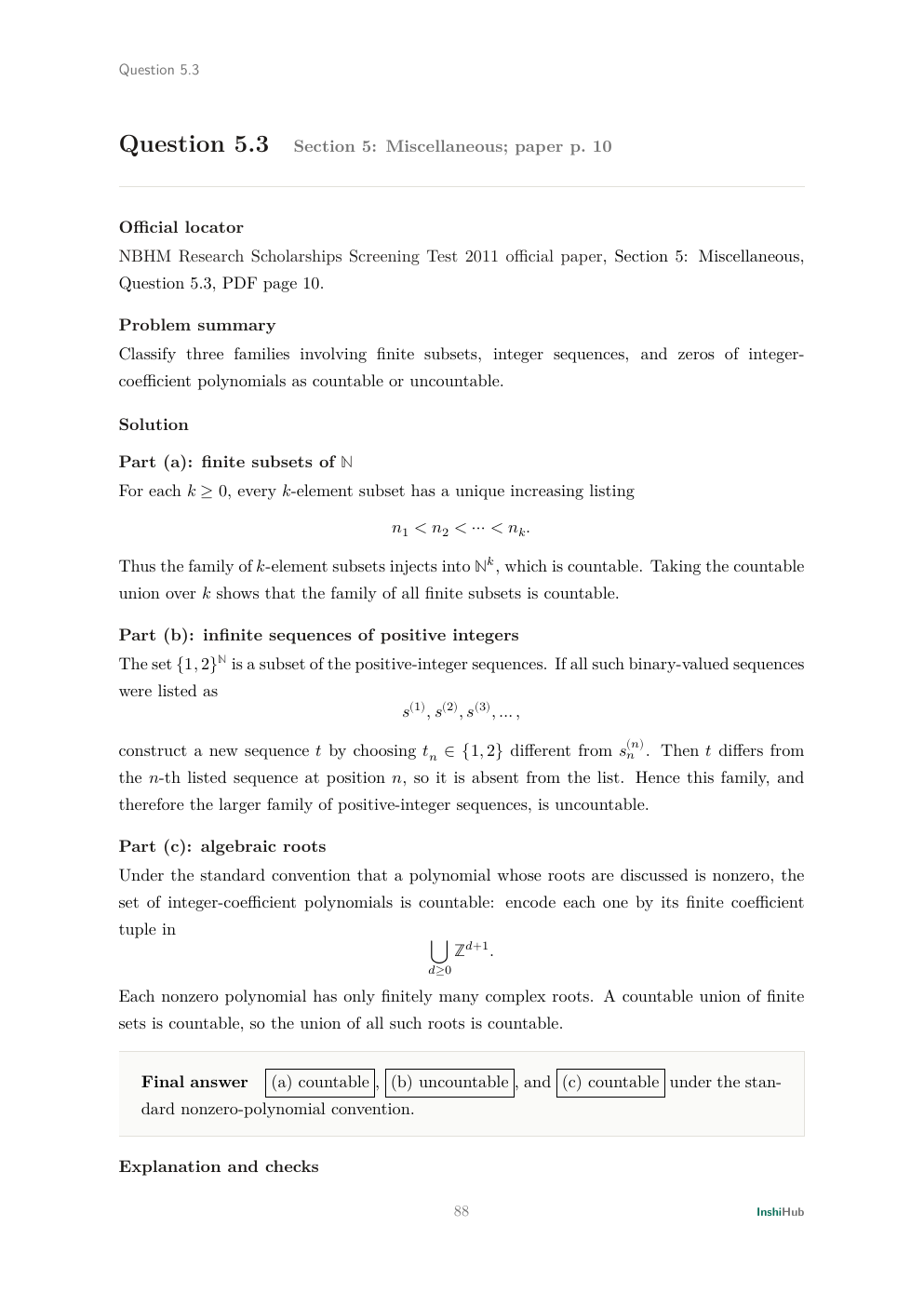
The preview covers Questions 1.2, 2.6, 3.6, 4.1, 4.2, 5.3 from the current 104-page manuscript. Every image is an InshiHub explanation page, never a scan of the official paper or answer key.
Crawlable HTML samples
These summaries identify the mathematical task without substituting for the official question. Open the source paper at the precise locator, attempt the problem, and then audit your work against the derivation, verification, and common-error note.
Free sample 1
Test three proposed sufficient conditions for uniform continuity, including two incompatible limits along a sequence and one of its subsequences.
A direct modulus proves the first condition, subsequence uniqueness exposes the impossible second premise, and a continuous compact-interval extension settles the oscillatory third function.
Under the intended non-vacuous exam reading, statements (a) and (c) imply uniform continuity. Statement (b) is internally inconsistent; under purely formal material implication it would also be vacuously sufficient.
Free sample 2
Determine what actually happens to the total surface area of a closed cylinder when the official paper asks for a maximum at fixed positive volume.
Eliminate the height using the volume constraint, inspect both endpoints before differentiating, and distinguish the unbounded-above printed problem from the unique minimum encoded by the archived key.
For the problem as printed, no maximum exists. For the intended minimum problem, h=2r, which is the archived key's result.
Free sample 3
Classify three families using finite encodings, Cantor's diagonal argument, and a necessary convention about the zero polynomial.
Finite tuples create countable unions in the positive cases, binary-valued sequences already force uncountability in the second family, and each nonzero polynomial contributes only finitely many roots.
Part (a) is countable, part (b) is uncountable, and part (c) is countable under the standard nonzero-polynomial convention.
Editorial quality system
Every solution identifies its official section, dotted question label, and paper page without copying the question or answer choices.
Each result is proved or disproved from the printed mathematical hypotheses before the final answer is compared with the archived key.
A different reviewer rechecks theorem use, calculations, counterexamples, boundary cases, source locators, and the rendered explanation.
Where dimension, vacuous truth, quantifier scope, extremum type, or an implicit algebraic convention changes the conclusion, the guide states the precise boundary and does not invent an official correction.
Review boundary
The guide page and free samples can be public while commercial validation remains incomplete. Seller accountability and end-to-end delivery approval are required before any payment control may be introduced.
Official sources, provenance, and rights
The paper itself is titled “Research Scholarships Screening Test.” The official NBHM past-paper archive classifies the file dated 22 January 2011 under Doctoral. This page uses “NBHM Doctoral 2011” as the searchable edition name while preserving the paper's historical title.
Independent answer-key comparison
Question 1.2's upper-triangular subgroup is normal when n=1 but not when n is at least 2, and Question 1.4's quotient-field conclusion needs the usual proper-ideal convention. Question 2.6 contains two incompatible limits along a sequence and its subsequence: the ordinary non-vacuous exam reading excludes that condition, while formal material implication makes it vacuously sufficient. In Question 3.6, eigenvalue bounds do not control nonnormal matrix norms when n is at least 2, although the n=1 family is compact. Question 4.1 has Simpson degree of precision 3 under the standard definition, while arbitrarily high individual odd polynomials are exact under a literal reading. Question 4.2 is unbounded above as printed; h=2r is the unique minimum condition recorded by the archived key. Question 5.3(c) is countable under the standard nonzero-polynomial convention, while including the zero polynomial would make every complex number a root. These are independent mathematical qualifications and are not presented as official errata.
National Board for Higher Mathematics publishes the source documents, which are hosted by The Institute of Mathematical Sciences. InshiHub links to that archive but does not republish its paper, answer choices, logos, or answer-key text.
InshiHub is independent and is not affiliated with, endorsed by, or sponsored by the National Board for Higher Mathematics, the Department of Atomic Energy, or The Institute of Mathematical Sciences. Official names identify the examination source only.
Transparent release status
The 2011 edition remains in validation. Publishing this page does not accept payment or create an order. Paid access may appear only after every recorded gate below passes for this exact edition.
Frequently asked questions
No. It contains independently written solutions and short, non-substituting topic summaries. Use the direct IMSc archive links on this page for the official question paper and archived key.
The current 104-page edition covers all 50 numbered questions and 52 addressable prompts, with dotted source labels, complete derivations, independent checks, and problem-specific error notes.
Question 5.3 contains three separately addressable classification parts. Counting those subparts produces 52 complete prompts without changing the official count of 50 numbered questions.
Question 1.2's upper-triangular subgroup is normal when n=1 but not when n is at least 2. Question 3.6's spectral-radius-bounded family is the compact interval [-2,2] when n=1 but is unbounded for every fixed n at least 2.
The proposed values along 1/n and 1/n squared are incompatible because the latter is a subsequence of the former. The ordinary non-vacuous exam reading excludes that condition; a purely formal material implication makes it vacuously sufficient.
Question 4.1 has standard degree of precision 3, although individual exact odd polynomials exist in arbitrarily high degree. Question 4.2 has no printed maximum; h=2r is the unique minimum condition. Question 5.3(c) is countable only under the usual nonzero-polynomial convention.
Not yet. The editorial page and free samples are public, but paid access remains disabled while seller, tax, payment, delivery, refund, and reconciliation validation is incomplete.
The configured one-time catalogue price is ₹999, inclusive of applicable tax. It is not a temporary discount or crossed-out-price promotion, and no payment control is present while validation remains incomplete.
Each solution was independently derived, checked against edge cases and source locators, and cross-reviewed before final comparison with the archived key. InshiHub is an independent publisher and is not affiliated with NBHM, the Department of Atomic Energy, or IMSc.