InshiHubIndia

Official 2026 sample sets · independent guide

ISI M.Math 2026 PMA and PMB Sample Questions — Independent Detailed Solutions

Work through all 31 PMA objective samples and all 18 addressable PMB proof or computation prompts. Every chapter supplies an exact locator, an original derivation, a check, and a problem-specific warning.

39 chapters · 49 promptsExact PMA and PMB locatorsIndependent range review

These are sample questions, not administered 2026 past papers. ISI's M.Math programme page controls that classification, and its index warns that a live test need not retain the sample structure.

Direct format answer

What are the ISI M.Math 2026 PMA and PMB sample sets?

PMA is the official forenoon-coded sample set and contains 31 four-option objective items. PMB is the afternoon-coded sample set and contains eight written questions with 18 requested proof or computation prompts. Neither sample PDF states marks, timing, negative marking, or a maximum score.

Official classification

Sample Questions 2026

PMA set

31 objective items

PMB set

8 written questions

Addressable prompts

49 total

Marks and timing

Not stated in samples

Official sample key

Not linked

PMA · Forenoon in the official syllabus

31 four-option objective sample questions

31 complete derivations, final conclusions, letter-only alternative audits, independent checks, and common traps.

PMB · Afternoon in the official syllabus

8 written sample questions with 18 requested prompts

Complete proofs or computations for every requested part, including explicit separation of hypotheses and tasks in PMB 6.

Exact-edition visual preview

Inspect six pages from the frozen 82-page guide

The cover and five sample-solution pages are lossless renders from the exact InshiHub-authored paid master. They contain no official scan, question wording, choice wording, logo, or page design.
Keep the free official PMA or PMB PDF open beside the preview. The locator identifies the source item without turning this page into a substitute copy.
Preview page 1 of 6Sample · not the official paper
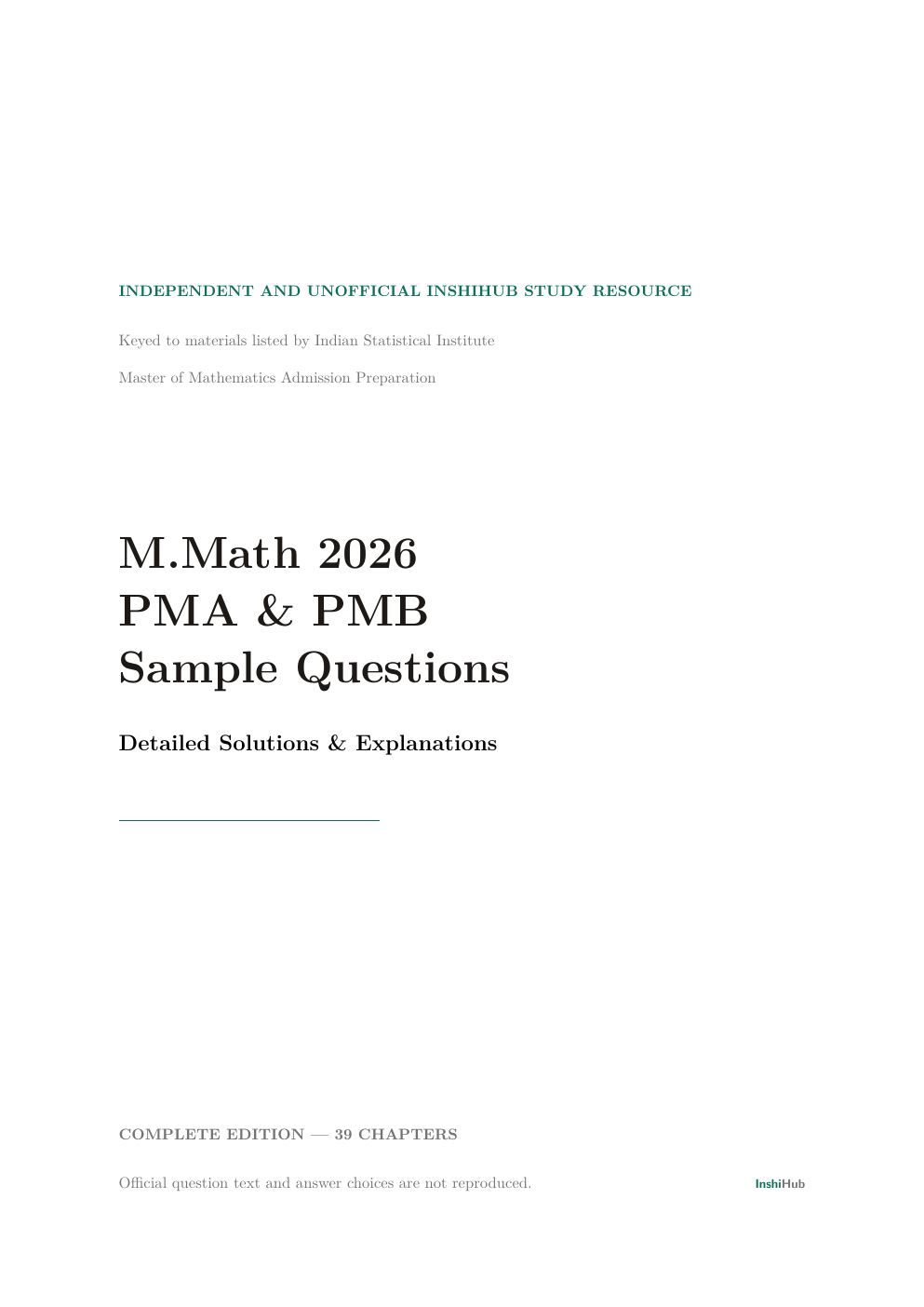
ISI M.Math 2026 PMA and PMB Sample Questions — Independent Detailed Solutions, preview page 1 of 6: Cover of the complete 82-page ISI M.Math 2026 PMA and PMB sample-question independent detailed-solutions edition.
Preview page 2 of 6Sample · not the official paper
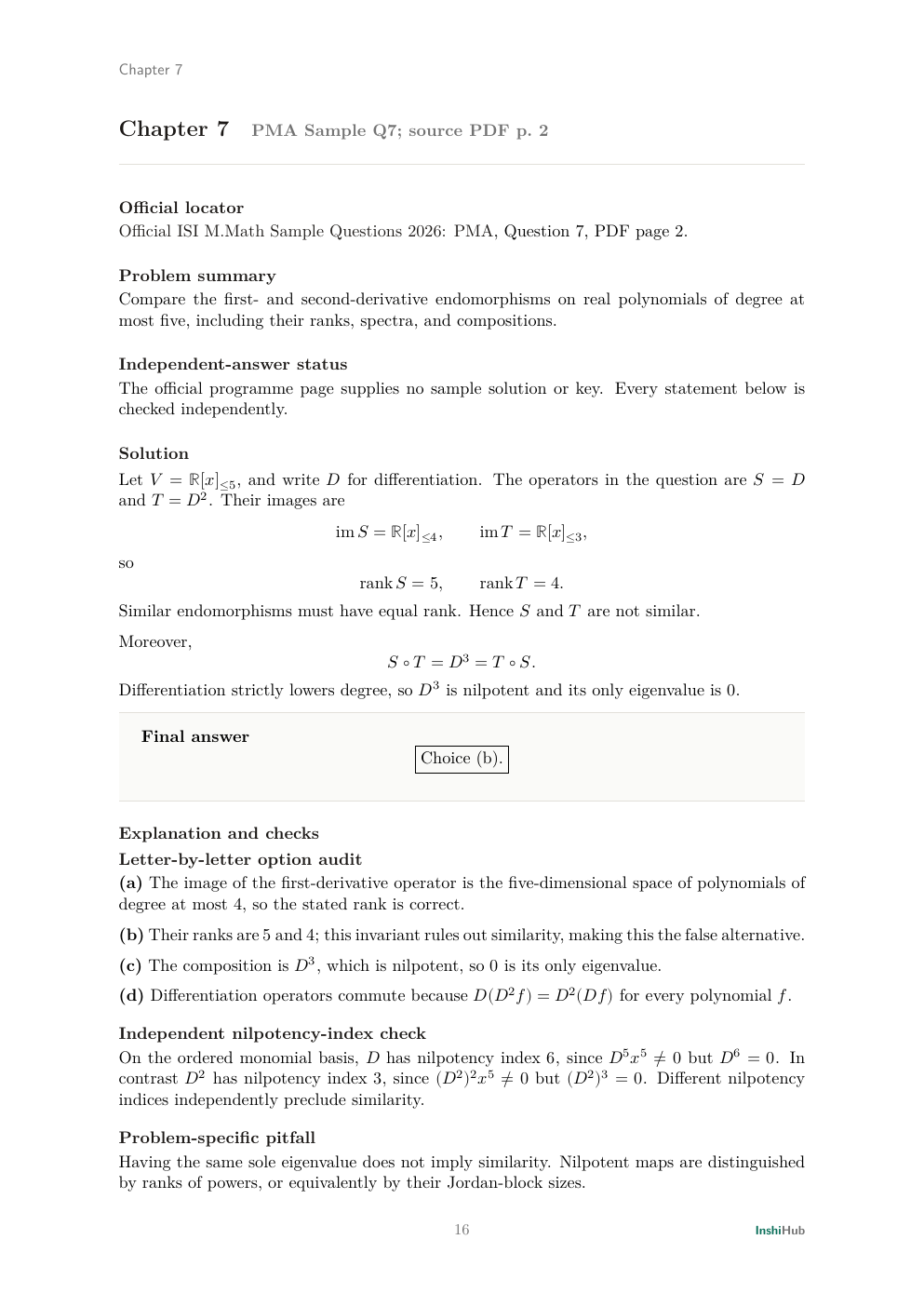
ISI M.Math 2026 PMA and PMB Sample Questions — Independent Detailed Solutions, preview page 2 of 6: PMA 7 solution comparing first- and second-derivative operators through rank, similarity, spectrum, and nilpotence.
Preview page 3 of 6Sample · not the official paper
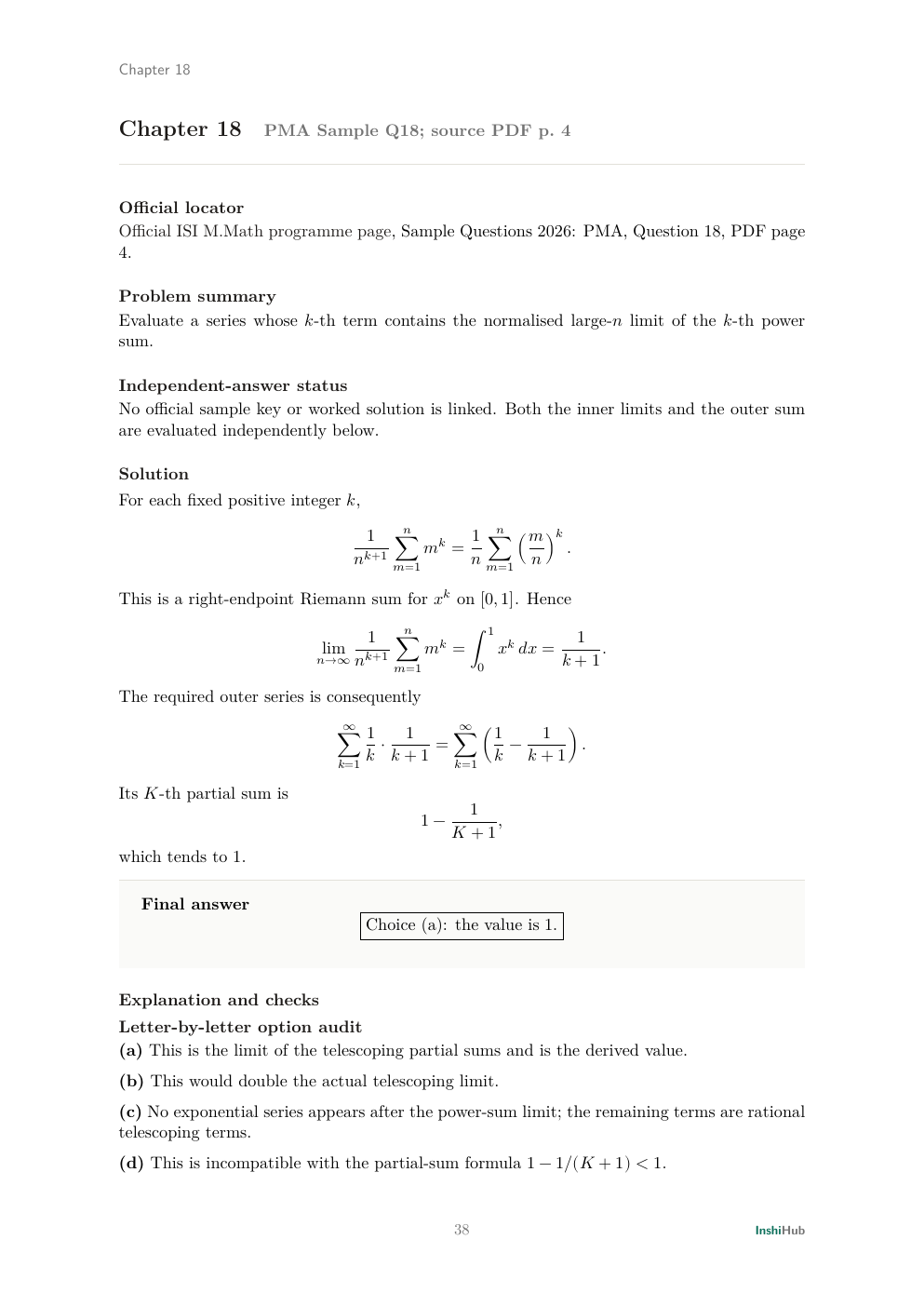
ISI M.Math 2026 PMA and PMB Sample Questions — Independent Detailed Solutions, preview page 3 of 6: PMA 18 solution converting normalized power sums into a Riemann integral before telescoping the outer series.
Preview page 4 of 6Sample · not the official paper
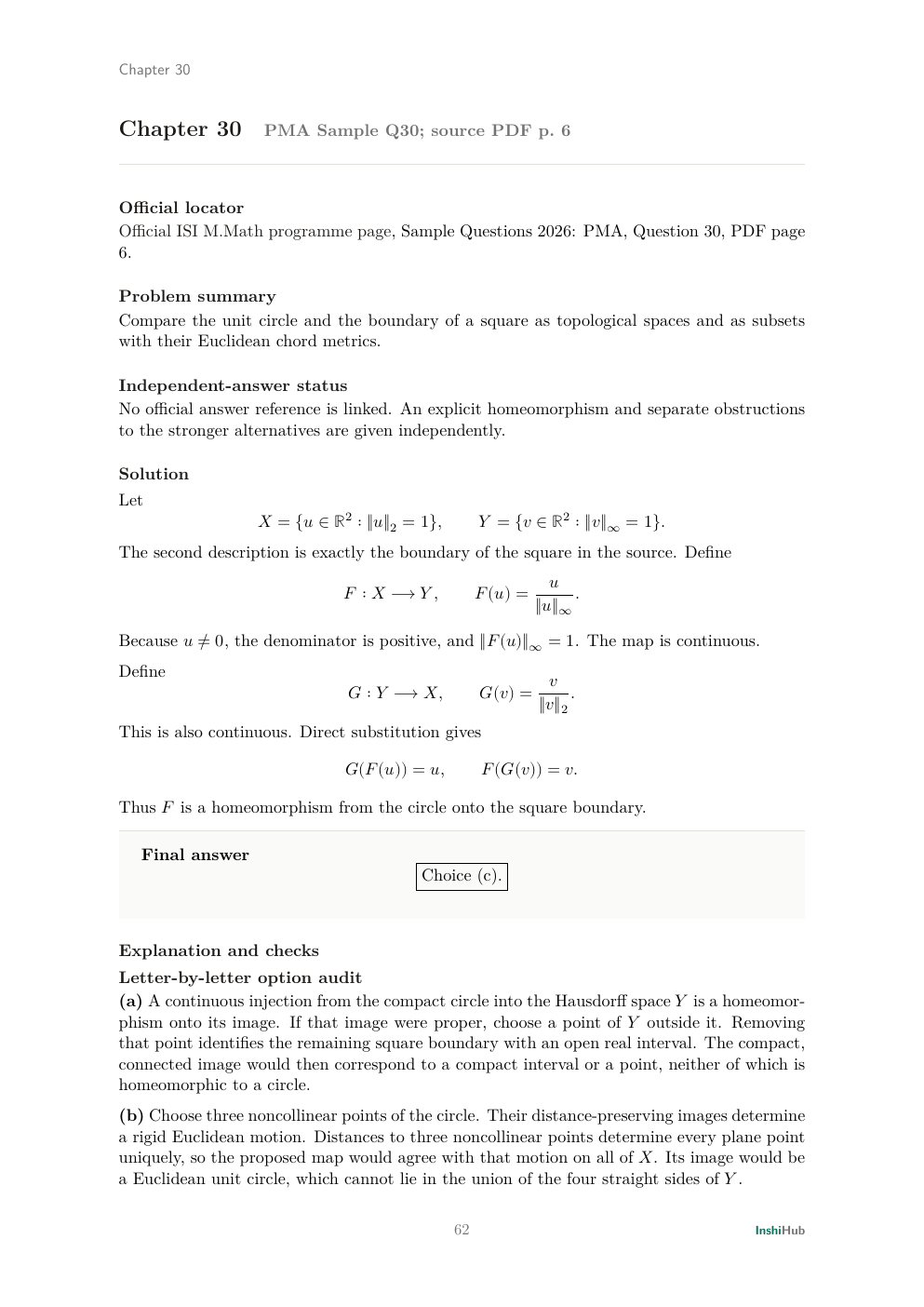
ISI M.Math 2026 PMA and PMB Sample Questions — Independent Detailed Solutions, preview page 4 of 6: PMA 30 solution constructing radial homeomorphisms between a circle and a square boundary while separating metric claims.
Preview page 5 of 6Sample · not the official paper
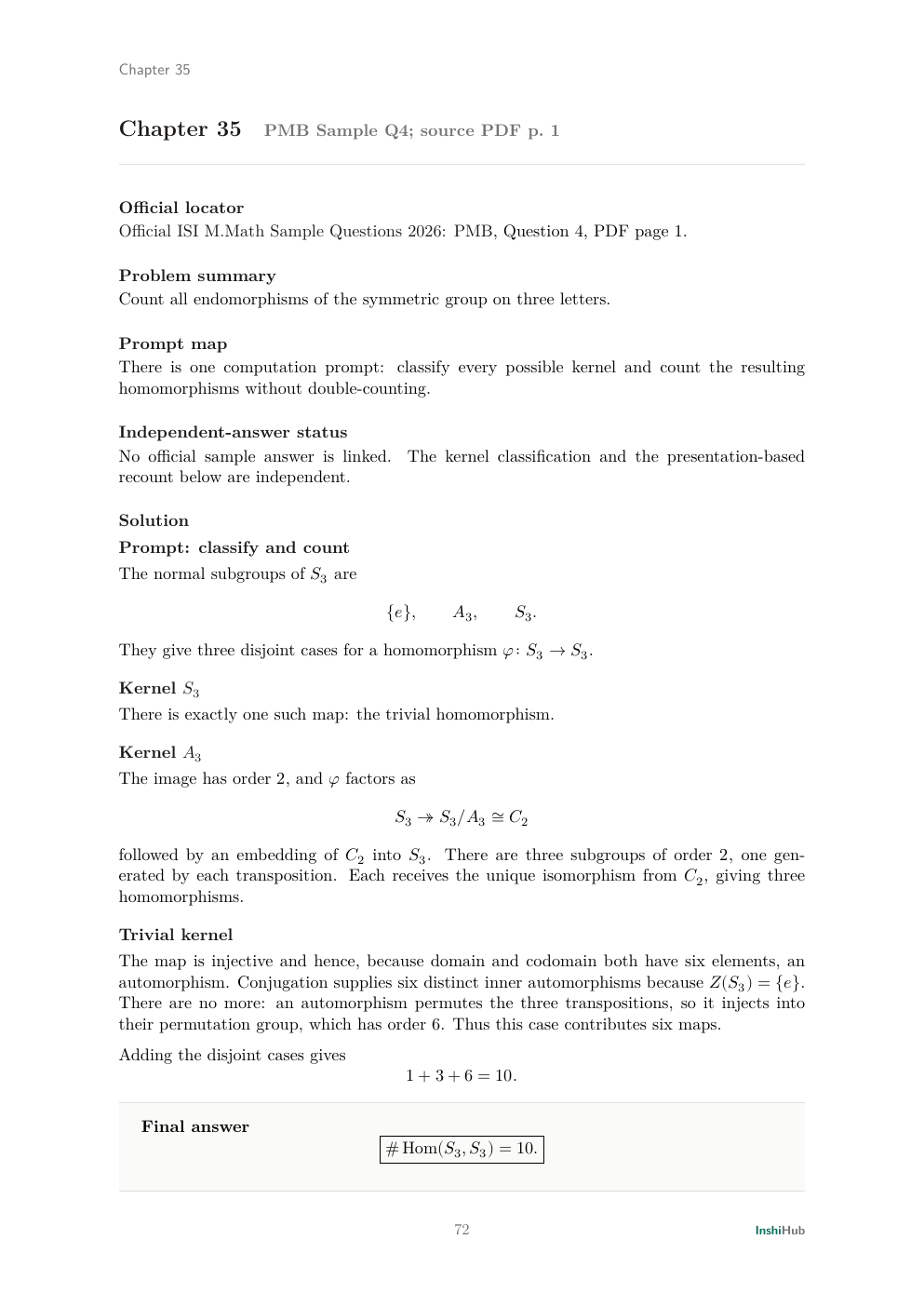
ISI M.Math 2026 PMA and PMB Sample Questions — Independent Detailed Solutions, preview page 5 of 6: PMB 4 solution counting all endomorphisms of the symmetric group S3 by kernel type and a presentation check.
Preview page 6 of 6Sample · not the official paper
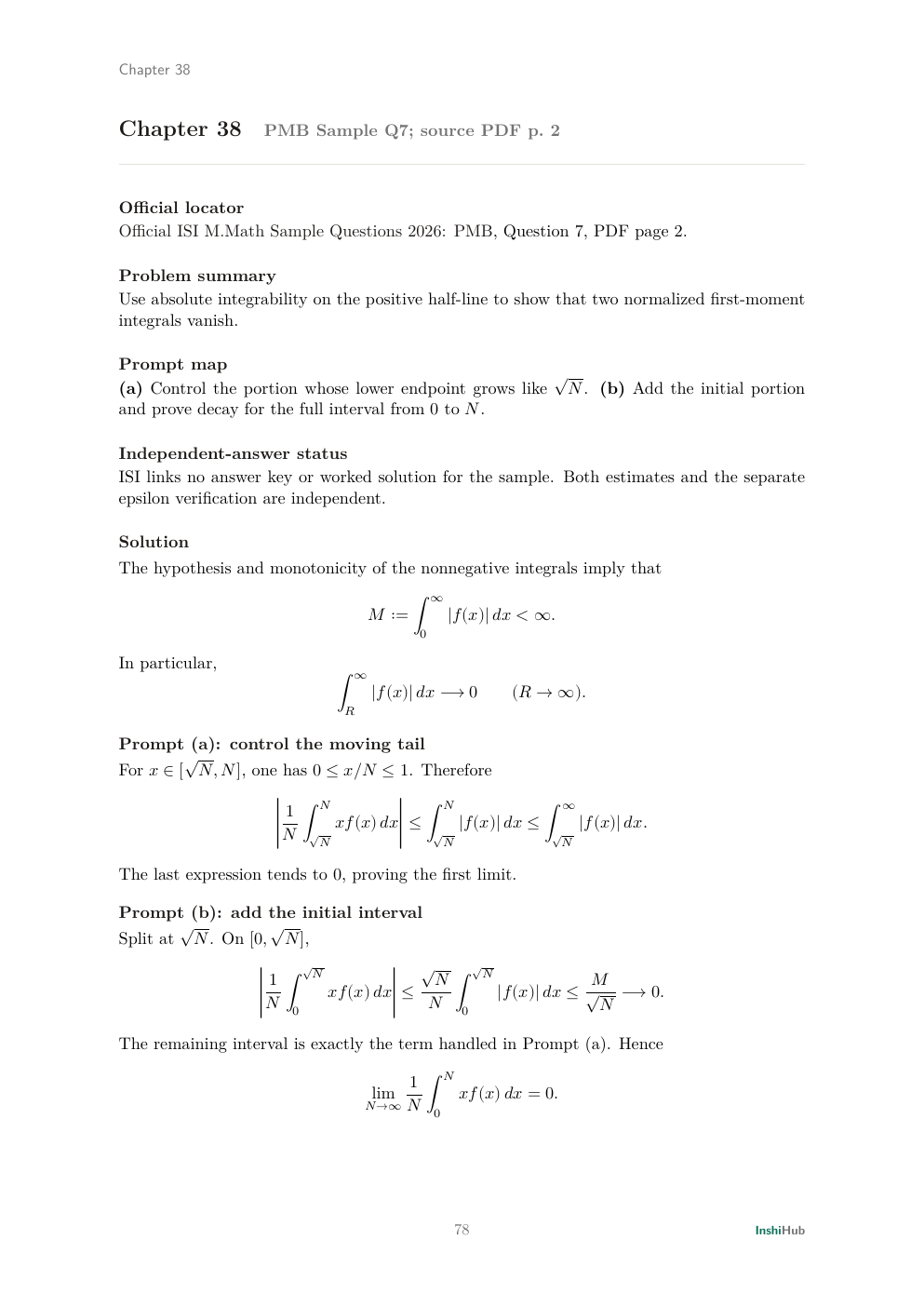
ISI M.Math 2026 PMA and PMB Sample Questions — Independent Detailed Solutions, preview page 6 of 6: PMB 7 solution proving two normalized weighted-integral limits using an L1 tail split and an independent cutoff argument.

Five complete searchable samples

Read the method, derivation, check, and likely mistake

These samples cover three PMA objective items and two PMB written items. Each summary is deliberately non-substitutive: consult the official sample set for the original task.

Free sample 1

PMA 7 · Differentiation operators, rank, similarity, and nilpotence

Cross-review recorded
Source locator
PMA Sample Questions 2026, official Question 7, PDF page 2
Review note
Independently derived and cross-reviewed; rank, composition, spectrum, nilpotency index, locator, and letter audit checked · 2026-07-28

Problem summary

Compare the first- and second-derivative endomorphisms on real polynomials of degree at most five through rank, composition, spectrum, and nilpotency index.

Core idea

Treat the two maps as D and D squared. Their image dimensions immediately separate their similarity classes, while their compositions reduce to the same nilpotent third derivative.

Step-by-step reasoning

  1. 1On polynomials of degree at most five, the image of D is the five-dimensional space of polynomials of degree at most four.
  2. 2The image of D squared is the four-dimensional space of polynomials of degree at most three.
  3. 3Similar endomorphisms must have the same rank, so the two differentiation maps cannot be similar.
  4. 4Both compositions equal D cubed because powers of the same operator commute.
  5. 5The third derivative is nilpotent and therefore has zero as its only eigenvalue.

Final result

Choice (b) is the false alternative: the first- and second-derivative operators are not similar.

Free sample 2

PMA 18 · Power-sum asymptotics, Riemann sums, and telescoping series

Cross-review recorded
Source locator
PMA Sample Questions 2026, official Question 18, PDF page 4
Review note
Independently derived and cross-reviewed; Riemann-sum limit, telescoping series, asymptotic check, locator, and letter audit checked · 2026-07-28

Problem summary

Evaluate a series whose k-th term contains the normalized large-n limit of the k-th power sum.

Core idea

Recognize the normalized inner sum as a right-endpoint Riemann sum, then telescope the resulting rational outer series.

Step-by-step reasoning

  1. 1For fixed positive k, rewrite the normalized power sum as one over n times the sum of (m/n) raised to k.
  2. 2This is a right-endpoint Riemann sum for x raised to k on the interval from zero to one.
  3. 3The inner limit is therefore the integral of x raised to k, equal to 1/(k+1).
  4. 4Multiplying by the remaining factor 1/k gives 1/[k(k+1)].
  5. 5The identity 1/[k(k+1)]=1/k-1/(k+1) makes the outer series telescope to 1.

Final result

Choice (a): the value of the series is 1.

Free sample 3

PMA 30 · Homeomorphism versus Euclidean isometry

Cross-review recorded
Source locator
PMA Sample Questions 2026, official Question 30, PDF page 6
Review note
Independently derived and cross-reviewed; radial maps, inverse identities, embedding obstructions, locator, and letter audit checked · 2026-07-28

Problem summary

Compare the unit circle and the boundary of a square as topological spaces and as subsets carrying their Euclidean chord metrics.

Core idea

Use reciprocal radial normalizations between the Euclidean and maximum norms to build an explicit homeomorphism, then separate that topological fact from the stronger metric claims.

Step-by-step reasoning

  1. 1Represent the circle by Euclidean norm one and the square boundary by maximum norm one.
  2. 2Map a circle point u to u divided by its maximum norm; the result lies on the square boundary.
  3. 3Map a square-boundary point v to v divided by its Euclidean norm; the result lies on the circle.
  4. 4Direct substitution shows that the two radial maps are continuous inverses.
  5. 5A distance-preserving embedding would be forced by three noncollinear points to agree with a rigid motion, whose circular image cannot lie in four straight line segments.

Final result

Choice (c): the circle and square boundary are homeomorphic, but the stronger Euclidean-isometry claim does not follow.

Free sample 4

PMB 4 · Counting endomorphisms of the symmetric group S3

Cross-review recorded
Source locator
PMB Sample Questions 2026, official Question 4, PDF page 1
Review note
Independently derived and cross-reviewed; kernel cases, automorphism count, presentation check, and locator checked · 2026-07-28

Problem summary

Count all homomorphisms from the symmetric group on three letters to itself by classifying the possible kernels.

Core idea

The normal subgroups give three disjoint kernel cases: the whole group, the alternating subgroup, and the trivial subgroup.

Step-by-step reasoning

  1. 1A whole-group kernel gives exactly the trivial homomorphism.
  2. 2A kernel equal to A3 produces an image of order two and one map for each of the three order-two subgroups.
  3. 3A trivial kernel makes the endomorphism injective and therefore an automorphism.
  4. 4All six automorphisms are inner because the centre is trivial, and there can be no more than the six permutations of the transpositions.
  5. 5The three cases contribute 1, 3, and 6 maps, respectively.

Final result

There are exactly 10 endomorphisms of S3.

Free sample 5

PMB 7 · Absolute integrability and normalized weighted integrals

Cross-review recorded
Source locator
PMB Sample Questions 2026, official Question 7, PDF page 2
Review note
Independently derived and cross-reviewed; both prompt estimates, fixed-cutoff check, and locator checked · 2026-07-28

Problem summary

Use finite absolute mass on the positive half-line to prove that two normalized first-moment integrals vanish.

Core idea

Split the interval at the square root of N: the weight is small on the initial part, while the absolute-integrability tail is small on the remaining part.

Step-by-step reasoning

  1. 1Let M be the finite integral of the absolute value of f over the positive half-line.
  2. 2On the interval from square root of N to N, the factor x/N is at most one.
  3. 3The absolute value of that weighted integral is therefore bounded by an L1 tail beginning at square root of N, which vanishes.
  4. 4On the initial interval, x/N is at most 1/square root of N, so the contribution is bounded by M/square root of N.
  5. 5Combining the two bounds proves that both requested normalized limits are zero.

Final result

Both normalized weighted-integral limits are 0.

Source wording and convention record

Three edges are disclosed instead of normalized away

No official sample key is linked. Where literal wording or a mathematical convention affects uniqueness, the guide states the boundary and distinguishes the intended reading from the literal one.

PMA 5

The zero-vector quantifier changes literal truth

The evident intended result is recorded, but the chapter also explains that including the zero vector makes two alternatives fail under the standard nonzero-eigenvector definition.

PMA 16

The ring convention is stated explicitly

The reviewed result uses the standard convention that a ring has an identity with 1 not equal to 0. The zero-ring edge is not hidden.

PMA 24

A permissive word creates non-uniqueness

The guide separates the forced complete classification from a second alternative that is also literally true as an existential statement.

Complete topic map

Which subjects do the 2026 M.Math sample questions cover?

The two sets move from linear and abstract algebra through real analysis and calculus to topology and metric spaces. The guide preserves the official PMA and PMB numbering so each solution can be located immediately.

Linear algebra and representations

PMA 1–12 · PMB 1–2

Spectral identities, rank and kernel, matrix subspaces, polynomial operators, generators, simultaneous diagonalisation, exact sequences, and invariant complements.

Abstract algebra

PMA 10–17 · PMB 3–4

Quotient rings, ideals, local generation, symmetric groups, Sylow theory, finite rings, Chinese remainders, and group endomorphisms.

Analysis and calculus

PMA 18–28 · PMB 5–7

Power sums, series, uniform convergence, liminf and limsup, monotone functions, differentiability, Riemann integrals, endpoint derivatives, supremum arguments, and absolute integrability.

Topology and metric spaces

PMA 29–31 · PMB 8

Continuous images of sequences, compact dense sets, circle and square boundaries, path-connected unions, and continuity detected by compact restrictions.

Full-edition scope

  • Original step-by-step solutions for all 31 PMA objective sample questions
  • Letter-only analysis of every PMA alternative without reproducing official answer-choice text
  • Original proofs and computations for all 8 PMB written sample questions and all 18 requested prompts
  • Exact official set, question number, and source-PDF-page locator for every chapter
  • Independent structural, asymptotic, algebraic, topological, or edge-case verification
  • Problem-specific strategy notes and common-error warnings
  • Prominent interpretation disclosures for PMA 5, PMA 16, and PMA 24
  • A dated correction process and public correction log after release

What is not included

  • The official PMA or PMB PDFs, official question wording, answer choices, figures, logos, institutional marks, or source layout
  • Any claim that the two 2026 sample sets were administered as the 2026 admission test
  • An official answer key, official worked solutions, or a claim of agreement with an unavailable key
  • Invented marks, negative marking, time limits, or a maximum score for the sample sets
  • A guarantee that a live ISI admission test will retain the sample-question structure
  • Admissions counselling, application evaluation, selection prediction, or score guarantees
  • Affiliation with, endorsement by, sponsorship by, or approval from the Indian Statistical Institute

Editorial quality system

Every prompt is derived, challenged, and source-mapped

1

Exact two-set mapping

Every chapter identifies PMA or PMB, the official sample-question number, and the PDF page while leaving the official wording and page design at ISI.

2

Independent derivation

No sample answer key is linked. Each objective conclusion, proof, computation, and counterexample is therefore derived directly and transparently.

3

Range-by-range cross-review

Separate reviewers re-derived PMA 1–16, PMA 17–31, and all eight PMB questions, covering every one of the 49 addressable prompts.

4

Ambiguity disclosed, not hidden

PMA 5, PMA 16, and PMA 24 retain explicit wording or convention boundaries instead of forcing an unsupported unique official answer.

Official sources, provenance, and rights

ISI keeps both official sample sets free

InshiHub links to ISI's programme page, sample PDFs, and syllabus. It does not republish official question text, answer choices, figures, logos, institutional marks, or page layout.

Admission-test date context
Source accessed
2026-07-28
Sample key status
Not linked by the official programme page
M.Math Sample Questions 2026: PMA SHA-256
4300e959d03f3d979bf684c287671fceed0f762ebc8bccd9b5310b2b8f391b84
M.Math Sample Questions 2026: PMB SHA-256
757019663b64407d1e406c5956e9c7ec8dfec0c33f9931f5c51c5ce40c340ea6
Frozen InshiHub edition
82 A4 pages · 1,020,853 bytes · SHA-256 4b9783070d13e56d932c544f1d13e442ac8bbe9c7b8d6e2f788e3060847a35c8

Independently produced by InshiHub. InshiHub is not affiliated with, endorsed by, sponsored by, or approved by the Indian Statistical Institute (ISI). ISI and related names are used only to identify the programme and official sample materials. This guide contains InshiHub's original explanations and solution methods. It does not reproduce the official question text, answer choices, figures, logos, institutional marks, or layouts. The official sample materials remain available from ISI. The purchase price is solely for InshiHub's original explanations, editorial verification, organisation, and controlled digital delivery.

Transparent release status

Free samples are public. Paid access remains disabled.

The standard one-time catalogue price is ₹1,999, tax inclusive. This page has no checkout, order form, or payment link while merchant, transaction-seller, tax, delivery, refund, and reconciliation gates remain open.

All 39 chapters and 49 addressable prompts independently authored and source-mapped
All three mathematical range reviews and the exact 82-page final-artifact audit passed
The six previews and five HTML samples hash- and claim-checked against the frozen paid master
Sample Questions classification and rights boundaries checked across PDF, previews, page, and provider record
Exact transaction-seller entity and India responsibility allocation confirmed
Current buyer terms, privacy notice, price display, and grievance route linked
₹1,999 final-price display, payment, delivery, refund, and order reconciliation tested

Paid access is under merchant review

For ISI M.Math 2026 Sample Solutions, the configured one-time catalogue price is ₹1,999, inclusive of applicable tax. Checkout stays disabled until the merchant, transaction-seller, INR payment, delivery, and refund checks are complete.

No release-alert form is active. InshiHub is not collecting email addresses or promising a release message until a verified double-opt-in email process is available.

Bookmark this page. The purchase button will replace this notice only after every published release gate passes.

The full PDF is stored outside the public site tree. Public files contain only the reviewed preview images shown above.

Frequently asked questions

ISI M.Math sample-guide details

Are these administered ISI M.Math 2026 past papers?

No. The controlling official M.Math programme page labels both files Sample Questions 2026. This guide preserves that classification and does not claim that either set was administered.

What is included in this guide?

The 82-page edition contains original detailed solutions for all 31 PMA objective sample questions and all 8 PMB written sample questions, with exact locators, derivations, proofs, independent checks, final results, and common-error notes.

How many PMA and PMB questions are covered?

All 39 numbered sample questions are covered: 31 PMA questions and 8 PMB questions.

Why are there 39 chapters but 49 solution prompts?

Each PMA question contributes one addressable item, while the eight PMB questions contain 18 requested proof or computation parts. The combined total is therefore 31 plus 18, or 49 addressable prompts.

Do the official sample sets specify marks or negative marking?

No. The two sample PDFs do not state marks, a maximum score, timing, or a negative-marking rule. This guide does not invent those details or transfer live-process score ceilings onto the samples.

Does ISI provide an answer key for these 2026 sample sets?

The official M.Math programme page links no answer key or worked solutions for these sample sets. InshiHub therefore derives each result independently and records separate mathematical reviews.

Can the live admission test use a different structure?

Yes. ISI's official index warns that a year's questions may not follow the structure of sample questions. The guide is preparation based on the official samples, not a format guarantee.

How does the guide handle ambiguous source wording?

It states the issue openly. PMA 5, PMA 16, and PMA 24 each retain a specific wording or convention disclosure instead of presenting an unsupported unique official answer.

Does the guide include the official PMA and PMB PDFs?

No. It contains InshiHub's independently written explanations and short non-substituting topic summaries. The official sample PDFs remain free at ISI through the links on this page.

Is this an official ISI publication?

No. InshiHub is an independent publisher and is not affiliated with, endorsed by, sponsored by, or approved by the Indian Statistical Institute.

What language and format is supplied?

It is an English, one-time digital PDF. The frozen edition has 82 A4 pages.

Is ₹1,999 the final tax-inclusive price?

₹1,999 is the standard one-time catalogue price, inclusive of applicable tax. Paid access is currently held, so this page does not accept payment or create an order.

How are review, corrections, and updated versions handled?

All 39 chapters passed independent range review, and the exact frozen PDF is separately audited. Material corrections receive a dated public note and a new controlled file version; access and update terms remain subject to the published delivery policy.

Related policies

Review the terms, delivery policy, refund policy, and privacy notice before any future purchase. Published .